Issue 107 – An unserious offer
The crypto industry has spent $200 million to get a bill too corrupt for Democrats to pass and a president too corrupt to sign anything that might meaningfully limit his grift.


The Clarity Act, a sweeping cryptocurrency market structure bill aimed at enshrining the crypto industry’s deregulatory wins into law, may be dead. Republicans’ “compromise” on ethics, endorsed by the President — a temporary provision that would expire when Trump leaves office, enforced only by a Justice Department run by his former personal lawyer — has been met with the response it deserves: Senator Angela Alsobrooks, one of two Democrats who voted to advance the bill out of Senate Banking, called it “an unserious offer”.
The crypto industry has spent $200 million (and counting) since 2024 to elect a Congress that would pass sweeping deregulatory crypto legislation. What they got was a bill too corrupt for Democrats to pass, a Republican majority too cowardly to rein in the president, and a president who won’t sign anything that meaningfully threatens his $1.4 billion-a-year grift.
Citation Needed is an independent publication, entirely supported by readers like you. Consider signing up for a free or pay-what-you-want subscription — it really helps me to keep doing this work.
In Congress
Clarity Act
With the Senate only in session for about two more weeks before the August recess, the Clarity Act cryptocurrency market structure bill’s chances of passing are growing slimmer by the day. Any hope of the bill clearing both chambers before August is already dead, given that the House begins its recess session at the end of this week. The Senate has a little longer — until August 7 — although some Senators have already said they will be absent next week to attend the funeral of Senator Lindsey Graham.1
When Congress returns in September, its members will be consumed by the midterms, leaving little time for complex negotiations. The lame duck session follows that: a notoriously challenging time for major legislation. The Clarity Act may well be kaput under this Congress, and the industry-tailored bill will face a significantly more challenging — if not impossible — path to law if Republicans lose their trifecta in the midterms. In May, Senator Cynthia Lummis predicted that if the bill doesn’t pass under this Congress, the next opportunity would likely not come until 2030.2
While some of the bill’s supporters had hoped that resolving the banking–crypto impasse on stablecoin yield [I99, 102, 103] would allow the bill to rocket to the President’s desk, significant disagreements remain. Chief among them is ethics. Senate Democrats — including those who supported the bill’s progression out of the Senate Banking Committee — are insisting on some provisions that would limit the President’s self-enrichment via crypto. The recent release of President Trump’s 2025 annual financial disclosure, which revealed he had made more than $1.4 billion in the last year just from his crypto ventures, has only amplified these demands.
 Molly White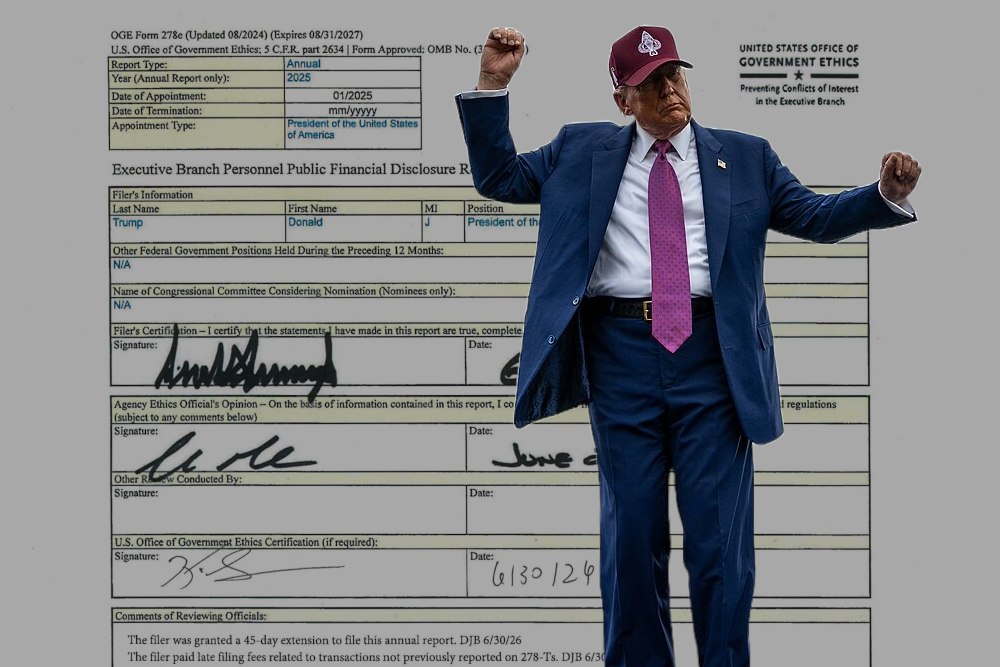
Republicans and crypto figures initially presented the latest draft, which went public on July 22 after White House sign-off, as a promising path to law. The so-called “compromise” on ethics would bar the president, vice president, and members of Congress from issuing cryptocurrencies, with enforcement delegated to the Department of Justice.
But the provision is extremely narrow: it bars the President from issuing tokens while largely leaving untouched his family’s existing web of crypto businesses. It gives him at least a full year to divest or move to a blind trust his stakes in World Liberty Financial and the $TRUMP memecoin.3 And it’s temporary, set to expire on January 20, 2029 — the day a new president takes office. The provision not only fails to establish a standard for future administrations, it shields Trump from future accountability by expressly barring enforcement of penalties for “pre-sunset conduct” after that date. The DOJ enforcement mechanism is entirely toothless. The department is run by Trump appointees who have already shown no appetite for investigating the president’s many conflicts of interest, and is currently headed by Todd Blanche — a former personal lawyer to Trump. Any violations would result in a fine capped at $500,000: less than 0.04% of Trump’s crypto income last year.
Democratic lawmakers still hadn’t seen the draft “compromise” the day before it went public,4 but that didn’t stop Republicans and the crypto industry from launching an aggressive PR campaign pressuring them to accept it — while preemptively assigning blame if the bill fails. “If Senate Democrats block this historic legislation after the administration has bent over backward to accommodate their concerns,” one White House source told The Hill, “stakeholders should make no mistake: it is the Democrats who are blocking this legislation because they were never serious about a legislative outcome.”5
Democrats appear unmoved. Senator Angela Alsobrooks (MD), one of the two Democrats who voted to pass the bill out of the Senate Banking Committee, has described the DOJ enforcement mechanism as an “unserious offer”.6 Democrats involved in the negotiations have previously insisted on enabling state attorneys general to enforce ethics provisions, and neither side seems willing to budge. Patrick Witt, the executive director of the President’s Council of Advisors for Digital Assets, has shown no sign of yielding, arguing that Democrats who believe an ethics provision without state AG enforcement is meaningless are “basically saying that ALL current federal ethics laws are meaningless because none of them are enforceable by state AGs”.7 Given this administration’s track record on ethics enforcement, he may have a point.
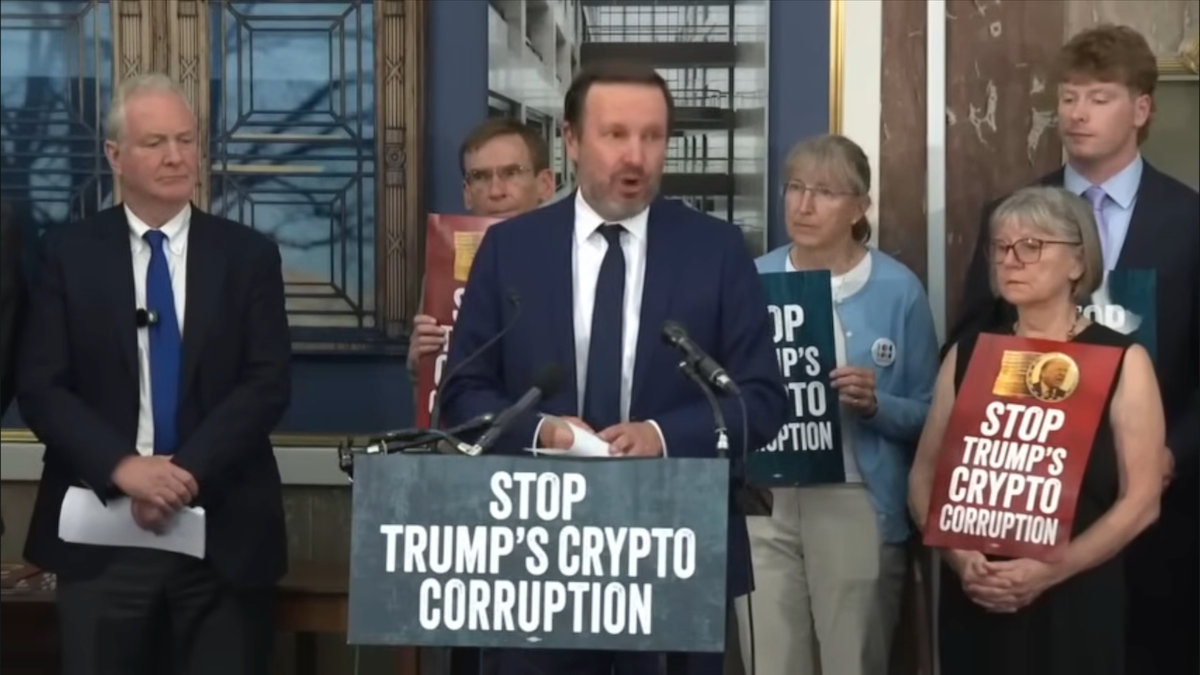
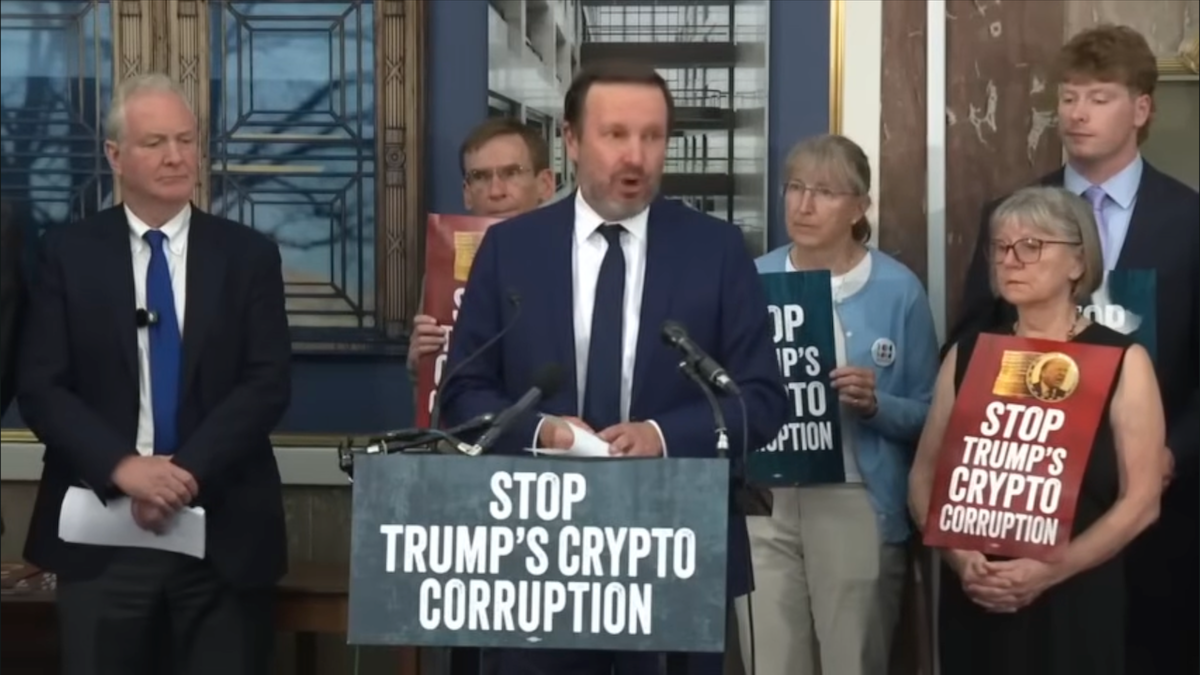
Other Democratic Senators remain firmly opposed. Senators Murphy (CT), Merkley (OR), and Van Hollen (MD) held a press conference last week condemning the bill as “in and of itself a fundamental corruption if it gives Trump’s corruption the power of law.” Merkley added that “there’s a lot more wrong with this Clarity Act than simply the fact that it lacks corruption measures.”8
Senator Elizabeth Warren (MA) said the bill “does nothing to stop President Trump from making his next $1.4 billion from crypto” and will “supercharge” his crypto corruption.9
Even seven of the Democratic Senators most open to crypto legislation — Alsobrooks, Booker (NJ), Cortez Masto (NV), Gallego (AZ), Hickenlooper (CO), Warner (VA), and Warnock (GA) — issued a statement that the draft “as it currently stands falls short”. Ethics, they noted, was only one problem with the bill. “Key provisions including those addressing ethics for elected officials, consumer protection, illicit finance, conflicts of interest and market integrity must be strengthened.”10 They noted that they were still committed to negotiating an acceptable version of the bill, but given this lengthy list of concerns and the dwindling time before August recess, the feasibility of reaching agreement seems doubtful.
And it’s not just Democrats who may pose obstacles. Some Republicans have also expressed concerns with the draft. Senators John Curtis (UT) and John Cornyn (TX) told Punchbowl News they aren’t happy with the result of the stablecoin negotiations, and remain worried that allowing stablecoin operators to offer yield could trigger deposit flight from community banks. “Crypto is not going to be loaning any money for small businesses,” Cornyn said. “If we’re taking loan capacity away from our banks who are in these communities — I want to make sure that we’re not hurting the very people who rely on these banks.”11 However, he told Semafor’s Eleanor Mueller that it would be “premature” to say whether he would vote against the current draft.12 Republican Senator Bill Cassidy (LA) also intimated that he “might” have concerns with the bill, but did not specify what they were.11
Republicans could force the draft bill to a vote before the August recess, and Majority Leader John Thune has repeatedly hinted he may do just that, but whether even the most crypto-friendly Democrats will support it remains dubious. The bill needs sixty votes to pass, meaning at least seven Democrats must sign on. After that, it would still have to pass the House.
If the Clarity Act dies, the crypto industry loses its best chance at a sweeping bill that would lock in the deregulatory gains they’ve achieved through agency capture. The SEC and CFTC are currently run by Trump loyalists who have aggressively rolled back enforcement and reinterpreted their authority to favor crypto, but the crypto industry knows that agency policy can be reversed by the next administration. That’s why they have been so desperate to get the Clarity Act signed into law. Losing it would be a massive blow to the industry after it committed $200 million (and counting) in super PAC spending since 2024, with a sweeping legislative rewrite as a primary goal.
Senator Gillibrand
Senator Kirsten Gillibrand (D-NY) has been among the Democrats working to broker a compromise on the Clarity Act. Following Trump’s financial disclosures, she published a statement reiterating her call for Congress to ban elected officials and their spouses from issuing digital assets, including memecoins and NFTs.13
Three progressive groups — Demand Progress, Indivisible, and the Revolving Door Project — responded with a letter to Senate Democrats condemning her as “a prime example of a Democratic leader whose conduct undermines efforts to hold the Trump administration accountable for their rampant corruption.” The letter cited recent reporting about her 22-year-old son, Theodore Gillibrand, who raised funding at a $300 million valuation for his American Perpetuals Exchange Corp. (APEC), a financial institution aiming to bring crypto’s popular perpetual futures concept to traditional US stocks. The Trump administration’s crypto-friendly CFTC only recently approved the first crypto perps trading in the United States [I106], and the younger Gillibrand will need separate regulatory approval for his venture.
Participants in the funding round included prominent crypto political donors, such as Ripple’s Chris Larsen and Erebor’s Palmer Luckey [I88, 101].14 “Whether Gillibrand’s son was able to raise funds from the crypto billionaire and other investors due to his mother’s ties, or if his investors are hoping to influence Gillibrand’s thinking on crypto by supporting her son’s venture, or both, the result is an appearance of unseemly conduct that undermines Democrats’ credibility in criticizing corruption stemming from President Trump, his family, and their allies in the administration,” the groups wrote.15
Axios wrote that the letter was “a warning shot to Democrats: Progressive groups are prepared to make support for the bill politically painful, even if it means another bruising intraparty fight over one of the crypto industry’s top legislative priorities.”16
In prediction markets
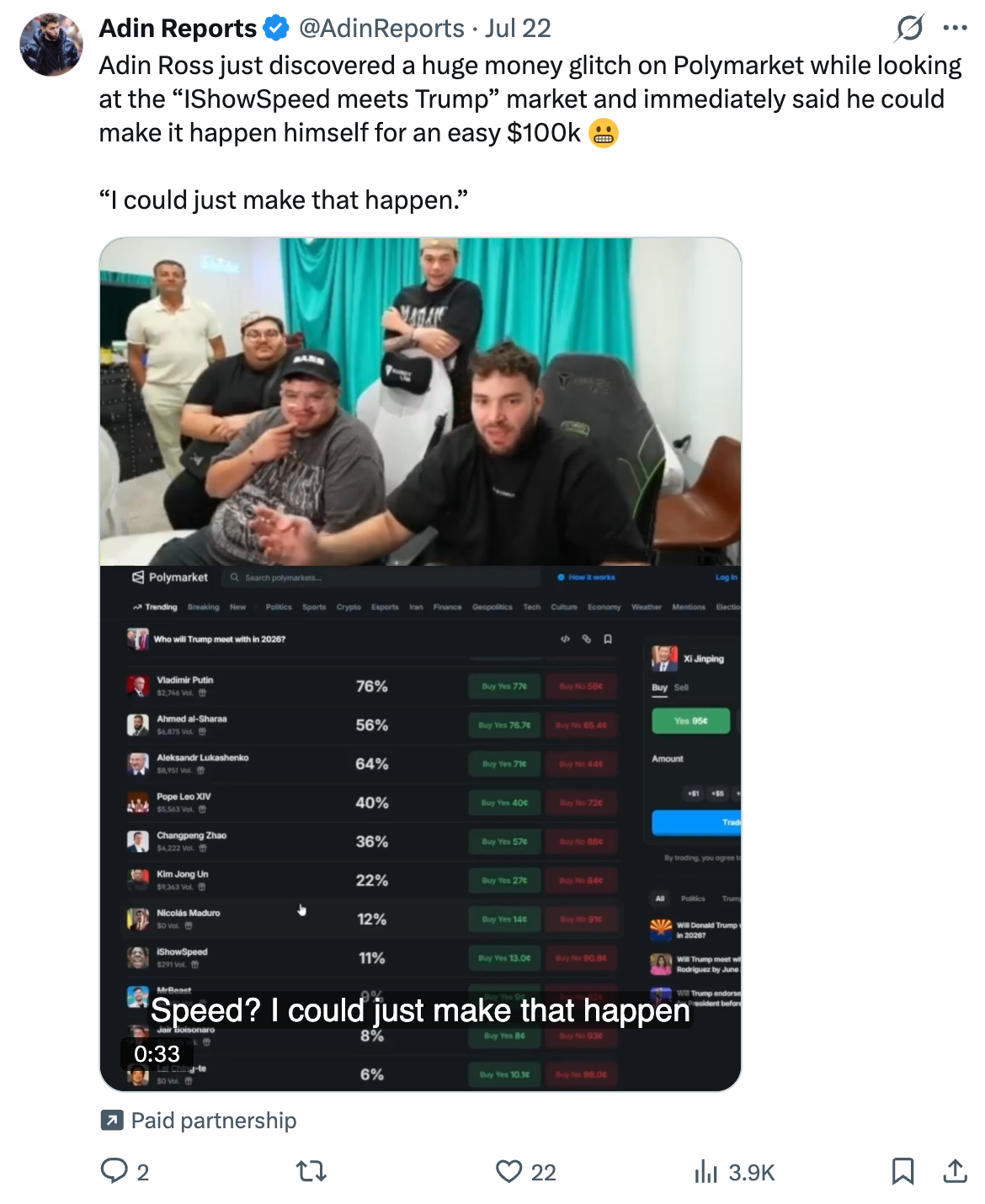
The world of prediction markets continues to be a crypto-esque wild west. Polymarket — a leading platform and one that counts Donald Trump Jr. among its investors and strategic advisers — is at the center of a recent Wall Street Journal investigation alleging that the company has been paying social media influencers to film themselves making fake trades, then using a “social-media army” to boost the videos. According to the Journal’s analysis of more than 1,000 videos posted by creators working with a Polymarket-contracted marketing company, $1.9 million in supposed bets were placed, but none were real. Among the influencers promoting Polymarket is Adin Ross, an Andrew Tate protégé with a multi-million dollar deal with the company. In videos, Ross repeatedly spoke about how he could profit from insider trading on Polymarket, such as by betting on the release date of an album by his friend Drake.17
The videos primarily target Americans, even though the New York-based Polymarket has been required to ban US users from its main platform since its January 2022 settlement with the CFTC [W3IGG]. This further illustrates that Polymarket is well aware its rudimentary IP-based geofencing is little more than a fig leaf. Recent research by Rutgers University statistician Harry Crane suggests Americans placed between $10.6 billion and $26.7 billion in bets on the platform from May 2025 to April 2026, accounting for about a third of the platform’s trading volume.18 Yet rather than taking action against Polymarket for failing to police its platform under the settlement, the CFTC in September greenlit the company to launch a US-targeted app [I92], which offers a subset of the markets available globally. Many of the bets featured in the promotional videos show trades unavailable on the US app — such as those on which words President Trump will mention in speeches — suggesting Polymarket is still actively steering American customers toward its ostensibly off-limits global platform.
Speaking of words Trump mentions in speeches: an assistant who has operated President Trump’s teleprompter for a decade has reportedly been trading on those very markets. Gabriel Perez won more than $100,000 on the Kalshi platform betting on markets tied to the February State of the Union address and several other speeches. According to ABC News, Perez often updates Trump’s prepared remarks with edits directly from the President. Investigators identified several instances in which he exited bets mid-speech after Trump skipped sections containing words Perez had wagered would be mentioned.19
Kalshi, a direct competitor to Polymarket, also added Donald Trump Jr. as an adviser shortly after his father’s re-election. The company gifted him a stake in the company worth $300,000 at the time. It’s likely worth millions now that the platform’s profile and valuation have soared under a friendly regulatory environment spearheaded by his father.20
Although Press Secretary Karoline Leavitt claims President Trump described the incident as a “disgrace”, and personally ordered that Perez be placed on unpaid leave, the President’s own Truth Social platform has recently announced it plans to charge for instant access to the President’s posts, leaving free users with an unspecified delay.21 This would allow institutional trading firms and others who pay for access to the feed to place trades on information contained in Trump’s frequent posts to the site, which often move traditional markets, crypto markets, and prediction markets. “Not that anyone cares but yes this is illegal,” wrote University of Colorado business law professor Ann Lipton on Bluesky. “If he’d simpl[y] said ‘I will tell you official Iran policy in advance for a million dollars’ that would be illegal tipping, and that’s functionally what this is,” she wrote.22 Trump owns a 41.5% stake in Truth Social parent company Trump Media & Technology Group via the Donald J. Trump Revocable Trust, of which he is the sole beneficiary.23
In the courts
The Department of Justice is reportedly planning to drop charges against Matthew Goettsche, creator of the Bitclub Network cryptocurrency Ponzi scheme that defrauded investors out of $722 million.24 Goettsche was indicted in 2019 after offering investors what he claimed were shares in a bitcoin mining pool and encouraging them to recruit other investors. Goettsche told his business partners that he was “building this whole model on the backs of idiots”, also describing his investors as “dumb” and “sheep”. When he told a co-conspirator to falsely “bump up the daily mining earnings starting today by 60%,” his partner replied, “that is not sustainable, that is ponzi teritori [sic] and fast cash-out ponzi . . . but sure.” He later directed a co-conspirator to reduce the supposed mining earnings so he could “retire RAF!!! (rich as fuck)”.25
Goettsche has been lobbying the Department of Justice for relief from the prosecution, hiring a team of lawyers with connections to President Trump. Among them is Bradford Cohen, an attorney who appeared as a contestant on The Apprentice in 2004 and has been an avid Trump supporter ever since, and Brett Tolman, a lawyer and Fox News contributor who has been helping clients lobby for Trump pardons since the first Trump administration. Among Tolman’s past clients are Charles Kushner, father of Trump son-in-law Jared Kushner, and crypto cause célèbre Ross Ulbricht [I75].26 Cohen has also been in the Trump pardon business since Trump’s first presidency, successfully lobbying for clemency for rappers Lil Wayne and Kodak Black.27
Miles Guo, also known by Guo Wengui and several other names, has been sentenced to thirty years in prison on multiple charges related to a series of crypto-related frauds that netted him more than $1 billion.28 Guo was once closely connected with former Trump strategist Steve Bannon, and the two co-founded the GTV Media Group firm that was ordered pay $539 million in a settlement [W3IGG] after an unregistered initial coin offering of “G-Coins” in 2020. It was aboard Guo’s superyacht that Bannon was arrested on fraud charges that same year.
In regulators
Circle, the operator of the USDC stablecoin, has received final approval from the Office of the Comptroller of the Currency to operate as a national trust bank. This means the company will now be able to manage reserves directly for its stablecoin, although it is more limited than commercial bank charters and does not allow the company to take deposits or make loans. Comptroller Jonathan Gould has served in the Office of the Comptroller of the Currency under both Trump administrations. Between the two, he was a partner at Jones Day, where Circle was among his clients.29
The approval and conditional approval of a slew of applications by cryptocurrency companies for national trust bank charters has drawn concern from various sources, including Senator Elizabeth Warren, who said in a May letter that the agency had “approved at least nine national trust charters for crypto companies that intend to engage in activities that appear to go far beyond the narrow set of activities permitted by law. These companies are effectively crypto banks that want to evade the fundamental safeguards and obligations that come with being a bank. Your decision to facilitate this regulatory arbitrage not only conflicts with federal law, it also poses serious risks to consumers, the safety and soundness of the banking system, and the separation of banking and commerce.”30 In April, she had opened an inquiry into the OCC’s approval of a bank charter for Erebor, a new neo-bank founded by Palmer Luckey (also an investor in Theodore Gillibrand’s venture) and backed by the likes of Peter Thiel and Joe Lonsdale.31 As part of her inquiry, she published a fundraising document circulated by Erebor to potential investors, which had promised the bank would obtain a charter within a remarkably short six months. A co-founder’s “unique connectivity to banking regulators (especially Jonathan Gould, next Comptroller) + Palmer’s political network will get this done,” the memo read.32

In an inquiry letter sent to Luckey, she asked, “Which Erebor co-founder had “unique connectivity” to Comptroller Jonathan Gould? Is it Jacob Hirshman, a former executive at Circle Financial, one of Comptroller Gould’s former clients?”33 She also noted that Erebor’s charter application had been submitted by Adam J. Cohen, who was named Chief Counsel and Senior Deputy Comptroller of the OCC only two months later.34
The CFTC has reached a final resolution with Celsius founder Alex Mashinsky, who is already serving a 12-year prison sentence for fraud and market manipulation. Now he is also banned for life from any commodities activities.35
In elections and political influence
Crypto PACs have surpassed $73.1 million in spending on the midterms, though recent weeks have not featured any truly massive expenditures on any given race like the ones we saw in New York, Alabama, or Illinois earlier this primary season.
One race the crypto sector is watching is in Michigan’s District 13, where the Fairshake network has spent just under $1 million to support Democratic incumbent Shri Thanedar and oppose his primary opponent, Donavan McKinney. Thanedar has published press releases on his website boasting that he “proudly voted for” the Clarity, GENIUS, and Anti-CBDC Surveillance State Acts, talking about how “we need to support innovative solutions, such as cryptocurrency and blockchain technology”.36 Donavan published a video denouncing the industry’s spending in his race, saying, “The crypto lobby is paying my opponent back for helping Trump make over $1 billion off crypto since taking office. ... I’m running to take on lobbies like crypto and AIPAC to fight for an agenda that puts money back in the pockets of everyday people.”37
Although Thanedar likely appreciates the roughly $1 million in support for his campaign from the crypto sector, it has not managed to fill the hole crypto has left in his finances. Thanedar is currently reporting negative receipts in his campaign filings, something I did not previously know was even possible. It turns out that Thanedar invested millions of dollars of his campaign’s funds — most of which he personally loaned to his campaign — into crypto. As of his most recent filing, he has reported $3.9 million in investment losses to date.38 While it is legal for candidates to invest campaign funds, “you’re usually going to find that they’re going to put it in something a little less volatile than the crypto market,” OpenSecrets director of insights Brendan Glavin told The Intercept.39
In Minnesota, progressive Independent Bernie Sanders pledged that “Together, we are going to take on crypto, the AI industry, AIPAC and other billionaire super PACs and send Peggy [Flanagan] to the United States Senate.” Flanagan is challenging current Representative Angie Craig for the Democratic nomination. These PACs have yet to spend in the race, though Sanders seems to think they plan to enter the fray. This does seem likely, given that her opponent Angie Craig co-sponsored the Clarity Act; executives from sixteen cryptocurrency and cryptocurrency-associated companies, including Coinbase, Andreessen Horowitz, and Kalshi, have directly contributed almost $175,000 to Craig’s campaign; and Fairshake contributed nearly $1 million to Craig’s House campaign in 2024.
The Web3 is Going Just Great recap
There were thirteen entries between June 19 and July 22. $69.03 million was added to the grift counter.
- 42DAO's Balance Coin algorithmic stablecoin crashes after $912,000 theft [link]
- Wanchain bridge on Cardano exploited for more than $9 million [link]
- Allbridge exploited for $1.66 million [link]
- Across Protocol exploited for $3.35 million [link]
- Ostium loses at least $24 million to oracle exploit [link]
- Bonzo Lend exploited for $9 million in oracle attack [link]
- Summer Finance exploited for $6 million, shuts down [link]
- Dutch Knaken crypto platform collapses with $8 million in customer funds missing [link]
- Polymarket customers lose $2.97 million, company blames third-party vendor [link]
- Users of the SecondFi Cardano wallet lose $2.4 million in series of hacks [link]
- Taiko bridge exploited [link]
- Highly active MEV bot known as jaredfromsubway.eth drained for $7.7 million [link]
- Main Street USD (msUSD) loses its dollar peg [link]
In the news
I was honored to be the first guest on Brian Merchant’s new Blood in the Machine podcast, where we talked about my Tech Influence Watch project, and why the tech sector is pouring hundreds of millions into American elections.
I also joined Paris Marx’s Tech Won’t Save Us podcast to talk about Tech Influence Watch and the AI and crypto sectors’ political spending.
OpenSecrets did a deep dive into FairShake, the cryptocurrency industry super PAC network that has raised more money than any other super PAC outside of the Senate Leadership Fund, the Senate Republicans’ super PAC. In the article, I talk about the network’s structure and their incredibly aggressive spending and PR strategies.
I spoke to NPR and Puck (paywalled) about AI industry super PACs and their influence on the midterms. Heather Cox Richardson and The Guardian quoted me talking about President Trump’s most recent financial disclosure that revealed more than $1.4 billion in crypto revenue over the past year.
That's all for now, folks. Until next time,
– Molly White
Have information? Send tips (no PR) to molly0xfff.07 on Signal or molly@mollywhite.net (PGP).
I have disclosures for my work and writing pertaining to cryptocurrencies.
References
“Senator Lummis: Ethics, other provisions in crypto Clarity Act to be further discussed”, CoinDesk. ↩
Tweet thread by Amanda Fischer. ↩
“White House pushes Senate Democrats to take 'historic' crypto Clarity Act ethics deal”, CoinDesk. ↩
“White House agrees to ethics provision in crypto bill”, The Hill. ↩
“Trump-backed crypto ethics rule puts DOJ in charge of enforcement, prohibits federal officials from issuing cryptocurrencies: sources”, The Block. ↩
“Sen. Murphy, Indivisible, Americans for Financial Reform, and Ben McKenzie to Hold Press Conference Opposing the CLARITY Act”, Americans for Financial Reform. ↩
“Clarity’s problems run deeper than you think”, Punchbowl News. ↩
“Gillibrand Calls To Ban Trump And Elected Officials From Issuing Memecoins”, Senator Kirsten Gillibrand. ↩
“Crypto billionaire among dozens to back startup from Gillibrand’s son”, Politico. ↩
Letter to Senate Democrats from Demand Progress, Indivisible, and the Revolving Door Project, sent July 21, 2026. ↩
“Scoop: Progressives scorch Gillibrand over crypto”, Axios. ↩
“They Looked Like They Were Getting Rich on Polymarket—but None of It Was Real”, The Wall Street Journal. ↩
“Americans Are Trading Billions of Dollars on Polymarket’s Banned Offshore Platform”, Wired. ↩
“White House teleprompter operator made more than $100K betting on Trump's speeches: Sources”, ABC News. ↩
“Donald Trump Jr set for Kalshi windfall after prediction platform gave him stake”, Financial Times. ↩
“Trump Media to Sell Faster Access to President’s Social Posts”, The Wall Street Journal. ↩
Bluesky post thread by Ann Lipton. ↩
Donald Trump’s 2025 Annual Executive Branch Personnel Public Financial Disclosure Report, filed June 29, 2026. ↩
“US to Drop Charges for Alleged $722 Million Crypto Fraudster (1)”, Bloomberg Law. ↩
“Three men arrested in $722 million cryptocurrency fraud scheme”, press release from the United States Attorney District of New Jersey. ↩
“Trump pardons drive a big, burgeoning business for lobbyists”, NBC News. ↩
“Nima Momeni’s new lawyer won Lil Wayne, Kodak Black pardons from Trump”, The San Francisco Standard. ↩
“Miles Guo Sentenced To 30 Years In Prison For Leading Billion-Dollar Fraud”, U.S. Attorney’s Office, Southern District of New York. ↩
Jonathan Gould, ProPublica. ↩
“Warren Presses OCC on Approval of Special Charters for Crypto Companies Seeking to Act Like Banks While Evading Bank Rules”, United States Senate Committee on Banking, Housing, and Urban Affairs. ↩
“Warren Deepens Probe of Seemingly Corrupt Approval of Bank Charter for Trump's Billionaire Friends in Silicon Valley”, United States Senate Committee on Banking, Housing, and Urban Affairs. ↩
Banking memo, Attachment A to Senator Elizabeth Warren’s letter to Comptroller Jonathan Gould on April 22, 2026. ↩
Letter by Senator Elizabeth Warren to Palmer Luckey on April 22, 2026. ↩
Letter by Senator Elizabeth Warren to Comptroller Jonathan Gould on April 22, 2026. ↩
“Congressman Shri Thanedar Votes to Unlock Innovation and Create a More Equitable Financial System”, Congressman Shri Thanedar. ↩
July Quarterly 2026 FEC Form 3 filed by Shri for Congress, page 150. ↩
“Two-Thirds of Shri Thanedar’s Campaign Cash Came Through AIPAC as He Lost Over $600K”, The Intercept. ↩
Read more
Issue 111 – Back the winners
A Trump crypto adviser’s firm took millions from Tether while he shaped stablecoin rules in their favor, a Senate probe targets Commerce Secretary Lutnick’s not-so-former firm, and crypto’s biggest super PAC plays it safe
Issue 110 – The Clarity Act collapses
Regulators race to reassure the crypto industry as the industry’s flagship legislation collapses, SBF tries his luck with the Supreme Court, and crypto PACs unleash $30 million against Sherrod Brown
The Senate must reject the Clarity Act’s ethics charade
The supposedly “unprecedented” ethics restrictions exempt Trump’s crypto businesses and leave enforcement to his loyalists
Issue 109 – Reg Crypto
The SEC’s “Reg Crypto” aims to carve out exemptions, the CFTC wields emergency powers to shield prediction markets from state regulators, and a Trump family crypto firm gets a bank charter