No new trial for Sam Bankman-Fried
The former CEO of FTX has essentially no realistic avenues left to avoid his 25-year prison sentence

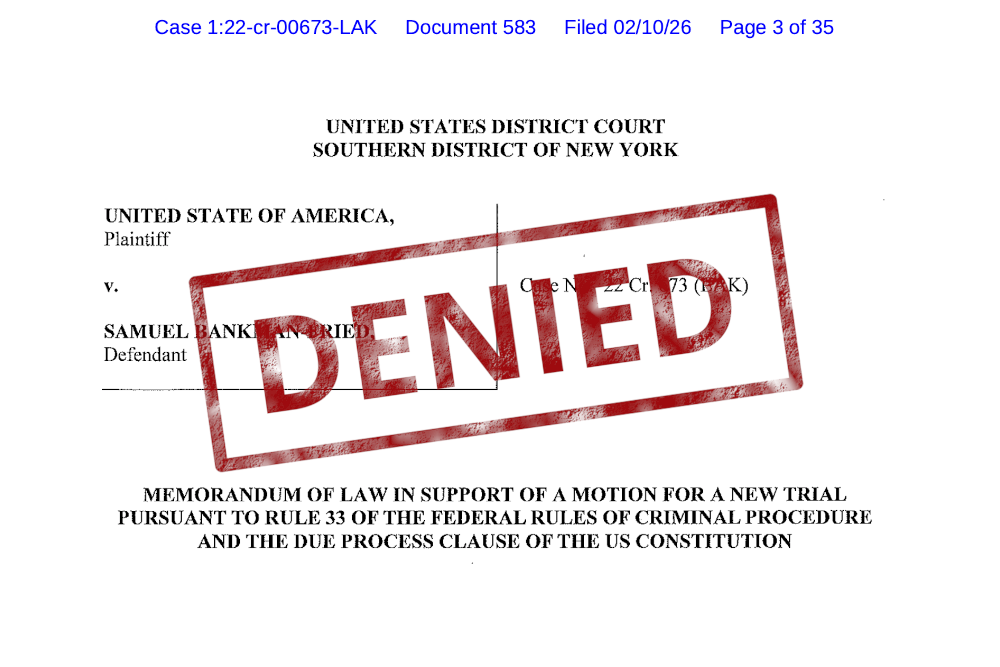

Sam Bankman-Fried is out of options.
Judge Lewis Kaplan has denied his motion for a new trial, and in doing so, closed off what was likely his last realistic avenue to escape his 25-year prison sentence besides his ongoing appeal to the Second Circuit — which is widely expected to fail.
Bankman-Fried had tried to withdraw his motion for a new trial, perhaps sensing that things were not poised to go in his favor after repeated questions as to whether his parents were writing his supposedly pro se filings for him, but Kaplan refused to let him slink away. Instead, he ruled on the merits and used the opportunity to condemn what he describes as Bankman-Fried’s ongoing, calculated campaign to rehabilitate his reputation — one that Bankman-Fried outlined in detail before he was even indicted.
Citation Needed is an independent publication, entirely supported by readers like you. Consider signing up for a free or pay-what-you-want subscription — it really helps me to keep doing this work.
In February, Bankman-Fried, representing himself, submitted a request for a new trial in front of a new judge. But cover letters and phone calls to the judge’s chambers by his mother, as well as envelopes sent not from Bankman-Fried’s prison but from the vicinity of his parent’s home hundreds of miles away, led Judge Kaplan to order him to file an affidavit under penalty of perjury stating which lawyers, if any, had been assisting with his supposedly self-drafted filings.
 Molly White
Bankman-Fried submitted the affidavit as ordered, claiming that no attorneys helped him, but admitting he had shared drafts with his parents who “made editorial and organizational suggestions, some of which I incorporated”.
He ended the affidavit with a rather petulant request to withdraw without prejudice his motion for a new trial.
As I have had to focus on responding to these questions rather than drafting a response to the prosecution’s opposition,a and because I do not believe I will get a fair hearing on this topic in front of you, I am now requesting to withdraw the Rule 33 motion, without prejudice to renewing it after my direct appeal and the related request for reassignment have been ruled upon.
Kaplan denied the withdrawal request and ruled on the motion anyway. By denying Bankman-Fried’s request for withdrawal without prejudice, Kaplan permanently closed this avenue — Bankman-Fried cannot try again later with a different judge or in a more favorable political climate (if such a thing exists). Kaplan writes that he believes Bankman-Fried “wants to retain the right to refile the motion at some later time of his choosing, perhaps after those most familiar with the extensive and complex trial record no longer are available.”
The PR strategy
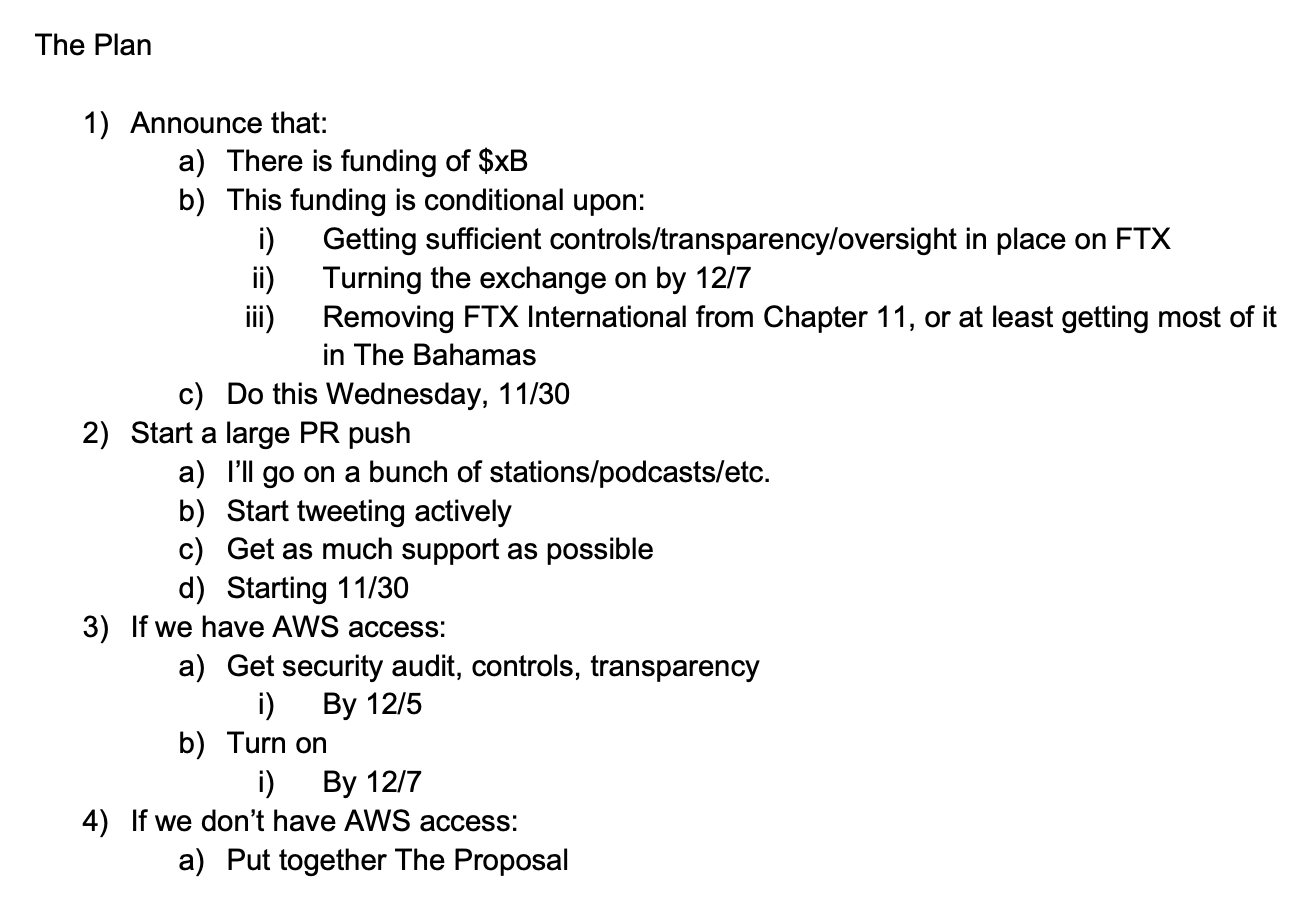
Kaplan also slammed Bankman-Fried’s “plan to rescue his reputation that Bankman-Fried hatched and even committed to writing after FTX declared bankruptcy but before he was indicted.”
The Google documents Kaplan mentions were unearthed around the time of Bankman-Fried’s sentencing and outline a detailed plan to rebuild his reputation by “start[ing] a large PR push” involving “go[ing] on a bunch of stations/podcasts/etc.” and “start[ing to] tweet[] actively” to “get as much support as possible”.
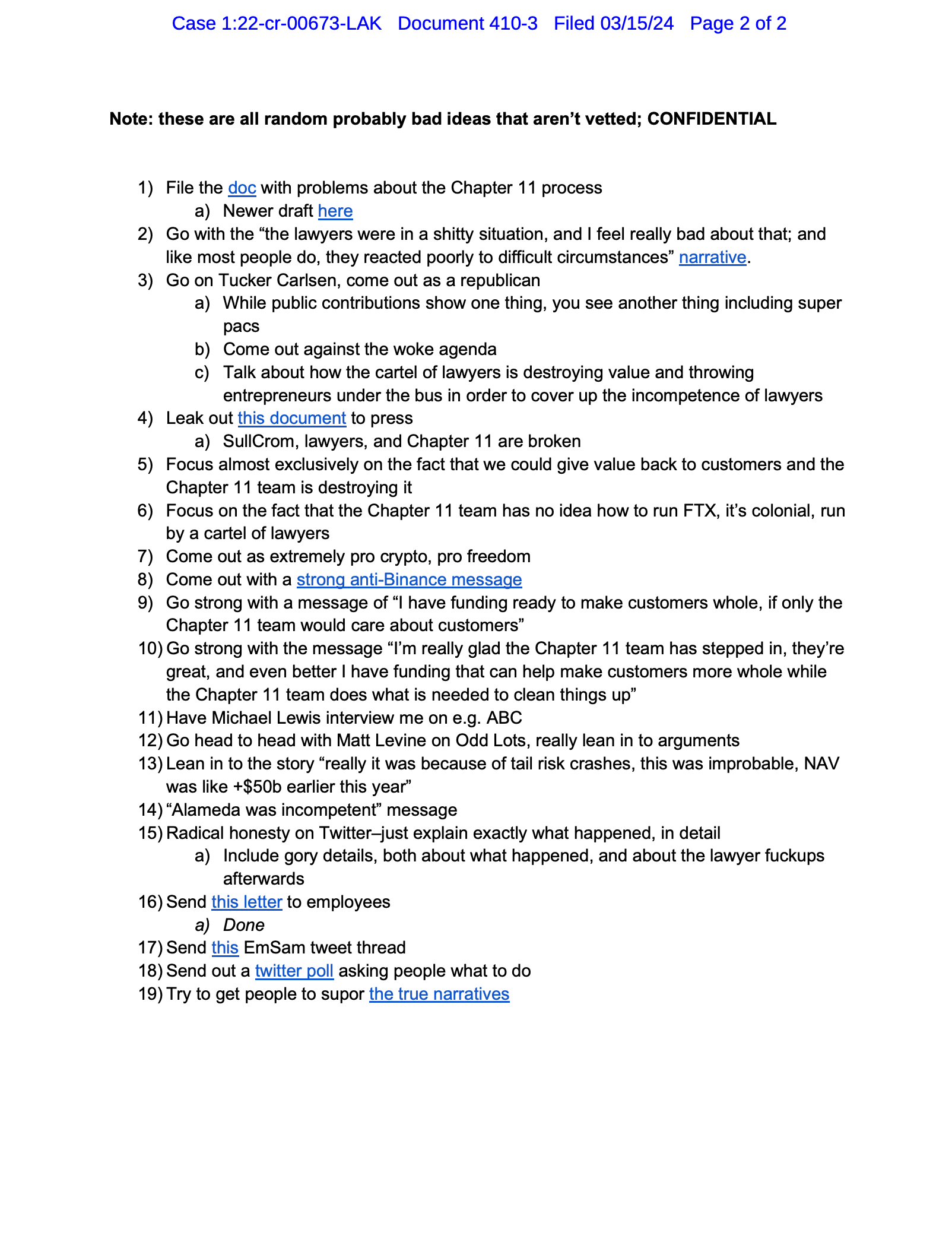
He brainstormed a list of “random probably bad ideas”, in his words, to further that goal, including:
- Have Michael Lewis interview me on e.g. ABC
- Radical honesty on Twitter—just explain exactly what happened, in detail
- Go on Tucker Carlsen [sic], come out as a republican
Judge Kaplan outlines how Bankman-Fried “followed his plan to a remarkable degree”, including while on house arrest or incarcerated. But Kaplan writes:
Time and time again, Bankman-Fried has sought to promote his narrative, which he previously described as “this is the reality, here are never before seen [sic] facts.” A fatal flaw of that spin (and the present motion) is that Bankman-Fried’s so-called “facts” have been seen before. Many times. They in substance are the same “facts” that during pretrial motion practice he conceded were “irrelevant, speculative, and unduly prejudicial.” They in substance thus are the same “facts” that this Court excluded at trial and that Bankman-Fried now argues on appeal to the Circuit should have been admitted. In no way are these “facts” never-before-seen, let alone newly discovered.
Bankman-Fried’s arguments
Kaplan also addresses Bankman-Fried’s actual arguments for why he deserves a new trial. Under Rule 33 of the Federal Rules of Criminal Procedure, a defendant can request a new trial even years later if they can demonstrate newly discovered evidence that was unavailable during the original trial.
Bankman-Fried claimed that his new evidence is “testimony that silenced witnessed [sic] would have given”. He pointed to three witnesses: Nishad Singh (who already testified at trial, but who Bankman-Fried claims was threatened by prosecutors), Ryan Salame (who has since tried to recant his guilty plea), and Daniel Chapsky (who refused to testify at the original trial).
Kaplan notes that “None of the witnesses, for example, is ‘newly discovered.’ Bankman-Fried well before trial knew all three of them and purportedly knew also what he hoped they would say were they to testify.”
On Salame specifically, Kaplan observes that he “recently has claimed through self-serving social-media posts and television and podcast interviews that the government’s case was a lie and that sworn statements he made during his guilty plea allocution were false.” But “the evidence on the record before this Court makes it clear that it in fact is Salame’s much-belated and now-withdrawn attempt to recant that is false.”
 Molly White
Bankman-Fried had also asked Kaplan to recuse himself, claiming bias. Kaplan also denied this request, noting that his recusal wasn’t requested until years later, after he “participated in much of the trial after the occurrence of the events of which he now complains”.
Out of options
At this point, Sam Bankman-Fried has essentially no avenues remaining to him to avoid his 25-year prison term.
The odds were against him from the get-go with his ongoing appeal to the Second Circuit — federal criminal appeals succeed less than ten percent of the time.1 But things looked even worse after the panel of judges heard oral arguments in Bankman-Fried’s case in November 2025 [I96]. They seemed deeply skeptical of Bankman-Fried’s go-to claim that FTX was solvent, just not liquid, with Judge Maria Araújo Kahn commenting that his “misrepresentations were not to solvency, but liquidity … part of the government’s theory of the case is that the defendant misrepresented to investors that their money was safe, was not being used in the way that it was the government claims and the jury convicted it was, in fact, used.”2
Judge Barrington Parker was similarly dismissive of another key argument. “Are you seriously suggesting to us that if your client had been able to testify about the role that attorneys played in creating these various documents, the ‘not guilties’ would have rolled in?” he asked.
After exhausting his direct appeal, he could theoretically pursue a habeas petition (which has an even lower success rate and requires showing constitutional violations).
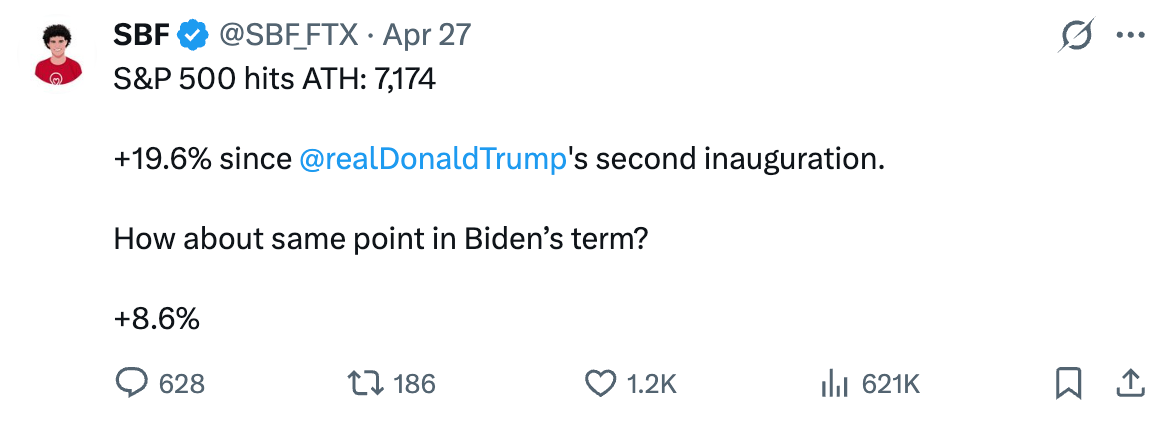
Besides that, his only hope is clemency. But even after interviews with the New York Sun and Tucker Carlson in which Bankman-Fried aimed to come out as a secret Republican [I78, 79], months of obsequious Twitter posts praising Donald Trump, direct appeals from his parents via a CNN interview [Helicopter parents], and ongoing reports of behind-the-scenes parental lobbying via lawyers and Trump associates [I76], Trump has twice said he will not grant a pardon.
Have information? Send tips (no PR) to molly0xfff.07 on Signal or molly@mollywhite.net (PGP).
I have disclosures for my work and writing pertaining to cryptocurrencies.
Footnotes
Bankman-Fried had three weeks to file the requested affidavit, and his deadline to file a response to the government’s opposition was extended to give him a full month. He must have a very, very busy prison schedule if a less than 400-word letter requiring no legal research meaningfully impacted his remaining time to file a reply to the prosecution’s opposition. ↩
References
“Just the Facts: U.S. Courts of Appeals”, United States Courts. ↩
“Appeals Court Seems Unmoved by Sam Bankman-Fried’s Claims of an Unfair Trial”, CoinDesk. ↩

Read more
On Meidas Defense: cryptocurrency, sanctions, and Trump quid pro quo
Last week I joined Joe Plenzler on the Meidas Defense podcast to talk about crypto. Meidas Defense is the MeidasTouch Network’s national security show, so we spent more time than I usually do on crypto as a geopolitical problem, in addition to a consumer protection one. The full episode
Issue 111 – Back the winners
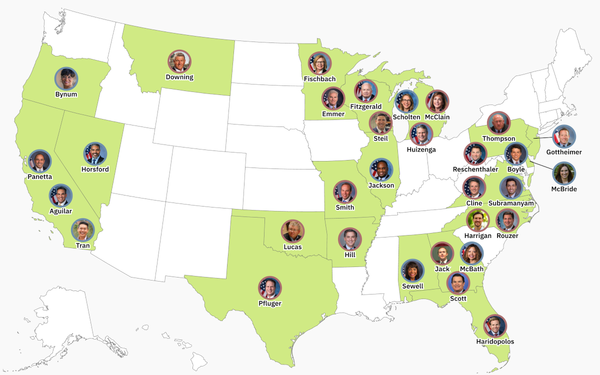
A Trump crypto adviser’s firm took millions from Tether while he shaped stablecoin rules in their favor, a Senate probe targets Commerce Secretary Lutnick’s not-so-former firm, and crypto’s biggest super PAC plays it safe
Issue 110 – The Clarity Act collapses
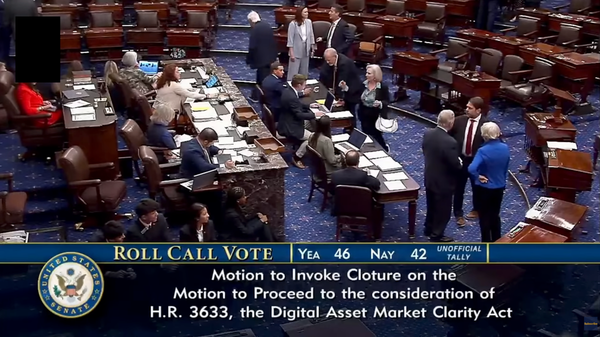
Regulators race to reassure the crypto industry as the industry’s flagship legislation collapses, SBF tries his luck with the Supreme Court, and crypto PACs unleash $30 million against Sherrod Brown
The Senate must reject the Clarity Act’s ethics charade
The supposedly “unprecedented” ethics restrictions exempt Trump’s crypto businesses and leave enforcement to his loyalists