Issue 104 – World Tyranny Financial
As the Trump family’s crypto dealings raise more alarms, crypto enforcement is falling to new lows


The Trump family’s World Liberty Financial is borrowing against its own thinly-traded token. New reporting suggests the company may have partnered with individuals connected to a US-sanctioned human trafficking operation. And Justin Sun, who was among the project’s earliest and largest investors, has denounced it as “‘World Tyranny,’ not ‘World Liberty Financial’” as his $75 million investment remains frozen.1
As the president’s family’s shady dealings continue to mount, SEC enforcement actions have collapsed to twenty-year lows. The CFTC says it doesn’t need staff when it has AI. The nominee for Federal Reserve chair is deeply invested in crypto and AI. And the new leader of the Justice Department is the guy who shut down the agency’s crypto enforcement despite an ethics commitment not to participate in crypto matters before divesting his own personal crypto wealth.
Citation Needed is an independent publication, entirely supported by readers like you. Consider signing up for a free or pay-what-you-want subscription — it really helps me to keep doing this work.
Trump business interests
Controversies are once again brewing around the Trump family’s World Liberty Financial project, which has promised since its 2024 launch to produce some kind of defi crypto trading application, but which has so far mostly just sold hundreds of millions of dollars’ worth of its own $WLFI token and issued a stablecoin.
The Dolomite loan
World Liberty put up 5% of the entire $WLFI token supply — worth a notional $450 million at the time — as collateral on the defi lending platform Dolomite. Against this collateral, they borrowed about $65 million worth of USD1 (World Liberty’s own stablecoin that other users had deposited into Dolomite) and another $10 million in USDC. The WLFI token has since dropped 20% to a new low of around $0.077.
Some observers saw this as an attempt to offload the thinly-traded token while saddling Dolomite with a loan they never intended to repay. “Don’t be exit liquidity for Trump’s cartel,” warned a pseudonymous crypto commentator in a popular tweet. “Those loans will likely never be repaid. Instead, when Trump leaves office, or even after the midterms if Republicans lose, $WLFI will dump, and Dolomite will be stuck with BAD DEBT.”2
Others fear a death spiral: if the $WLFI price drops enough to trigger automatic liquidation, Dolomite would be forced to dump huge amounts of the thinly-traded token on the market, crashing its price even further.
And many were furious about the practical impact on ordinary Dolomite users. Because of the position’s size — over half of all assets held as collateral on Dolomite — users who had loaned their USD1 to the platform in hopes of earning yield found themselves unable to withdraw their funds until World Liberty repays the loan.
World Liberty has defended the loan by dismissing concerns as “FUD” (an acronym for “fear, uncertainty, and doubt” that is widely used in the crypto sector to deflect criticism). They wrote that the loan was “nowhere near liquidation”, and that they could always supply more collateral if the $WLFI price continued to drop. They also described World Liberty as an “anchor borrower” on Dolomite, “generating the yield that makes WLFI Markets compelling for everyone else”.3
The team later announced that they had repaid $25 million of the loan in two payments. CoinDesk noted that World Liberty Financial had minted $38.5 million of new USD1 in three batches over five days, and that “these minting activities track directly with the repayment timeline.”4 While CoinDesk doesn’t come out and say it, there are serious concerns with a project using tokens it issues both as collateral and principal, as this creates the ability to manufacture the appearance of repayment without any real deleveraging, while the actual risk stays with Dolomite’s depositors.
Conflicts of interest
The ties between Dolomite and World Liberty intensified concerns. Dolomite co-founder Corey Caplan has served as an adviser to World Liberty Financial since shortly after its launch, and has since been described as the company’s chief technology officer.5 One of the few actual services World Liberty provides, the “WLFI Markets” lending and borrowing web app, is essentially a reskinned version of Dolomite’s product. “The borrower and infrastructure are linked... same circle on both sides of the trade,” wrote Twitter user StarPlatinum.6 The setup drew comparisons to FTX, whose circular borrowing with sister trading firm Alameda Research and reliance on its self-issued FTT token ultimately caused its collapse.7
And suspicions intensified when WLFI moved around $40 million in stablecoins to Coinbase Prime, a platform for institutional trading or cashing out crypto to dollars. “Just a few hours before Trump announced the Iran ceasefire, WorldLibertyFi sent $40M+ in stablecoins to Coinbase,” wrote Twitter user EthanDeFi. “Did they use these stablecoins to long the markets, knowing what Trump would announce?”8
Justin Sun jumps in
The Dolomite controversy drew one particularly high-profile complaint: from Justin Sun, the shady crypto billionaire who has poured $75 million into World Liberty Financial and invested or committed to invest $148 million more into other Trump-linked crypto projects. Despite having received substantial benefits after his Trump investments — including an SEC settlement on fraud charges, an apparently dropped criminal investigation, and a Nasdaq listing for his company Tron brokered by the Trump family-linked Dominari Securities — Sun seized on the Dolomite situation to air his own grievances.9
Sun’s complaints stem from September 2025, when World Liberty blocked his wallet from trading $WLFI tokens. The freeze was part of a broader action against 272 wallets, most linked to phishing attacks or compromised accounts, though World Liberty listed one unnamed wallet as “suspected of misappropriation of other holders’ funds”.10 Some speculated this was Sun’s wallet, theorizing he’d been selling tokens through his HTX exchange using his customers’ positions.11 World Liberty won’t say.
Sun claimed that the ability for World Liberty to freeze tokens was never disclosed to him, and that the company had taken actions “to extract fees from users, to secretly implant backdoor controls over user assets, to freeze investor funds without disclosure or due process, and to treat the crypto community as a personal ATM”. He further alleged that the project had not followed proper governance processes with votes authorizing some of their actions, and had withheld information, restricted participation, and predetermined the outcomes.12
World Liberty Financial quickly fired back:
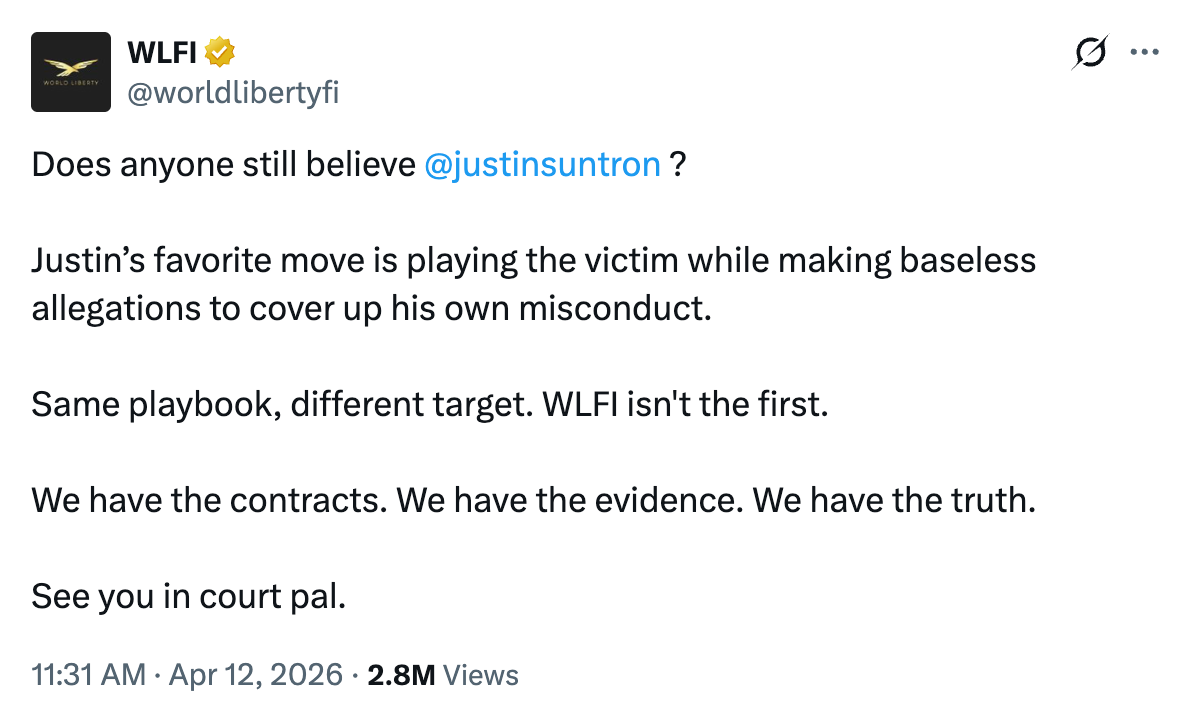
I think I speak for everyone when I say: please, please, please take this to court.

Justin Sun topped the leaderboard to attend the second Trump memecoin event scheduled for this coming weekend [I102], which could make for some awkward lunch conversation. However, given the all-day event at Trump’s Mar-a-Lago club in Florida coincides with the White House Correspondents’ Dinner in Washington, DC, there’s some chance Trump won’t show. Fine print on the memecoin website reserves the right to provide a “limited edition TRUMP NFT” in lieu of the President’s attendance, which is sort of like promising to send concertgoers a JPEG of the band if they don’t show up.
Sanctioned partners
World Liberty is also facing scrutiny over its November 2024 partnership with a firm called AB. Reporting from the Organized Crime and Corruption Reporting Project and the Sunday Times alleges that when World Liberty partnered with AB, AB’s operators were working on and promoting a resort project in conjunction with Yang Jian, who had been sanctioned by the US Treasury in October 2024 for his connections with the Prince Group. Along with the sanctions, the Treasury seized $14.4 billion in bitcoin based on allegations that the Prince Group has been operating a network of scam centers from which employees try to befriend or romance their targets in order to defraud them. The employees are themselves allegedly victims of human trafficking, held hostage and forced to work [I95].
OCCRP writes that “There is no evidence that AB is directly connected to the Prince Group, or that illicit funds flowed into the resort project. ... There is no suggestion that World Liberty ... or any other political figures were aware of sanctioned people’s prior involvement.”13 But the Sunday Times comments, “For a company co-founded by the sitting president to go into a relationship with a business recently associated with members of the Prince Group is remarkable, especially given the vigour with which the US authorities had denounced the organisation a month earlier.” The Times article was later updated with a notice that both the Prince Group and World Liberty Financial had filed legal complaints over their reporting.14
In regulators
SEC
The SEC has finally, belatedly, reported its 2025 enforcement results, revealing that enforcement actions fell more than 20% compared to the previous fiscal year.15 Of the 456 enforcement actions brought during FY 2025, nearly half were initiated before Trump returned to office. The agency characterized its retreat from crypto enforcement as a “necessary course correction” stemming from the previous leadership’s “misinterpretation of the federal securities laws”. Offering a thin veneer of continued vigilance, the press release highlights two token examples of crypto enforcement actions. One is the action against Unicoin, an investigation that began during the Biden administration [I72] and continues only because Unicoin rejected the SEC’s settlement offers [I82].
The SEC’s enforcement data was quickly met with a letter from Senator Elizabeth Warren, who wrote that the downward trend in enforcement actions was “deeply disturbing”, and that the data “raise significant concerns about [Chairman Atkins’] candor with Congress” in his February hearing. At the time, when Senator Warren noted that the SEC under his leadership had brought fewer new enforcement actions than at any point in the last ten years, Atkins replied, “I’m not sure what data you’re looking at because we actually haven’t released our data yet, but I would disagree with your premise.” Now that the SEC has published its numbers, it shows that the number of enforcement actions are actually at a twenty year all-time-low.16
The agency is also working on a safe harbor framework for crypto, which Chair Atkins has been calling “reg crypto”. This would further pare back SEC oversight of the sector by exempting early crypto projects from full registration for a four-year period, and by allowing projects to sell tokens that would typically qualify as securities under the Howey test under an “investment contract safe harbor”.17 Speaking at a crypto event, Chair Atkins urged the industry to get involved in the midterm elections to ensure that Congress will continue deregulating crypto alongside the SEC. “We’ve got to make sure that your friends are in Congress. I think you saw how that really paid benefits in the last election,” he said.18
CFTC
The CFTC still has only a single Commissioner out of its usual five, has cut a quarter of its staff, and is facing a significantly expanded workload after staking claim over both the crypto sector and the rapidly expanding world of prediction markets. But Chair Selig says not to worry! They’re using AI to make up for the lack of actual investigators and enforcement attorneys.19
Either the remaining CFTC staff or their AI software have reached some settlements lately. The offshore KuCoin crypto exchange will pay a $500,000 penalty and stop serving US customers for at least two years, as the result of a 2024 lawsuit alleging they had operated an unlicensed derivatives exchange, failed to register as a futures commission merchant, and failed to implement sufficient programs to identify their customers.20 The CFTC’s case had been filed alongside a criminal case that resulted in a $300 million fine in February 2025 [I54, 76].
The CFTC has also settled its case against Nishad Singh, the former head of engineering at FTX. Singh had faced criminal charges along with Bankman-Fried and three other executives of the collapsed exchange, but avoided jail time. Now he’s agreed to pay $3.7 million in disgorgement, which represents the value of real estate Singh purchased in October 2022 using funds from his FTX account “that he knew or recklessly disregarded the fact that they consisted, at least in part, of misappropriated FTX customer assets.” Singh is prohibited for five years from commodities trading and for eight years from applying for CFTC registration or working for CFTC-registered entities.21
In the courts
Alex Mashinsky
Alex Mashinsky, who is serving a 12-year sentence for fraud and market manipulation as CEO of the Celsius cryptocurrency platform, has written to the judge overseeing his case with a pro se motion claiming “new evidence has come to my attention which implicates my attornies [sic] as constitutionally ineffective.” He argues this evidence would have significantly reduced his guideline sentence, and asked the judge to appoint counsel to help him prepare a Habeas petition. He says he cannot afford private counsel following asset seizure and forfeiture.22 Mashinsky was represented by Marc Mukasey, at the time a partner at Mukasey Young. Mukasey had previously represented then-private citizen Donald Trump in a 2019 lawsuit to avoid disclosing his tax returns to a Manhattan district attorney, and Sam Bankman-Fried in his sentencing-related matters, though not during his criminal trial.23
The judge denied the request, explaining that “the right to appointed counsel ‘extends to the first appeal of right, and no further.’” Because Mashinsky pleaded guilty and never filed an appeal — the 14-day deadline to inform the court he intends to appeal has long since passed — he missed that chance. While the judge informs him he does have discretion to appoint counsel in Habeas cases, he tells Mashinsky he must first demonstrate his claim has merit with the resources available to him.24
Yuga Labs v. Ryder Ripps
The long-running case by Yuga Labs against artist Ryder Ripps has ended. The court had initially decided that Ripps and his co-defendant would have to pay $1.4 million in disgorgement, around $200,000 in damages, and a massive $7.3 million in attorney’s fees and costs after the court found the defendants had been “obstructive and evasive” and made “disgraceful and slanderous statements about Yuga, its founders, and its counsel” throughout the case [I13, 14, 25, 43, 44]. But on appeal, the Ninth Circuit reversed the decision to grant summary judgment in favor of Yuga, determining that the question of whether buyers were truly misled by Ripps’ knockoff apes was one for a jury [I89]. Rather than go to trial, the two parties have settled the lawsuit. The terms of the settlement aren’t entirely clear, but the defendants will be prohibited from using the Bored Ape trademarks, providing benefits to holders of the RR/BAYC NFTs, or registering or operating websites or social media accounts using Yuga Labs marks. The smart contracts and web domains that were transferred to Yuga Labs as part of the original decision will remain with Yuga, and the defendants have agreed to transfer any remaining NFTs or domains to the company.25 All their (fake) apes gone.
In Congress
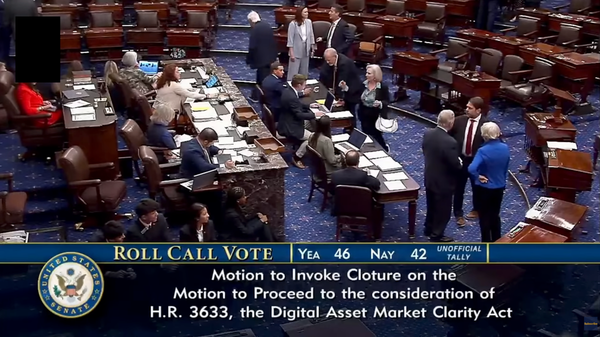
The Clarity Act draft cryptocurrency market structure bill continues its familiar pattern this month: repeated promises from Senators and industry figures that it will imminently be released and pass Senate markup,26 followed by repeated delays.27
On April 8, the White House Council of Economic Advisers released a report backing the crypto industry’s view that stablecoin issuers should be allowed to offer yield on investor holdings.28 This contentious portion of the Clarity Act has driven much of the bill’s delay, after bank lobbyists strongly objected over concerns that yield-bearing stablecoins could dramatically diminish bank deposits and lending [I99, 102]. The Council’s report concluded that prohibiting stablecoin yields would increase bank lending only marginally “while forgoing the consumer benefits of competitive returns on stablecoin holdings”. Bank lobbyists, however, have pointed out that the Council studied the wrong question: their concern isn’t whether prohibiting yields would increase deposits, but whether permitting them would decrease deposits.29
In the White House
There has been extensive coverage of the ouster of former Attorney General Pam Bondi, but far less attention paid to her acting replacement, who was previously the Deputy Attorney General, Todd Blanche. A former personal lawyer to Trump, Blanche was nominated shortly after Trump’s election and confirmed in March 2025. Barely a month into the position, he issued a memo dismantling the Department of Justice’s National Cryptocurrency Enforcement Team, directing the agency’s Market Integrity and Major Frauds Unit to “cease cryptocurrency enforcement”, and ordering prosecutors to “not charge regulatory violations in cases involving digital assets including but not limited to unlicensed money transmitting..., violations of the Bank Secrecy Act, unregistered securities offering violations, unregistered broker-dealer violations, and other violations of registration requirements under the Commodity Exchange Act” unless they have specific knowledge that the defendant knowingly and willfully violated a specific requirement [I81]. He issued these directives before divesting between $159,000 and $485,000 in crypto holdings, despite having pledged not to participate in any matter that could have a “direct and predictable effect on [his] financial interests in the virtual currency”.30
Trump’s pick to lead the Federal Reserve, Kevin Warsh, has submitted financial disclosures ahead of his Senate confirmation hearing (scheduled for Tuesday, though Senate Banking Democrats have urged for the hearing to be delayed due to the criminal investigations into Federal Reserve officials31). The 69-page disclosure reveals extensive cryptocurrency investments, including stakes in the dYdX decentralized crypto derivatives exchange, crypto-focused investment firm Polychain, the Lightning Network payments protocol, sports NFT platform Match Day, and blockchain firms Solana, Blast, and Optimism. Some investments are relics of crypto’s frothier days, like Friends With Benefits — a DAO-run Discord server that Andreessen Horowitz valued at $100 million in 2021 after it promised to build “the very first IRL metaverse”.32 Warsh’s investments extend well beyond crypto, spanning artificial intelligence (a lot of it), healthcare, and defensetech, with highlights including a “robotic coffee bar platform” and a “digital persona cloning platform” that claims to let people create AI clones of themselves to handle their work.33

In elections and political influence
As I wrote recently in my first [noted] post, the Fellowship PAC is showing signs of life. I’ve been watching it closely ever since it claimed to have $100 million “committed” for the elections, but then reported $0 in fundraising in its 2025 end-of-year filing. But its Q1 2026 filing has revealed it’s brought in $11 million in contributions, primarily from Cantor Fitzgerald — the financial services firm previously run by Commerce Secretary Howard Lutnick. (Lutnick “divested” by selling the company to his two twenty-something sons.) Fellowship PAC is using the funds to back a slate of MAGA candidates, including Clay Fuller in his runoff special election for Georgia’s District 14, Nate Morris in his Kentucky Senate bid, and Pete Ricketts in his Nebraska Senate re-election campaign.
So far, Fellowship PAC has spent $1.5 million in independent expenditures backing these candidates. The spending also traces a web of crypto industry and government connections. All of the PAC’s independent expenditures, plus an additional $3 million in “issue advocacy advertising”, flow through NXUM Group — a firm co-founded by Bo Hines, the former director of Trump’s crypto advisory council [I72, 90] who is now CEO of Tether US [I91]. Fellowship PAC itself is led by Jesse Spiro, Tether US’s head of government affairs. And Cantor Fitzgerald and Tether share deep ties [I70, 71].
In prediction markets
Kalshi has appealed Nevada’s ban on prediction markets to the Ninth Circuit. During oral arguments last week, one judge dismissed as “sophistry to the nth degree” Kalshi’s longstanding argument that prediction markets fundamentally differ from sportsbooks and casinos because bettors trade against each other rather than against the house.34 But in New Jersey, the Third Circuit has sided with Kalshi, overturning a ban and opining that the platform’s events contracts do indeed fall solely under the CFTC’s jurisdiction.35 It seems likely to me at this point that this is a question destined for the Supreme Court.
As I’ve mentioned in the past, the federal government and regulatory agencies have joined the fight on the side of prediction markets [I101]. On April 2, the CFTC and DOJ filed a lawsuit against Arizona, Connecticut, and Illinois, arguing that the state regulators are encroaching on the CFTC’s exclusive regulatory authority over prediction markets.36 One of the DOJ attorneys on the case is Yaakov M. Roth, now a Principal Deputy Assistant Attorney General. In 2023, while at Jones Day, Roth represented Kalshi in its lawsuit against the CFTC that ended with a finding that the CFTC had overstepped, and allowed for the explosion of prediction markets we’ve seen in the years since. Now he’s working alongside the CFTC to advance a legal position that benefits his former client.
At a hearing in front of the House Agricultural Committee, which oversees the CFTC, Chair Selig faced predictable fury from Democrats over prediction markets. Selig was evasive throughout, avoiding even simple questions about whether government officials should be allowed to place prediction markets bets on non-public information.
Representative McGovern (D-MA) pressed the corruption angle, questioning why Donald Trump Jr. would be an adviser to two competing prediction markets platforms. He asked if anyone at the White House had demanded or implied that the CFTC should drop its probe into Polymarket, a question that Selig again indignantly dodged.
Representative McGovern (D-MA) questions CFTC Chair Selig about the Trump family’s involvement with prediction markets
McGovern: Mr. Chairman, are you aware that President Trump’s son, Donald Trump Jr., has been hired as an advisor for both Kalshi and Polymarket, two competing companies?
Selig: Congressman, I’m aware of this.
McGovern: And would you say that it’s accurate then that the Trump family has a financial stake in how these prediction markets are regulated?
Selig: Congressman, I believe this hypothetical that you’re trying to engage in is a political exercise.
McGovern: Hypothetical? The president’s son is involved with both of these companies. I mean, he makes a lot of money for it. But of course they have a financial interest in all of this. I mean, the president’s son is on the board of both multi-billion dollar prediction market companies. So it seems to me like the only reason two competing companies hired the same person is because they think he must be really, really, really valuable. And I wonder why they would think that, right? Mr. Selig, has anybody in the White House ever asked or insinuated that you should drop the CFTC probe into Polymarket?
Selig: Congressman, we treat all market participants alike. We do not pick winners and losers or engage in favoritism or bring politics into any of these matters. We take them very seriously, and I think it’s insulting that you’re insinuating that we would play political games.
McGovern: No, I’m worried because it smells like corruption, I’ll be honest with you.
Outside the US
Argentina
While United States officials have little appetite to investigate our President’s crypto corruption, Argentine prosecutors have proven more willing to investigate theirs. They have continued digging into the circumstances around February 2025’s $LIBRA fiasco, in which President Milei endorsed a cryptocurrency that quickly plummeted amid questions of insiders cashing out [I77, 79, 82, 84, 85, 98].
While Milei has insisted he had no connection to the project and merely was highlighting a project that he’d come across online, prosecutors have obtained telephone logs showing seven calls between Milei and Mauricio Novelli — one of the people responsible for launching $LIBRA — on the night of the endorsement. Messages pulled from Novelli’s phone suggest he had been paying Milei a monthly “salary” dating back to at least 2023, after Milei, then a Congressman, endorsed a crypto video game project Novelli was involved in. Additional audio messages indicate Novelli was also making payments to Milei’s sister Karina, who has been implicated in the $LIBRA scandal and is widely described as a gatekeeper controlling access to her brother.37
Last month, Argentine media reported on messages from Novelli’s phone revealing what appeared to be a $5 million draft agreement between the president and $LIBRA creator Hayden Davis, the 29-year-old American CEO of his family’s Kelsier Ventures crypto investment firm. The agreement outlined a $1.5 million advance, $1.5 million for a Twitter post from Milei identifying “Hayden Davis/Kelsier/the Davis family” as his advisers, and $2 million for a signed “blockchain/AI consulting” agreement with either Milei or the Argentine government.38
Poland
Poland’s Prime Minister Donald Tusk has accused the crypto exchange Zondacrypto of sponsoring politicians from the country’s national-conservative Law and Justice and far-right Confederation Liberty and Independence parties. He has also alleged that Zondacrypto was funded by the Russian mafia and Russian intelligence services. Among the politicians he alleges have been funded by Zondacrypto is Polish President Karol Nawrocki, who has vetoed two crypto regulation bills he has described as overly burdensome to crypto businesses. The country’s Parliament has twice tried and failed to overturn the veto, failing to achieve the 60% majority required.39 Zondacrypto also sponsored a CPAC event held in Poland in 2025, where former US Secretary of Homeland Security Kristi Noem endorsed Nawrocki as a Trump-style leader who would “turn Europe back to traditional values”.40
Zondacrypto has also been facing reports of delayed withdrawals, which has led to speculation that the exchange could be insolvent or dipping into customer funds to meet other customers’ redemption requests. Zondacrypto’s CEO has described this speculation as part of a coordinated campaign against the exchange, which he tried to counter by revealing a wallet address holding 4,500 BTC (around $330 million) as proof of solvency. However, the keys to that wallet were known only to the exchange’s previous CEO, who didn’t transfer control of the wallet to the exchange’s new owners when the company was sold in 2021. The former CEO has been missing for four years.41
United Kingdom
The United Kingdom’s Liberal Democrats are calling for investigations into Nigel Farage’s crypto activities and his involvement with Stack BTC, a bitcoin treasury company [I102]. Daisy Cooper, the Liberal Democrats’ Deputy Leader, wrote to the CEO of the UK’s Financial Conduct Authority urging an investigation after Farage appeared in a promotional video for the company. She warned that “the Reform UK leader is looking to copy the Donald Trump playbook”, citing a January Bloomberg report that estimated Trump had profited around $1.4 billion from his crypto ventures while directing policy for the sector.42
Cooper also raised concerns that Farage was encouraging his audience to purchase cryptoassets, pointing to an interview in which he touted crypto’s “huge financial returns” and appeared to endorse his interviewee’s prediction that bitcoin could reach $1 million per token.4344
The Web3 is Going Just Great recap
There were ten entries between April 1 and 20. A massive $615.26 million was added to the grift counter.
- Aave faces approximately $200 million in bad debt after Kelp DAO bridge exploit [link]
- RaveDAO accused of pump-and-dump as token crashes 98% [link]
- Kelp DAO bridge hacked for $292 million [link]
- Rhea Finance exploited for $18.4 million, some recovered [link]
- Russian Grinex exchange halts trading after $13 million+ exploit [link]
- CoW Swap users lose estimated $1.2 million after DNS hijacking [link]
- Users lose $9.5 million to fake Ledger wallet app on the Apple App Store [link]
- Hyperbridge exploited two weeks after April Fools' hack joke [link]
- Bitcoin Depot hacked for $3.67 million [link]
- Drift exploited for $285 million [link]
That's all for now, folks. Until next time,
– Molly White
Correction: An earlier version of this newsletter said that Polish PM Donald Tusk had accused Zondacrypto of sponsoring politicians from the Confederation of the Polish Crown party. Tusk was more likely referring to the Confederation Liberty and Independence party.
Have information? Send tips (no PR) to molly0xfff.07 on Signal or molly@mollywhite.net (PGP).
I have disclosures for my work and writing pertaining to cryptocurrencies.
References
Tweet thread by World Liberty Financial. ↩
“World Liberty Financial executes a massive $22 million stablecoin shuffle amid its borrowing controversy”, CoinDesk. ↩
“Trump family’s World Liberty crypto venture faces investor backlash”, Financial Times. ↩
“Trump’s World Liberty Financial Makes FTX-esque Move, Borrows Against Its Own Crypto Token”, Gizmodo. ↩
Justin Sun and Tron on Follow the Crypto’s quid pro quo tracker. ↩
Tweet thread by World Liberty Financial. ↩
“Politically Connected Crypto Project Pursued Resort With Alleged Scam Syndicate Figures”, OCCRP. ↩
“Trump crypto venture linked to firm tied to sanctioned figures”, The Sunday Times. ↩
“SEC Announces Enforcement Results for Fiscal Year 2025”, U.S. Securities and Exchange Commission. ↩
Letter from Senator Warren to SEC Chair Paul Atkins, April 15, 2026. ↩
“Regulation Crypto Assets: A Token Safe Harbor”, U.S. Securities and Exchange Commission. ↩
“SEC close to putting out 'reg crypto' for fundraising questions, Chair Atkins says”, CoinDesk. ↩
“U.S. CFTC's Selig says AI has helped make up for staffing cuts at key crypto watchdog”, CoinDesk. ↩
Consent order for permanent injunction, civil monetary penalty and other equitable relief against defendant Peken Global Limited filed on March 30, 2026. Document #58 in CFTC v. Mek Global Limited. ↩
Supplemental consent order against Nishad Singh filed on March 31, 2026. Document #39 in CFTC v. Singh. ↩
Letter filed on April 10, 2026. Document #176 in US v. Mashinsky. ↩
“Ex-Trump lawyer Mukasey joins law firm Seyfarth Shaw”, Reuters. ↩
Memorandum and opinion filed on April 17, 2026. Document #177 in US v. Mashinsky. ↩
[Proposed] stipulated permanent injunction as to defendant Ryder Ripps filed on April 7, 2026. Document #574 in Yuga Labs v. Ryder Ripps. ↩
“Tillis hopes to release plan to end Wall Street-crypto clash this week”, Politico. ↩
“Clarity Act's stablecoin yield language pushed back; ban on idle balances still intact”, The Block. ↩
“Effects of Stablecoin Yield Prohibition on Bank Lending”, The White House Council of Economic Advisers. ↩
“The CEA studied the wrong question on stablecoin ‘yield’ and community banks”, ABA DataBank. ↩
“Top DOJ Official Shut Down Enforcement Against Crypto Companies While Holding More Than $150,000 in Crypto Investments”, ProPublica. ↩
“Democrats Make Final Push to Delay Confirmation Hearing of Trump’s Fed Pick”, The New York Times. ↩
“Investing in Friends With Benefits (a DAO)”, a16zcrypto. ↩
Executive Branch Personnel Public Financial Disclosure Report (OGE Form 278e) for Kevin Warsh. ↩
“Ninth Circuit Signals Skepticism on Prediction Markets’ Bid to Bypass State Gambling Laws”, Gambling Insider. ↩
“Appeals court blocks New Jersey from shutting down Kalshi's sports markets”, CoinDesk. ↩
“CFTC Sues Trio of States to Reaffirm its Exclusive Jurisdiction Over Prediction Markets”, CFTC. ↩
“New Revelations Reignite Crypto Scandal Involving Argentina’s President Milei”, The New York Times. ↩
“Exclusivo: un documento recuperado del celular de Novelli revela un pacto de 5 millones de dólares por el apoyo de Milei a $LIBRA”, El Destape. ↩
“Polish parliament again fails to overturn president’s veto of crypto regulation bill”, TVP World. ↩
“Polish leader Tusk claims Russia-linked crypto firm backed Nawrocki’s presidential bid”, AP News. ↩
“Zondacrypto under fire as Poland’s prime minister links exchange to legislative interference”, CoinDesk. ↩
“Trump Family’s $6.8 Billion Fortune Is Increasingly Tied to Crypto”, Bloomberg. ↩
“UK lawmaker calls for FCA probe of Farage's crypto promotion, citing ‘Trump playbook’”, The Block. ↩