End Citizens United’s Tiffany Muller on fighting big money in politics
Tiffany Muller talks to me about what Citizens United enabled, how crypto and AI fit into the bigger picture of money in politics, and what it would actually take to fix this broken system.


Sixteen years after the Citizens United decision opened the floodgates to unlimited corporate spending in American elections, corporations and billionaires are regularly spending tens of billions of dollars on our elections. While many people are aware that interests like big oil, big pharma, and big banks spend heavily on elections, there are some newer entrants in this field that voters largely don’t know about. The cryptocurrency industry alone spent $130 million in 2024, and is on track to spend even more in 2026. Now AI is following the same playbook, with the same operatives running both campaigns.
I’ve spent the past two years tracking this spending through Follow the Crypto, which I just relaunched this week as Tech Influence Watch — an expanded real-time tracker covering both crypto and AI political spending across the 2026 cycle.
But crypto and AI are just the newest entrants in a system that was deliberately built to let them do exactly what they’re doing. To understand that system, I wanted to talk to someone who’s been fighting for years to dismantle it.
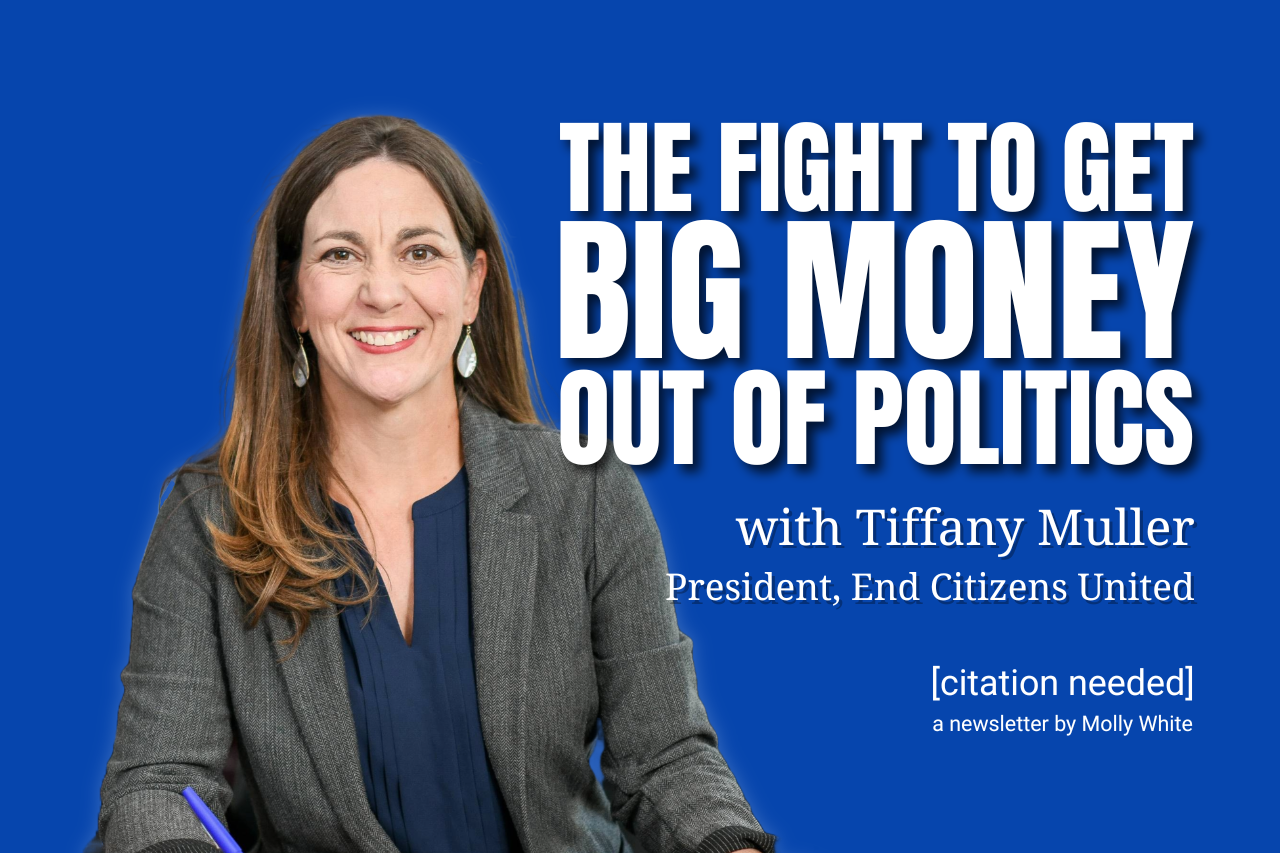
Tiffany Muller is the president of End Citizens United, the organization working to end the influence of big money in politics. In this conversation, we talk about what Citizens United enabled, how it’s shaped policy outcomes on everything from climate to gun control to healthcare, what’s different about this newest wave of tech industry spending, and what it would actually take to fix the system.
Watch the interview, or read the lightly edited transcript below.
Citation Needed is an independent publication, entirely supported by readers like you. Consider signing up for a free or pay-what-you-want subscription — it really helps me to keep doing this work.
Molly White: Hello, I am Molly White, the researcher and writer behind the Citation Needed newsletter, which covers cryptocurrency, tech policy, and the way the tech industry is shaping the world around us. Earlier this week, I launched Tech Influence Watch, which is my expanded campaign finance tracker that now tracks artificial intelligence industry spending as well as cryptocurrency industry spending. The site documents more than $400 million in contributions from these industries this election cycle.
I put so much work into it because I think that making this spending visible in real time, while voters and candidates and journalists and activists can still act on it, is one of the most important things I can do right now. Like I said, it updates in close to real time as election spending is filed with the Federal Election Commission, and you can find it at influence.citationneeded.news to see how these industries are impacting the elections that affect you.
But the story of money in politics really did not start with crypto and AI. This type of huge corporate spending traces back to 2010, when the Supreme Court passed down the Citizens United ruling. This decided that money was speech, and opened the floodgates to unlimited corporate spending in our elections. In the sixteen years since then, political spending has ballooned. Tens of billions of dollars were spent in the 2024 election, and even this year, in a midterm election cycle, we are seeing massive amounts of money flooding into elections across the country.
The industries I track are certainly the newest and fastest growing players in this system, but they operate in a system that was designed to do exactly what they’re doing, which is allow corporations to spend unlimited amounts of money to put their interests above those of everyday people.
To really dig into this, I wanted to talk to Tiffany Muller. She’s the president of End Citizens United, which is an organization that is working to end the influence of big money in politics. She’s been fighting this fight for years, and I wanted to talk to her about the broader system that makes this kind of crypto and AI spending possible, and what it would take to change it.
Molly White: Citizens United was decided in 2010, which was 16 years ago now. For those who aren’t familiar, can you explain what that ruling made possible and what the effect has been on American citizens since then?
Tiffany Muller: It was a January 2010 ruling, and it was decided by the 5–4 conservative majority, and it really overturned a hundred years of precedent. And it basically took these two really terrible ideas, and it merged them together, and it said corporations are people and money equals speech. And it allowed for the unlimited and undisclosed election spending to flood into our elections that we’ve seen since that time. And again, we had had a law on the books for a hundred years that kept unlimited corporate spending out of our elections, and it had worked pretty well up to that point.
So as a result of this ruling, what really happened is that corporations and billionaires and the wealthiest Americans really gained the right to spend unlimited amounts of money to influence our elections. And what we’ve seen since then are just these skyrocketing amounts that have been spent. And every single cycle, we see new election records being broken, to where in 2024, there’s almost $20 billion spent to influence our elections. And only 300 billionaire families accounted for 20% of that election funding, right?
And the American people know it. They are so sick of the money in politics. They know that it increases corruption, it drowns out their voices, and it creates a government that just isn’t working for them. And it’s working just for the biggest billionaires and the special interests, but not for the American people.
White: Definitely. And so besides seeing more political ads and getting more junk mail, what is the material impact of something like the Citizens United decision on people’s everyday lives?
Muller: Yeah, well, I think we’re all tired of the political ads and the direct mail that comes to your mailbox, but the real impact is the policy outcomes, right? The real impact is the gridlock and the dysfunction that we are seeing on Capitol Hill, and the fact that we can’t manage to address any of our biggest pressing policy priorities despite the fact that there is, in some of these cases, near universal support for policy outcomes.
So I’m going to give a couple of examples. We could go on all day because the money relates back to everything, but I’ll give a couple of examples. Number one, let’s go with the impacts of climate change, right? We have known that this is a pressing problem for decades, and prior to the Citizens United ruling, we actually saw fourteen instances of Senate Republicans joining with Senate Democrats to address the impacts of climate change. And we were one vote away from passing cap and trade. Cap and trade wouldn’t have been perfect, but it would have been a good starting point to address the devastation caused by climate warming. Citizens United happened, and the oil and gas lobby became the number one spender in our elections with 90% of that money going to Republicans. Since that day, there have been zero instances of Senate Republicans joining with Senate Democrats to try to address the impacts of climate change. Because it’s not only about the amount of money that’s being spent, it’s also about the threat of money that could be spent.
Let’s take another one. Let’s take guns. There is 90% support for universal background checks. We understand that we need to make our communities and our families safer. We need to have common sense proposals in place that keep guns out of the hands of people who are dangerous. And yet, we can’t manage to get it passed. Even after devastation like the Sandy Hook shooting and other things we have not been able to get it passed, and it’s because the gun lobby and the NRA continues to have such a stranglehold on Congress.
Look at big pharma. We pay more for prescription drugs in this country than anywhere else in the world, and that is because Congress continues to capitulate to big pharma. Part of the reason they do that is that, number one, they spend about $300 million every election cycle to influence our elections. And number two, they have 1,500 lobbyists on Capitol Hill every single day. That is three lobbyists for every single member of Congress. So how are people like us supposed to compete in that kind of environment?
And so every single kind of policy issue that we’re facing — housing prices, grocery prices, childcare costs, everything that we are facing — we can trace back the just lack of anything being done for the American people to this money in politics.
And my very last example is, if you look just last year at the “Big Billionaire Bill” that was passed in Congress, it was the largest tax break in US history to corporations and the richest Americans. And yet we know that it meant coming at the cost of tens of millions of Americans being kicked off their healthcare, right? What we are seeing are policy choices that skew to the biggest industries and the richest people.
White: Right, that makes sense. I mean, if an individual voter can give at most $3,300 to a candidate and then a billionaire or a super PAC can spend $50 million, at what point does the incentive structure completely flip, right?
Muller: Right. And they say that that was going to be independent of the candidate. The candidate wouldn’t know who was giving that money, but we all know —
White: Right. [laughs]
Muller: Exactly. I mean, it is laughable on its face. We all know that it’s not true. And the corruption that is inherent in that system is what we’re seeing play out in real time right now.
White: Absolutely. I want to talk about some of the newer players that have emerged as well. You mentioned big oil, big pharma, the NRA. I think people are fairly familiar with these forces in politics influencing policy. But in the past couple of years, we’ve seen the cryptocurrency industry and now the artificial intelligence industry entering the picture in a really major way. I track the campaign spending from the crypto and now the AI industry is at my influence.citationneeded.news project. And it’s really pretty striking. Three of the top 20 super PACs if you rank them by the amount of funds they’ve raised are crypto or AI PACs. And they have hundreds of millions of dollars to spend into the midterms, on hand, ready to go. Do you think the playbook is different for these new super PACs or is this more of just more industries getting in on the spending that’s already been happening?
Muller: I think it is a scale that we haven’t seen before. And I actually think that it is just another, another example of how bad the system is getting and how badly needed reform is. And I mean, you know this because you’re tracking this, but the crypto industry has already committed to spending around $300 million toward the 2026 election. $300 million. First of all, that’s more than double what they spent in 2024, where it was around $120 million. Secondly, they actually have more money right now than the party committees have. And what you are seeing is the bending of the entire system toward what they want. Less regulation, no oversight, being able to pad their profits.
And you are seeing campaigns and candidates on both sides of the aisle, Democrats and Republicans, putting up websites that contain all the buzzwords that crypto says they need to see. All of the, basically, the lack of oversight and accountability that they are committing to and saying that they won’t enact strict regulations on an industry that we know has been really problematic. And the same is true with AI. We are seeing AI at this point say that they are going to spend, you probably know this number even better than I do, but they are over $70 million at this point. I think most folks think that they will get over $100 million. These sums are staggering, just staggering.
And so we’re already seeing, again, that bending of the entire system, bending of the policy toward the money as candidates just chase the big money or are scared about this big money coming in against them.
And I think you’re also going to see other industries taking a page out of their playbook. What I worry about is they’re not going to be alone in 2028. Instead, all of these other industries who are like, “oh, look, if we go spend $300 million, which is a drop in the bucket to our total revenue”... And it’s just a return on investment because that’s the way they look at this, right?
If — going back to pharma for a second — if pharma spends $300 million on an election cycle, but they are getting $42 billion in tax breaks every single year, that’s a good return on investment for them. And crypto is in a similar place. AI is in a similar place where if they can keep the regulation from passing, they could make billions and billions and billions of dollars. We’re not talking hundreds of millions. So, investing $300 million so that they can make $30 billion.
White: Yeah, it’s an obvious choice.
Muller: Obvious choice. But again, this isn’t about ideology. This isn’t about values. This isn’t about what’s best for our democracy. This is about special industries and corporations being able to try to buy an outcome in order to keep their profit high. And it’s all coming at the expense of us, of the American people.
So, here’s the other thing. We have seen crypto start spending in these primaries, both on the Democratic side and Republican side. And in some cases, we have seen the amount of spending in the primary have a backlash effect, and that the campaigns and candidates that they are spending against actually be able to use it to help educate the primary electorate and be able to stand up and actually win. And Juliana Stratton in Illinois, I think is a great example of this this year. Crypto came in and spent $10 million against her. And every dime that they spent ended up helping push her to a victory. And she ended up winning by over five points. And now definitely understands that she already was going to go to Washington and only be fighting for the families of Illinois. But also when you’ve stood up against that kind of money and won, you are given a little more freedom to be able to do that.
White: Yeah, I was going to ask about that because it does feel like, at least anecdotally, there’s more of a shift recently where voters are becoming more aware of this corporate funding. We’re seeing some campaigns directly addressing it by calling it out like Juliana Stratton. Do you think this is a meaningful backlash or do you think the benefit for a candidate in potentially accepting millions of dollars in campaign support from these corporations outweighs the criticism?
Muller: So I’m so glad you asked this question. I think we are seeing a meaningful shift and I’ll talk about it kind of in two parts. First, I think that what we see across the country and with voters is that corruption and the amount of money and politics is actually a real top concern for them. And voters already are connecting the corruption of our system, which they mostly blame on the money in our system, to higher prices that they are paying. Voters actually really understand that. We don’t even have to connect the dots for them. They’re already connecting those dots for themselves.
One of the things that we have seen this cycle is candidates are running on how they would change the system, cleaning it up. Not taking corporate PAC money, saying that they would ban stock trading by members of Congress, saying that they would get this big money out of our elections. We have over 200 candidates that have signed up to take that pledge and to run on those issues. That’s a huge amount. Even in 2018, which was kind of a wave of reformers elected, we are outpacing those kind of numbers in 2026. I think that we are seeing a meaningful shift.
I think the other thing that we are seeing is that where there is this backlash to crypto and AI in particular, right now, at least tends to be in the primary elections. I think we just don’t have enough — we don’t know yet if it will also play out the same in the general election in 2026. But I think that voters are more and more concerned about: who are you answering to? Who are you fighting for? Who are you working for when you’re going to Washington? And so I think the more that crypto and some of these big industries come in for some of these candidates, I think it really hurts their ability to say that they would go to Washington and not just be sold out.
Where we have seen it play out the most effectively is in these primary elections. And yeah, in a lot of cases, we are seeing the big money not win. And I think that is such a powerful message. I think it’s such a powerful message that when we stand together, we actually can beat back the millions of dollars because they want us to feel hopeless and like there’s nothing we can do. They still can’t buy our votes. We still have say in these elections, we still have say in calling it out, we still have say in demanding a better system. So I’m really excited about the kind of backlash that we have seen because I think it shows that there is a limit to what money can buy.
White: I’m really glad to hear that because for me, it feels like there’s been that backlash. I watched the Illinois elections. I’ve seen it playing out in a couple of other states that have had early primaries, but I was wondering to what extent was this just me wishcasting versus something actually happening. So that’s really heartening to hear.
Muller: I don’t know, I think movements are built on wishcasting. We have to wish it into existence and then fight for it every inch of the way. So I think keep the wishes up and we are seeing real evidence that it’s working.
White: That’s great. But one thing that really strikes me, especially about these crypto PACs, is it seems like to some extent they’re aware that people are not fond of this type of behavior, and corporations coming out and spending huge amounts of money on campaigns. Especially when it’s something like crypto, which is already a bit controversial among voters. It seems like they’re trying to fly under the radar a little bit. So you see these super PACs that have names like FairShake and Defend American Jobs, right? And the AI industry is following the pattern as well. They have Leading the Future, which, you know, that could be anything. It seems like they’re sort of trying to deliberately disguise what they’re actually about. A lot of the ads that they’re running don’t even mention cryptocurrency or AI. They just are coming out as attack ads or running ads based on whatever the candidate might be running on. How do you counter an influence operation that’s deliberately deceiving people who are watching the ads they’re putting out?
Muller: Yeah, and they’re doing it. You are absolutely right. First of all, they’re using these really innocuous names because they’re hoping that no one goes and scratches below the surface. I think the other thing that we are seeing is that they’re not willing to come out and have an actual debate about their industries. They know that there are real problems with their products and how people feel about them. And that is what should be happening. What should be happening is we are having these debates in the public square and out in the sunlight, and talking about the harms caused by crypto or the harms caused by AI in a meaningful way. And instead what they’re trying to do is buy people who will rubber stamp whatever they want in Congress and hiding it while they do it.
You know who else does that? We see big tobacco do that still, right? Big tobacco, before there was actually regulation saying that they couldn’t advertise, understood that their reputation was harmed and that they needed to hide how much money they’re spending. They’re still spending money in elections. They’re just hiding it through (c)(4) organizations, dark money organizations, so that nobody can trace it back to them. And so they donate to a group called, I don’t know, America for a Better America or We Love Puppies or whatever it is. And it’s being bankrolled by industries like big tobacco. But if big tobacco went and tried to just engage on behalf of a candidate, there would be an uproar. There would be an accounting to be had for that, because there is so much harm that we know that big tobacco has caused. So they just hide their money.
That is what crypto and AI is doing, too. They’re trying to hide their money. They’re trying to make sure that they are talking about anything but their issues because the ads that they’re running, to your point, aren’t about AI. They’re not about crypto. They’re about everything else.
White: I’ve seen crypto ads that attack candidates for accepting corporate contributions. That’s my favorite, is when they sort of try to play off that a candidate is bankrolled by big banks or something like that. And meanwhile, they’re spending $10 million on this ad.
Muller: The irony, sometimes it’s enough to make your brain explode, right?
White: It is.
Muller: But yeah, I think one of the things that big money counts on is not having complete transparency and disclosure. One of the reforms we need is disclosure and transparency. We’ve been trying to pass that since Citizens United was decided. And what we have seen is what we call dark money really increasing over the last 16 years. And it is everything from industries like this that have real problems that are trying to hide where their money is going. But it’s also billionaires who don’t want to be found out. We have seen even foreign governments and foreign nationals engaging in our elections, despite the fact that that is illegal. Hiding their money in these dark money groups so that so that people can’t trace it back. Because that disclosure, that transparency, that sunlight is one of the key tools we have to rooting out corruption and to holding people accountable. So I am not surprised that crypto is unwilling to stand in the public town square and debate these ideas because I think they understand there are real problems with their product.
White: Absolutely. And you talk about dark money, illegal campaign contributions. Theoretically, there’s supposed to be an oversight group. There’s supposed to be accountability. There’s supposed to be a watchdog in the FEC. But I reported in 2024 that these campaign contributions by Coinbase, after it was negotiating and ultimately received a federal contract, were likely illegal. And I worked with Public Citizen to file a report to the FEC about this $25 million campaign contribution that appeared to have violated the law. As far as I know, nothing has come of it since then.
 Molly White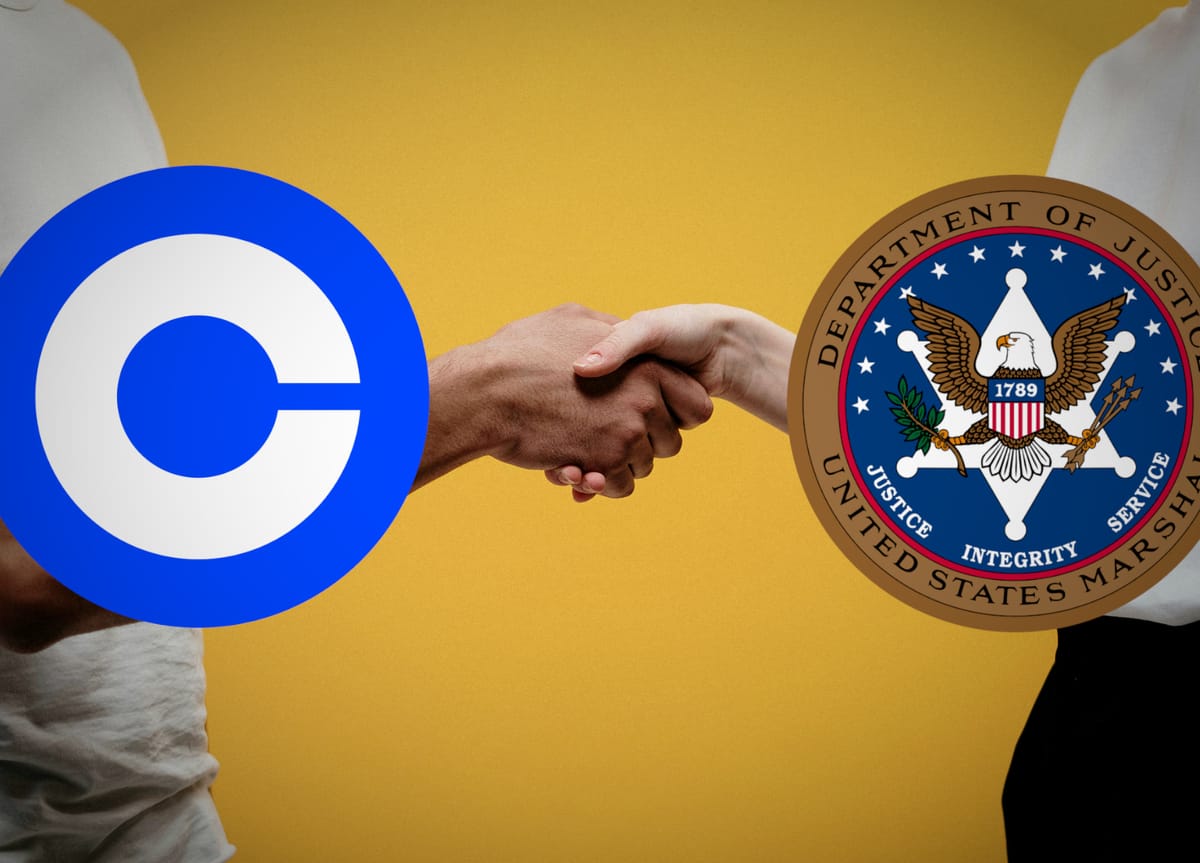
Coinbase has already contributed more than $50 million to crypto PACs in this cycle. We’ve seen them contributing millions more to various congressional PACs, to Trump’s super PAC. Why isn’t the FEC doing its job? Why aren’t these complaints being investigated in a timely fashion and ultimately acted upon?
Muller: This is such a great question. And the FEC was dysfunctional and gridlocked even in the best of times. It is now non-functional. There has not been a quorum at the FEC for over a year at this point, so they literally can’t even open up an investigation because there aren’t enough commissioners. I think we are down to actually two commissioners, and there’s supposed to be six. The FEC has had a lot of problems, we will talk about that, the FEC needs reform.
But what we have seen this White House do, this administration, is basically any watchdog that could stand in their way, any watchdog that could root out corruption, that could hold folks accountable for breaking the law, is really being targeted and decimated. So whether it is the Inspectors General in 13 different agencies that were fired or the just gutting of the Federal Election Commission, the targeting of other independent agencies from the SEC to the FCC to the FTC, all the acronyms, to the weaponization of DOJ. We have seen this administration really go to war with the government watchdogs. And we are seeing the real limitations that an organization and agency like the Federal Election Commission has.
In normal times, there are six commissioners. There are three Democrats, three Republicans. That is supposed to be split on party lines. But it takes four commissioners to actually vote to even open an investigation. The investigators that are on staff who are phenomenal, phenomenal investigators can’t even open an investigation on their own. They can recommend that an investigation is opened, they can say that they think that there is enough evidence to warrant looking into it more, but they can’t actually open an investigation without a quorum. Four of the six commissioners voting on it. And as you can imagine, in these more partisan times, what happens a lot is there is a three–three party split. And if it is a three–three vote, nothing happens. It just doesn’t go anywhere.
Donald Trump, for instance, has had over 50 complaints filed against him, with the investigators, the staff saying that there should be investigations opened in over 30 of those. And every single time the FEC has voted not to move forward. Every single time.
We had a comprehensive democracy reform bill that included Federal Election Commission reform in it. That would include things like making an odd number of commissioners so that it was five commissioners, that it wasn’t split on party lines, that the investigations could be opened and explored without first having to go through a vote like this. There are things we could do to actually make this a functioning agency again.
The other thing we have to do is figure out how to protect the independence of these independent agencies. Because again, if we can just leave it sitting non-functional for a year, what is the point of it?
White: Right, absolutely. And we’ve seen very similar things you mentioned with the SEC, the CFTC. I mean, the CFTC has one commissioner right now. So there’s just one person running the entire agency and it’s a farce.
Muller: The CFPB, they’re just decimating the CFPB.
White: Absolutely. So, we’re seeing all this money being spent on elections. The FEC is asleep at the wheel. It feels like things are pretty dire. What can we do about it? I know that End Citizens United has launched this Unrig Washington campaign. Can you tell me what that entails and what you think should be done?
Muller: Well, first, for those who don’t know, End Citizens United is a grassroots powered organization. We have over 4 million members across the country. And really, our goal is pretty simple: to root out the corruption and get the big money out of politics and to actually have a government that works for the people again and not just the people who can write the biggest checks. We know that who is in office matters to being able to actually get meaningful reform passed, and so we work with campaigns and candidates to really center these ideas and to talk to voters about them because we know that they are at the top of the concern for voters.
We launched the Unrig Washington commitment, and it is three really common sense proposals. It is, number one: ban stock trading by members of Congress. Look, if you are in Congress, you shouldn’t be using your insider intel to line your own pocket. And with such a lack of faith and trust in our public officials, we need to take steps to restore that faith and trust. And so banning stock trading is an easy one. Number two: don’t take corporate PAC money. This seems pretty easy. Corporations have a big enough seat at the table. And it is a way for candidates and elected officials to show that they are going to be working for the people and not just for the people on K Street who are giving them a check. And then number three: get rid of the dark money. We were just talking about all the ways that this dark money passes into our system. Disclosure and transparency is key to getting the corruption out of our politics.
We are so excited. We have over 200 candidates running on this, including some of the folks that we talked about, like Juliana Stratton. It’s folks running in the general election. It’s folks running in the primary election. It is everyone from progressives to moderates to everyone in between. And it’s really about saying to voters that they are going to come to Washington, they are going to vote to change a broken system, and that they are going to give some of the power back to the people. And that’s what we need to do because right now.
Washington is so broken that we have talked about all the things that are being held up. And until we break that connection between money and policy outcomes, we are going to continue to see just gridlock and dysfunction that leaves the American people behind. So folks can find out more, and you can go to endcitizensunited.org and sign up. We always have volunteer activities going. We do polling and research and messaging. We are out across the country doing town halls all the time. You can also go to unrigwashington.org and see who is signed up and if your candidates have signed up.
Have your members signed up to be a part of this? And if not, ask them to. Tell them to. The more that we all are using our voices around these issues, that folks know this isn’t popular. The way to make them not be sold out to the money is to make sure that they understand their voters are paying attention to it.
White: Absolutely. But I’ve seen the argument that it’s all well and good to refuse corporate PAC money, but everyone is playing by the same rules. If a candidate is arbitrarily refusing corporate PAC money, maybe they’re just handicapping themselves when they’re running against a candidate who’s more than willing to accept potentially tens of millions of dollars. They could wind up losing because they took a moral stand and refused the money and were outspent by the other side. What is your argument when that type of thing comes up?
Muller: What I love is that these are the talking points that were created by the corporate PAC for corporate PACS. In case you did not know, there is actually a PAC for corporate PACs. It’s called the Business Association PAC, seriously. And this is their talking point.
Here’s what we’ve actually seen happen. What we’ve actually seen is that, for candidates who choose not to take corporate PAC money, they actually outraise their colleagues who are choosing to take corporate PAC money. And part of that is because they are giving permission and inspiring people to get more involved in their campaigns. People feel like they are actually a part of something bigger, and that matters when their elected officials and candidates aren’t just sold out to the corporate PACs. We have been tracking this since January 2019, and every single quarter, we have seen the folks not taking corporate PAC money outraise the folks taking corporate PAC money.
Here’s the other thing that we have seen. It is one of the most powerful messages to voters that we have been able to find, particularly with independent voters and swing voters. The same folks who voted for Donald Trump because he said he was going to drain the swamp are the same folks who want to vote for a candidate who says they’re going to swear off corporate PAC money and come to Washington and change the system. It’s because it is tapping into that desire for change and to restore some power back to the people.
That is so critical to winning, right? Being able to actually figure out a way to talk to those voters who are the most cynical, who are the most checked out. So not only does it not handicap them in terms of money, it also gives them a message that is such a powerful political winning message to be able to talk to voters about.
White: Yeah. And that seems so important in this conversation because I feel like a lot of people feel really defeated about the influence of money in politics. Like there’s no coming back from this. There’s no way that candidates would ever support legislation that would reduce the money to support their campaigns, for example. Or they think, well, it’s Citizens United, it would require a constitutional amendment to undo this decision. What do you say to someone like that who is given up, who has decided that this is basically an intractable problem?
Muller: I think that that is how the big money wants you to feel. And don’t let them make you feel that way. We have seen real progress on these issues. In 2018, we elected a wave of reformers across the country, and they demanded that the very first bill in a new Congress and under a Democratic House was going to be a comprehensive democracy reform bill. And that bill would have made sure that no matter who you are, where you live, you had the same access to the ballot box. And especially in the wake of all the voter suppression that we are seeing and the gutting of the Voting Rights Act, that is so critically important. It would have stopped all the gerrymandering wars that we are seeing. And actually made it illegal to do mid-decade redistricting as well. It would have gotten a bunch of this big money out of the system. It would have done the disclosure and transparency. It would have reformed the Federal Election Commission. It would have even set up a first-of-its-kind public financing system for members of Congress and candidates for Congress. And it would have restored ethics and oversight and stopped some of the revolving door and lobbyist influence that we’re seeing. It was tackling all the problems that we are seeing in our democracy and it passed the House five different times.
And right now, we know it will be the top one or two item in a new Congress under Democratic leadership. So there is real support for this. People are willing to vote on it. They are willing to fight to get it passed into law because they understand the kind of decimation that we are seeing to our democracy and that we have to make real changes.
So don’t let anyone tell you that it is hopeless because that is how the big money wants you to feel. And the fact is, we’re actually much closer than folks think to being able to get this through and signed into law.
White: That’s really promising to hear.
Muller: We gotta keep going. We gotta keep that hope up.
White: Absolutely. And as far as Citizens United, what is the best hope as far as overturning that or undoing the damage that was caused in 2010? Obviously there are steps we can take to reduce the corruption and improve the oversight, but it feels like unless we tackle that, there are still going to be issues around massive corporate spending.
Muller: You’re absolutely right. Long term, we need to overturn Citizens United and the connecting decisions that have allowed this system that we now have in place. And to do that, we have to either pass a constitutional amendment or we have to have the Supreme Court overturn itself. Both of those are hard, right?
But there is a lot we can do tomorrow with a simple vote of Congress, which we just talked about. So I think it is both how are we building the short term movement that’s going to get us some of this money out, get us the disclosure and transparency, restore ethics and oversight in the short term — while we’re building the longer term movement to do one of those two things.
I also think it’s why we need Supreme Court reform so badly. We absolutely must pass Supreme Court reform because right now we have a Supreme Court that’s been captured by big money itself. Leonard Leo in the Federalist Society spent over $600 million to get the three conservative justices confirmed — Kavanaugh, Gorsuch and Coney Barrett — and then spent another $500 million to overturn Roe. And they understood that campaign finance limits were standing in their way, and it’s why they attacked campaign finance limits.
First and foremost, we need ethics, recusal, transparency, and a gift ban on the Supreme Court. I don’t know about you, but I don’t think that lavish vacations and RVs and private school tuition should be given to Supreme Court justices, particularly not from people who have business in front of the Court. The Supreme Court cannot police itself. We need an actual oversight authority that can police the justices because we know they’re not doing a good enough job of it on their own. Number two, we need term limits. Mostly it’s been kicked around the 18-year term limits, something to that effect, is critically important to reforming the Supreme Court. And then on top of those things, we can look at expansion, but we need all three, not just one of them.
White: Yeah, absolutely. And so as far as this fight, building this movement, what are some of the top things that people who care about this — who care about ending corruption, getting money out of politics — what can they do to make a difference today?
Muller: Well, first and foremost, you can vote. Never underestimate the power of your vote and making sure all your friends and family are voting and have a plan to vote. Because as we’ve talked about, no matter what big money tries, they can’t just go buy votes. They can try to influence votes. They can try to buy elections. But at the end of the day, our vote still has the most power, which is why they are working so hard to either buy it or to suppress it. So please go vote.
Number two, use your voice and your platform. Each of us have a voice. Each of us has a platform. And use it to call out the influence of big money, use it to hold your candidates and your elected officials accountable. Ask them questions about things like where they stand on crypto money in our elections, or AI money in our elections, or corporate PAC money in our elections. The more that they hear about it, the more that they will know that it is an important issue that they have to tackle when they are in office. They really pay attention to what they’re hearing out in these town halls and in these public forums. So using your voice is really important.
Number three, of course you can sign up for organizations like ours, EndCitizensUnited.org. There are other organizations fighting this fight as well. Please join forces, volunteer. We need folks who are willing to send postcards or knock on doors or make phone calls. We always have things going on because sadly there is always more to do in this fight, so we can definitely use that.
And I would say don’t give up. Again, I think it is the playbook of the big money to make us feel like it is hopeless. In order to make change, I think sometimes we are fighting for an inch at a time and waiting for that opportunity for the door to be cracked so that we can actually make a big change. And sometimes that inch at a time can be really tiring, right? It can be really hard. And so showing up matters. You never know who else you’re giving the courage to show up the next time or inspiration to show up the next time. And on the days when it’s hard for you, take inspiration and courage from others. That is how we resource ourselves. That’s how we keep going in this fight. So those are my suggestions.
White: That’s great. As we wrap up, is there anything that you wish people understood about this fight or anything that doesn’t get enough attention that you’d really like to underscore?
Muller: The other thing I would say is there’s some really great work going on at states and localities trying to tackle this. I think states are the real creative labs of our democracy and we’re seeing really exciting things happen at the state and local level, whether that is more disclosure and transparency. Whether that is in Montana, there is an effort being made to not overturn Citizens United, but to get around Citizens United and to limit what powers corporations have and that they can’t spend in elections. In Michigan, there’s an effort being undertaken to break the power that big industries like the energy companies or big insurance has over the state legislature. So there’s also these really amazing fights being had, not just on the federal level, but at the state and local level, that’s going to give us a roadmap of things that we should fight for on the federal level as well. Some people feel like, oh, Congress is just so broken, there’s nothing we can do. Well, I don’t believe that. And there’s lots of stuff we can do at the state and local level as well.
White: Yeah, and that’s actually something I wrote about is watching some of the state ballot questions about corporate money in politics. And they’ve been enormously popular with voters. I mean, my home state of Maine had a ballot question in 2024. And it was like 75% of people supported it, to limit corporate spending in politics. I feel like that’s very promising as far as the voter sentiment about this type of action. People really hate it. And it’s not necessarily a partisan thing, nobody wants to see politicians who were bought and paid for by corporations. It’s really nice to at least see that as sort of weather vane for public opinion on these types of things.
Muller: I could not agree more. To your point, Maine was 75% of the vote. I think in Montana, there was a ballot measure to tell members of Congress that they needed to overturn Citizens United. It passed with 72% of the vote. These aren’t just blue states that are passing.
And what we see is across the country, Democrats, Republicans, Independents, they all think that there’s way too much money in our politics. And they just want the power to be given back to the people. And that makes me feel very hopeful. When you have that much of the, the country united on like what the solution needs to be, it is just about breaking the corrupting influence of these big donors and these big industries in order to get it done.
White: I think you’re right. Well, Tiffany, thank you so much for taking the time for this conversation. I think this is really important. Again, for listeners who want to get involved or learn more about what you’re doing, where should they go?
Muller: Go to EndCitizensUnited.org or you can also follow us on all the social medias, either @StopBigMoney or @EndCitizensUnited. And we’d love to have you join us. This has been such a great conversation, thanks so much for having me on.
White: And I’ll link to all of that in the show notes as well so people can find that. Thank you so much for coming. This has been such a great conversation.
Have information? Send tips (no PR) to molly0xfff.07 on Signal or molly@mollywhite.net (PGP).
I have disclosures for my work and writing pertaining to cryptocurrencies.