Issue 110 – The Clarity Act collapses
Regulators race to reassure the crypto industry as the industry’s flagship legislation collapses, SBF tries his luck with the Supreme Court, and crypto PACs unleash $30 million against Sherrod Brown

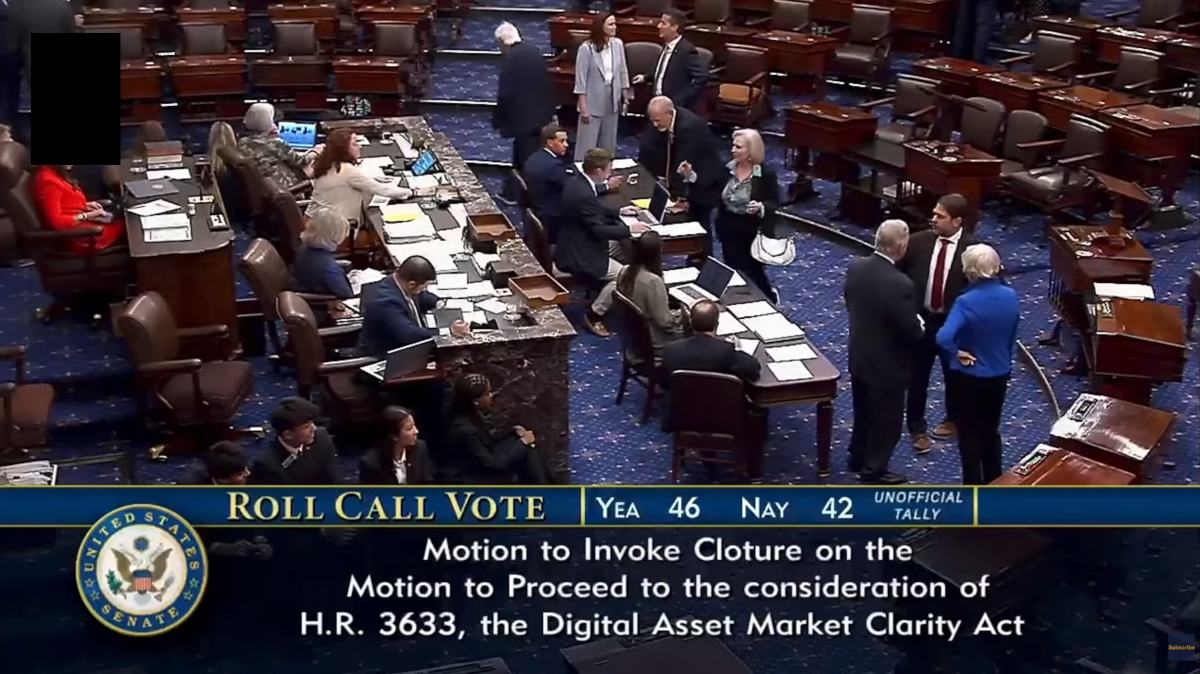
After years of political pressure, hundreds of millions of dollars to fund the campaigns of pro-crypto politicians, and at least $8 million in lobbying,1 the Clarity Act collapsed at the eleventh hour when a procedural vote to advance the broad-ranging cryptocurrency market structure bill fell far short of the 60 votes it needed. While the crypto lobby had a long wishlist for Trump’s presidency — and has already secured wins such as the Genius Act stablecoin bill and regulatory capture at the CFTC and SEC — broad legislation that would cement the deregulation of the crypto sector while giving it a veneer of legitimacy was their top priority.
This is good news. The Clarity Act isn’t about “clarity” any more than the PATRIOT Act is about patriotism. It promised regulatory structure but would have carved out crypto from the scrutiny applied to similar financial products, instead building a custom regime to allow it to operate without meaningful oversight. Trump has already dismantled the agencies that should police the sector, replacing bipartisan commissions with a handful of loyalists who have dismissed the majority of crypto enforcement actions and investigations. But those are changes can be reversed when Trump leaves office. Legislation is far more durable — which is why the crypto industry so desperately wanted the Clarity Act to lock in deregulation. Rebuilding from Trump’s devastation won’t be easy, but today we can be grateful there won’t be additional bad legislation blocking the way.
In Congress
As I wrote just prior to the Clarity Act vote, Republicans had decided to plow ahead with a bill that had only token provisions to address Trump’s crypto corruption, without securing bipartisan agreement. When Democrats made a last-minute counteroffer, which would have reportedly added more restrictions on things like the amount of crypto elected officials could hold and paid crypto promotions, Republicans shot it down. Senate Banking spokesman Jeff Naft characterized the Democratic proposal as an attempt to “move the goalposts again” after he said Republicans had agreed to numerous Democratic demands.2
While members of both parties had been working together on a final version of the bill after it advanced out of the Senate Banking Committee in mid-May, that cooperation eroded as the time left to feasibly pass the bill dwindled. Republicans repeatedly shared draft text with the crypto industry — or even the general public — before providing it to their Democratic colleagues.3
Ultimately, not a single Democrat voted for cloture — not even Kirsten Gillibrand (NY), a longtime crypto advocate who had been pushing Democrats to support it just the day before.4
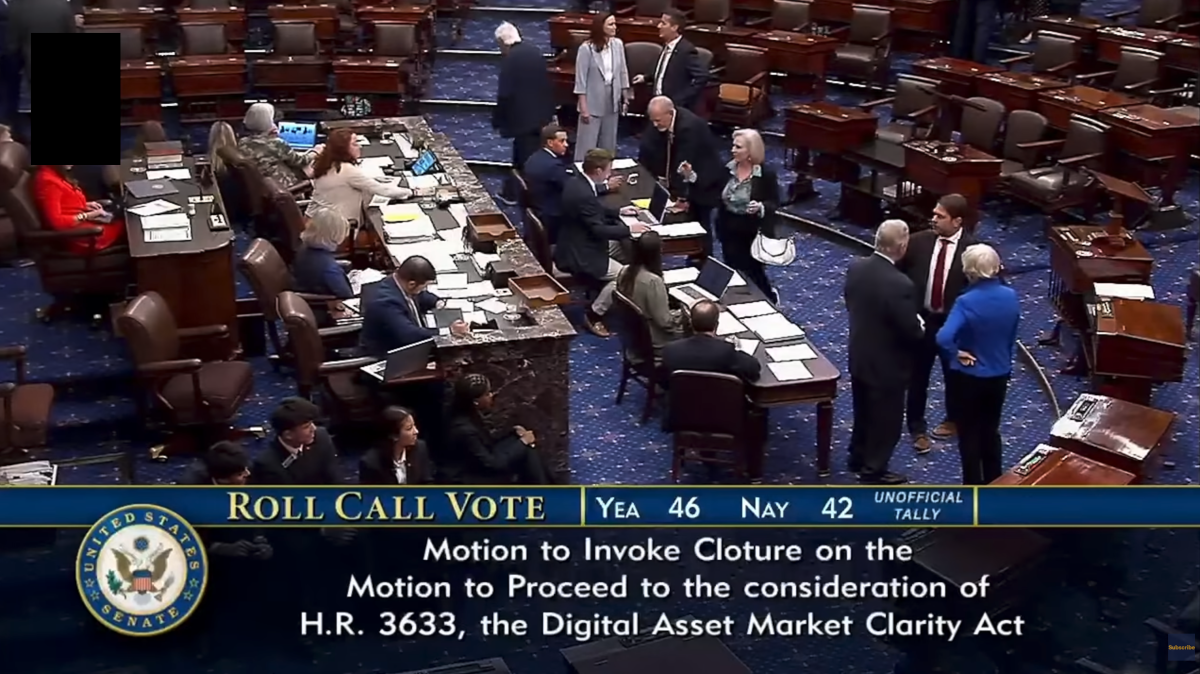
And some Republicans broke with their party to oppose the bill. Josh Hawley (R-MO) and Jerry Moran (R-KS) kept their promises from August to vote against the bill, citing concerns from farmers that inadequate language around stablecoin rewards could cause deposit flight from community banks, in turn reducing those banks’ ability to make the agricultural loans they depend on [I108]. More surprisingly, we saw Susan Collins (R-ME) break with the rest of her party to oppose the bill. Unlike Hawley and Moran, Collins is up for re-election this cycle, and I suspect once she realized the bill was unlikely to achieve the votes it needed, she opted not to add one more challenging vote to defend in what is shaping up to be a challenging race to land a sixth term in office.
Now the blame game is in full swing. Senator Tim Scott (R-SC) penned an op-ed in the crypto publication CoinDesk titled “Democrats killed the Clarity Act”, where he railed against Democrats for “bl[owing] another opportunity to put money in the pockets of Americans” and repeated Naft’s line about Democrats constantly moving the goalposts in negotiations.5 Elsewhere, Republicans attempted to spin the story as “Democrats say they want crypto regulation and limits on Trump’s corruption so bad, and then they vote against it!” (as though Clarity would have provided any meaningful regulation, rather than the opposite).6 And some Democrats are pointing fingers at Republicans. “It’s the Republicans who died on the hill of Trump corruption,” argued Senator Raphael Warnock (D-GA).7
Some blame Coinbase and its CEO Brian Armstrong, who in January pulled their support for the bill, causing Senators to cancel a key vote and stalling progress for several months [I99]. “[Armstrong] could effectively veto portions he didn’t like—and he did,” wrote the Wall Street Journal. By the time Senators were able to negotiate a compromise on the stablecoin rewards issue that had prompted Coinbase’s objections, Trump’s annual financial disclosure had come out, revealing his $1.4 billion in crypto profits. The public outrage over the sheer magnitude of Trump’s grift made the Clarity Act a political lightning rod, especially as midterms loom, and even the most pro-crypto Democrats began to more vocally demand meaningful ethics provisions in the bill. “We had a lot of momentum in January. Then one group in our industry kind of shot ourselves in the foot,” said Ripple CEO Brad Garlinghouse.8
In regulators
As the Clarity Act collapsed, commissioners at the CFTC and SEC raced to reassure the crypto industry that they will still deliver a friendly regulatory environment, though it’s thin consolation for an industry that had been counting on the permanence of legislation. The CFTC has sent a proposed rule to the White House for review, and while its contents have not been published, its name — “Regulation Crypto Asset Transactions and Regulation Crypto Asset Markets” — suggests a broad scope.9 The SEC, perhaps sensing the impending doom of the Clarity Act, had already released its lengthy “Regulation Crypto” proposed rule prior to the cloture vote [I09].
The SEC has now followed that with what they’re calling the “Innovation Exemption”: an order that carves out exemptions for “tokenized securities venues” (TSVs) so that they are not considered to be “exchanges” under securities laws.10 TSVs are platforms where people can trade tokenized securities — that is, instead of buying a stock, you can now buy a crypto token that represents a stock. Crypto companies including Coinbase, Kraken, Robinhood, and others have been clamoring for the SEC to allow them to offer such products to US investors, and the SEC has granted their wish.
While the SEC has in the past exempted smaller operators from the types of onerous regulations and requirements that apply to stock exchanges like the Nasdaq or New York Stock Exchange, this exemption is a shocking departure. The most comparable historical exemption is Regulation ATS, applying to “alternative trading systems”, which was issued amid the surge in electronic trading in the late nineties.11 However, that rule was made after several years of observation of various ATSes that were operating under no-action letters, and with the experience gleaned from that period — not as the first step. It was also created via the full notice-and-comment rulemaking process, unlike this exemption, which is an exemptive order the agency says was necessary in order to “address the immediate concerns” of the crypto industry. Finally, while Regulation ATS exempts ATSes from the definition of exchange, it also installs a separate set of conditions and registration requirements for ATSes, which remain fully subject to the SEC's authority. While the SEC claims that exempted TSVs will also be subject to various requirements, such as limits on the number and volume of tokenized stocks that can be listed on the platform, these platforms will not be required to register with the SEC, leaving the agency with little ability to enforce it.
The Better Markets advocacy group was quick to condemn the exemption, writing that “the SEC has proven that it will do anything to benefit the crypto industry. That now includes exempting crypto companies that want to facilitate tokenized stock trading from the federal securities laws. In doing so, the SEC endangers investors.”12 One comment submitted to the SEC shortly after the exemption condemns the SEC for “dismantling the national market system in the name of ‘innovation’”.13
It remains to be seen whether anyone will take the SEC to task over this brazen overstep. A legal challenge might normally come from competitors — in this case, the stock exchanges that do have to comply with onerous regulations. But the exchanges also may not see TSVs as a serious competitive threat.
These tokenized stocks are of dubious appeal, and there’s little reason to think traders — particularly institutional traders — would prefer them to trading the stocks themselves. The crypto industry’s main pitch is that TSVs would allow 24/7 trading, but it’s not clear a significant portion of the market actually wants that. TSVs also bring various risks and downsides: if you buy a tokenized stock on one TSV, there is little infrastructure that would allow you to sell it elsewhere, essentially locking you in to that platform. And what happens to those locked-in traders if a TSV hits its volume cap and is required to pause trading in that stock for three months?
Stock issuers also may not wish to allow TSVs to tokenize their stocks, and the SEC stopped short in this order of granting Robinhood’s wish to tokenize stocks without issuer consent.14 While the handful of publicly traded crypto companies will likely allow it, an exchange that only offers shares of Coinbase and Microstrategy may not attract much interest.
Why spend the money and political capital on a lawsuit against your regulator over a product that’s unlikely to gain meaningful traction? My guess is most exchanges will wait and see if these venues catch on — and maybe even dabble in launching their own — before deciding challenging the SEC is worth the trouble.
In the courts
FTX
Having lost his appeal to the Second Circuit, Sam Bankman-Fried is now taking his case to the Supreme Court.15 He hasn’t changed his arguments much — despite repeated statements from both his trial judge and the appeals court that “but we paid you back” does not actually make fraud not a crime, he still seems convinced that if he could’ve just explained to jurors that FTX’s assets eventually appreciated (after he drove the company into bankruptcy), the jury would’ve let him walk free. This is going to be a tough way to convince the Supreme Court to overturn the lower courts’ decisions, given that only last year the Court unanimously agreed in Kousisis v. United States that fraud convictions are valid even if the victim didn’t seek to cause economic loss, and even if the victim doesn’t ultimately lose money.
Bankman-Fried also added arguments addressing the $11 billion forfeiture order, which he says violates the Eighth Amendment protections against excessive fines. I would be shocked if the Supreme Court agrees to take up the case, but you can’t blame a guy for trying, I guess.
Meanwhile, his fellow former FTX executive, Caroline Ellison, has been free from prison since January, and has now found gainful employment! She will be working for Manifund, an effective altruist grantmaking organization. In a blog post explaining why he hired her, CEO Austin Chen listed first among his bullet points “I specifically enjoyed Caroline’s Tumblr and other writings, which I found thoughtful and relatable.” (This is the blog where Ellison regularly blogged about “human biodiversity”, a euphemism for scientific racism, and wrote, “how do I signal my genuinely sweet and feminine nature on my dating profile? should it go before or after the section on wire fraud”). He also wrote that “Caroline brings specific, useful expertise around finance and systems management to Manifund.”16 Which, yeah, I guess I can't argue with that, in the same way that Bernie Madoff had very specific expertise.
FTX essentially bankrolled Manifund and the associated Manifold Markets (think Polymarket but with fake money) through grants and investments. This may explain why Chen, citing a “keen debt” to FTX, decided to hire Ellison and pay her using funds derived from her fraud — money Manifund is currently fighting the FTX estate over rather than returning to creditors.17
Binance
Binance has dropped its March defamation lawsuit against the Wall Street Journal over the outlet’s reports that the Department of Justice was investigating Binance for violating sanctions against Iran [I102].18 The request to dismiss the lawsuit came the day after Bloomberg confirmed that the Manhattan US Attorney’s Office is indeed probing Binance’s compliance program to determine whether the company knew that customers were using its platform to circumvent the sanctions.19
I’ll be interested to see how that investigation plays out. The Southern District of New York is currently headed by Jamie McDonald, a former Trump personal lawyer. While in private practice, he represented Coinbase in its lawsuit from the SEC, and has also represented Polymarket and other crypto-adjacent firms.
Binance has been a lucrative partner to Trump, accepting a $2 billion investment from the United Arab Emirates’ MGX investment fund denominated in the USD1 stablecoin [I83]. That $2 billion is a substantial chunk of USD1’s reserves, and helped to generate $8.3 million in income for Trump in 2025. Binance has also provided software to the Trump family’s World Liberty Financial, listed USD1 for trading, and offered incredibly generous promotions to incentivize traders to buy the Trump family’s stablecoin [Quid pro quo].
The benefits have gone both ways for Binance. A 2023 enforcement action by the SEC, which accused Binance of fraud and operating as an unregistered securities exchange (and included a quote from Binance’s Chief Compliance Officer that “we are operating as a fking unlicensed securities exchange in the USA bro”), was dismissed with prejudice in May 2025 [I85]. Later that year, Trump pardoned the company’s former CEO, Changpeng Zhao, who was convicted of violating anti-money laundering and sanctions laws [I95].
Trump family business interests
As the Trump administration boosts prediction markets and clears the way for them to operate without pesky oversight, Donald Trump Jr. is leading a $1 billion funding round into Polymarket through his 1789 Capital VC firm.20 A previous 1789 Capital investment into Polymarket saw Trump Jr. named to the firm’s advisory board in August 2025; he simultaneously serves as a strategic adviser to Polymarket’s largest competitor, Kalshi.
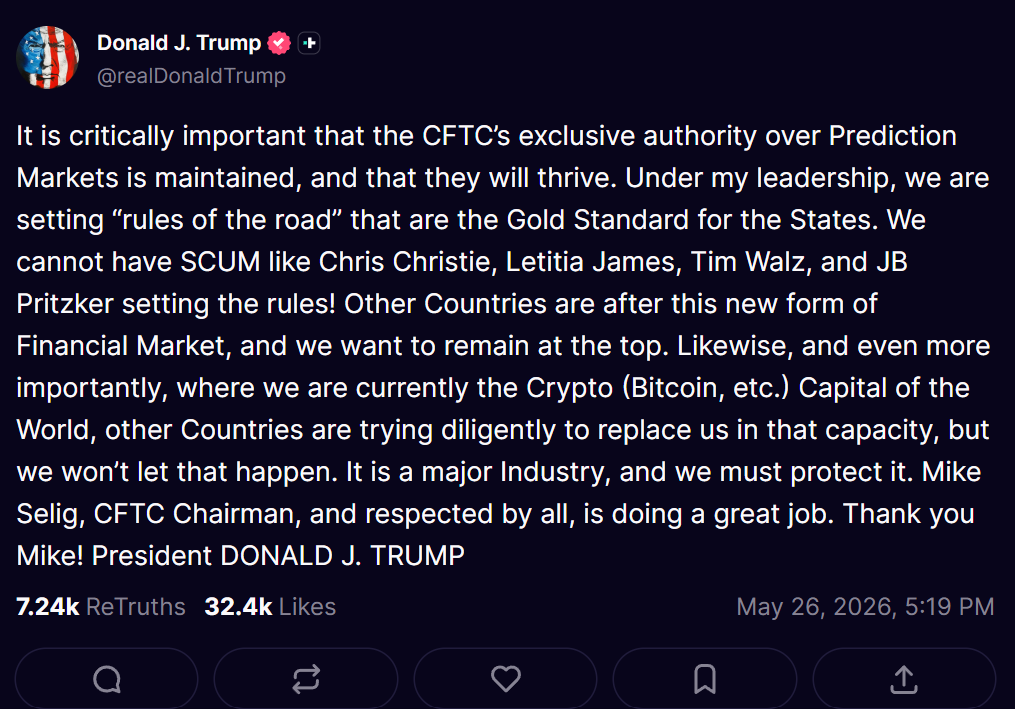
In July, the New York Times reported that 1789 Capital had achieved whopping 200% returns by “cashing in on the policies of the current administration openly and without apology.”21
Many of the companies that 1789 has invested in have large government contracts while others, like Polymarket, have benefited directly from new Trump policies or rollbacks of existing laws. The firm bought shares in some of the most coveted private companies before many went public, including SpaceX, Anduril, Cerebras and Reflection AI, often by leveraging their political and business connections to secure a stake or to help boost the companies’ sales.
In prediction markets
Prediction markets are drawing nearer to the Supreme Court’s docket as a split grows between circuit courts. In April, the Third Circuit issued a ruling in Kalshi’s favor, finding that federal commodities laws preempt state gambling laws in New Jersey.22 But in August, the Ninth Circuit upheld a lower court’s decision that state gambling laws are not pre-empted by commodities regulations in a Nevada case.23 And now the Sixth Circuit has agreed with the Ninth in an opinion saying that Ohio and Tennessee can enforce state gambling laws against the platforms.24 Writing that the Commodities Exchange Act was created to “protect the 'national public interest by providing a means for managing and assuming price risks, discovering prices, or disseminating pricing information,’” Judge Julia Smith Gibbons wrote that “it is... difficult to see how determining the probability that a certain number of corner kicks will be taken in a given soccer game—or that a 30-leg parlay will hit—would serve [to] advance those goals.” She wrote that the handful of examples of the economic significance of sports-related events contracts provided by amicus, such as a sports bar hedging against the cost of offering free drinks if the Knicks won the first game of the NBA finals, were a “far cry from establishing that sports-event contracts are inherently associated with a financial consequence or are commonly used to hedge risk and derive pricing information in any meaningful way.”
New Jersey has already appealed the Third Circuit’s ruling to the Supreme Court, and the widening split among the Circuit courts makes it more likely the Supreme Court will see the need to take up the case.
Meanwhile, politicians just can’t seem to stop betting on themselves. In April, Kalshi issued five-year suspensions to Minnesota Democrat Matt Klein, Texas Republican Zeke Enriquez, and Virginia Independent Mark Moran for wagering on their (ultimately unsuccessful) primaries.25 Since then, Republican former New York Representative George Santos — who settled a related case with the CFTC in August [I108] — has received a lifetime ban for wagering on his State of the Union attendance.26 North Carolina Republican Laurie Buckhout also earned a ban from the platform after betting on her own House race against Democrat Don Davis.27 And now, the CFTC is investigating former Democratic Representative Adam Kinzinger, who retired from his Illinois Congressional seat in 2023. Kinzinger, who served on the House select committee to investigate the January 6, 2021 attack on the Capitol, won around $800 betting that President Biden would pardon him.28
In elections and political influence
Crypto industry super PACs are grappling with the fallout from the Clarity Act’s defeat. While the bill was pending, the industry talked a big game about using its political muscle punish those who voted against it. Some of that rhetoric persists: the Coinbase-linked Stand With Crypto advocacy group issued a statement threatening that “The results of today’s vote make it clear which officials are with our community, and which are against us — and we’ll make sure our advocates are ready to cast their ballots accordingly in this and future elections.”29 But other strategists worry this is the wrong approach, warning that the crypto industry still needs to court Democrats — including some of the same people who blocked cloture — to advance its agenda, especially if the midterms shift the balance of party power.30
Those worries didn’t stop the ostensibly bipartisan Fairshake, the crypto industry’s leading super PAC, from committing to spend at least $30 million against Sherrod Brown, who is challenging incumbent Republican Jon Husted for his Senate seat in Ohio. A more explicitly MAGA crypto super PAC, the Digital Freedom Fund, has also shelled out $3 million to boost Husted and oppose Brown. Brown was ousted in 2024 by Republican Bernie Moreno, who won his race with the help of a $40 million crypto super PAC spending blitz — the most the industry spent on any one race that cycle.
Brown was the chair of the Senate Banking Committee before he lost his re-election bid in 2024. As chair, he was an outspoken critic of the cryptocurrency industry, often pushing to reform banking and traditional finance rather than greenlight the industry’s requests for lax regulation, often made in the name of financial inclusion. “Allowing more people to trap their money in risky, speculative investments isn’t the kind of financial inclusion we need,” he said in a February 2022 statement.31 In a December 2022 interview shortly following FTX’s collapse, Brown spoke about his efforts to “educat[e] my colleagues and trying to educate the public about crypto and the dangers that it presents to our security as a nation and to consumers that get hoodwinked by them.”32
Brown seems to be trying to avoid antagonizing the crypto industry while on the campaign trail, objecting to the New York Times’ characterization of him as “outspoken against crypto” in the 2024 election, and saying that he simply does not believe industries should be permitted to write their own regulations. “Crypto has a part, a role, in our economy. They do. They likely will for a lot of years to come. I don’t have great interest in going beyond that for now,” he told the Times.33 But the softer stance hasn’t protected him from the industry’s most aggressive spending blitz yet this cycle.
As usual, Fairshake’s ads make no mention of crypto. Instead, one of their most-run ads against him thus far focuses on accusations that Brown “voted to unleash 87,000 IRS agents on you while giving social security benefits to illegals.”
Defend American Jobs anti-Sherrod Brown ad (via Google Ads Transparency Center)
Crypto is far from Brown’s only deep-pocketed enemy this race. The industry’s spending against him thus far makes up only about 10% of the $72 million in opposition spending, which is also coming from the GOP’s Senate Leadership Fund and others.
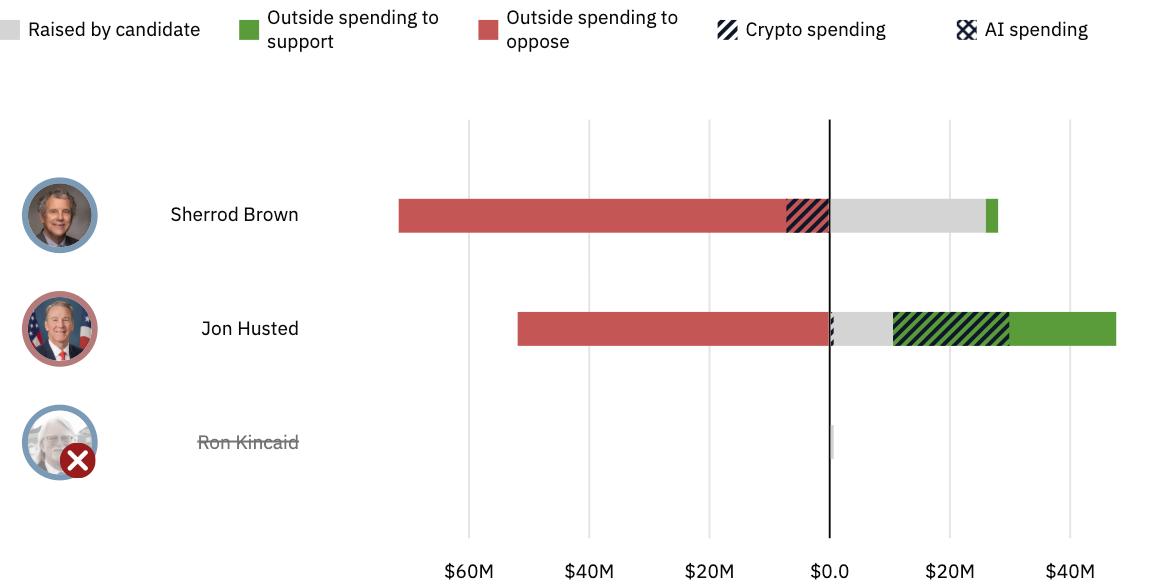
These PACs have much more spending planned; AdImpact reports that the SLF has reserved $54 million in ads for Ohio alone.34 The race has been the most expensive so far this year, with nearly $200 million in ad spending across both sides.35
Outside the US
The crypto industry's efforts to buy politicians are metastasizing. Some ten-figure donations from crypto billionaires to Reform UK’s Nigel Farage caused outcry in British politics in late 2024 and throughout 2025, as he accepted around £17 million ($22.4 million) across several contributions from Tether-linked British–Thai citizen Christopher Harborne [I98, 102, 105]. The contributions prompted discussion among the UK government over whether to ban large political contributions from British citizens who live overseas.
That conversation has been renewed as the Reform party has accepted contributions amounting to £72 million ($97 million) — half from Harborne, and the other half from BitMEX founder Ben Delo.36 Delo and other BitMEX cofounders were charged in the US in 2020 for violations of anti-money laundering laws; Delo ultimately was sentenced to probation and paid a $10 million fine. In 2025, Delo and the other BitMEX cofounders were pardoned by President Trump [I81].
“If you don’t pay taxes, if you don’t live here, you can’t buy your way into our democracy because you’re a billionaire,” said Housing Secretary Angela Rayner in an interview arguing for the Labour Party’s planned legislation. I would argue that even if billionaires do pay taxes and live somewhere, they shouldn’t be able to buy their way into democracy, but I suppose it’s a start.37
The Web3 is Going Just Great recap
There were eight entries between September 1 and 30. $416.52 million was added to the grift counter.
- Magic Eden users lose NFTs and $1.8 million in wETH to legacy approvals exploit [link]
- Meter token prices crash after unauthorized mint [link]
- Payy Network bridge fully drained of $1.8 million [link]
- Duelbits crypto casino goes offline after $7 million theft [link]
- Bitget crypto exchange hacked for $388 million, pauses withdrawals [link]
- Projects on the defunct Neutron chain lose $1.8 million to governance attack, Cosmos Hub halts chain [link]
- Single attacker steals $2.25 million from three crypto projects in the “Artificial Superintelligence Alliance” [link]
- 4,000 BTC (~$320 million) stolen from Liquid Network by claimed whitehats, 90% returned [link]
In the news
I joined Gil Duran on his Nerd Reich podcast to discuss the cryptocurrency and artificial intelligence industries’ massive campaign finance blitz, as well as their enrichment of the President, and what they’re hoping to get in return.
I helped The Washington Sun with an investigation into a change in the vesting schedule for Trump, his family members, and other insiders who hold substantial quantities of World Liberty Financial tokens.
That's all for now, folks. Until next time,
– Molly White
Have information? Send tips (no PR) to molly0xfff.07 on Signal or molly@mollywhite.net (PGP).
I have disclosures for my work and writing pertaining to cryptocurrencies.
References
"Crypto industry gave $8 million to Clarity Act lobbyists who didn't close the deal", CoinDesk. ↩
“Republicans pour cold water on Democratic crypto bill counteroffer”, Politico. ↩
“How months of work on the Clarity Act all fell apart”, CoinDesk. ↩
“Gillibrand privately urges Dems to advance crypto bill, September 14, 2026. ↩
“Democrats killed the Clarity Act”, CoinDesk. ↩
“Lummis Statement on Democrats Killing Clarity Act”, Senator Cynthia Lummis. ↩
"Democrats cope with crypto’s Ohio blitz", Punchbowl News. ↩
"Crypto Blew Its Big Moment—and the Blame Game Has Begun", The Wall Street Journal. ↩
Pending EO 12866 Regulatory Review, Reginfo.gov. ↩
Order Granting Temporary Conditional Exemptive Relief, SEC.gov. ↩
Regulation ATS—Alternative Trading Systems, Code of Federal Regulations. ↩
"SEC’s Innovation Exemption Imperils Investors", Better Markets. ↩
"Subject: File No. 4-927", SEC.gov. ↩
“Sam Bankman-Fried Asks Supreme Court to Review Fraud Conviction”, The New York Times. ↩
"Caroline Ellison has joined Manifund", The Fox Says. ↩
"The effective altruists who won’t return FTX money just hired Sam Bankman-Fried’s ex", The San Francisco Standard. ↩
Stipulation of voluntary dismissal filed on September 22, 2026. Document #38 in Binance v. Dow Jones. ↩
"DOJ Probing Binance Over Potential Iran Sanctions Violations", Bloomberg. ↩
"Donald Trump Jr.’s Firm Leads $1 Billion Funding Round for Polymarket", New York Times. ↩
"Donald Trump Jr.’s Investment Firm Posts Staggering Returns of 200%", New York Times. ↩
KalshiEX, LLC v. Flaherty, 3d Cir. 2026. ↩
KalshiEX, LLC v. Assad, 9th Cir. 2026. ↩
KalshiEX, LLC v. Orgel, 6th Cir. 2026. ↩
"Enforcement update: Kalshi continues crackdown on political insider trading", Kalshi. ↩
"Kalshi bans former congressman George Santos for life after State of the Union trades", NPR. ↩
“Kalshi suspends GOP House candidate in North Carolina for betting on own race”, The Hill. ↩
"Financial regulator investigates Adam Kinzinger over Kalshi trading", Politico. ↩
"Stand With Crypto: Senate’s Failure to Advance CLARITY Act Leaves Millions of Americans in Limbo", Stand With Crypto. ↩
"Crypto weighs revenge against Democrats — and the risks that come with it", Politico. ↩
Opening statement by Chairman Sherrod Brown, Examining the President’s Working Group on Financial Markets Report on Stablecoins, February 15, 2022. ↩
“Meet the Press - December 18, 2022”, NBC News. ↩
“The Crypto Industry Aims to Crush One of Democrats’ Top Senate Candidates”, The New York Times. ↩
Updated Political Projections Report 2025–2026, AdImpact. ↩
“Ohio Senate race leads in midterm ad spending at nearly $200 million”, The Washington Post. ↩
“Labour Signals Action Against Farage’s Crypto Donation Surge”, Bloomberg. ↩
"Labour Signals Action Against Farage’s Crypto Donation Surge", Bloomberg. ↩
Read more
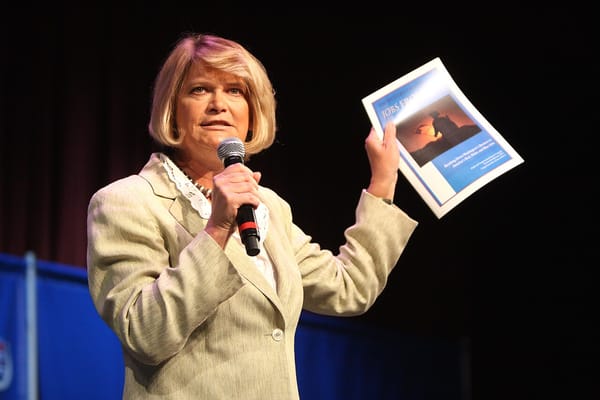
The Senate must reject the Clarity Act’s ethics charade
The supposedly “unprecedented” ethics restrictions exempt Trump’s crypto businesses and leave enforcement to his loyalists
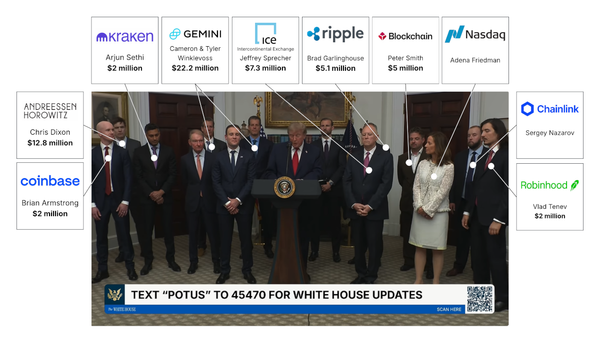
Issue 109 – Reg Crypto
The SEC’s “Reg Crypto” aims to carve out exemptions, the CFTC wields emergency powers to shield prediction markets from state regulators, and a Trump family crypto firm gets a bank charter

Issue 108 – In a word, applesauce
Firms close up shop amid a continued crypto winter, a Trump venture ditches its crypto plans, and the Clarity Act fails to reach a vote before August recess
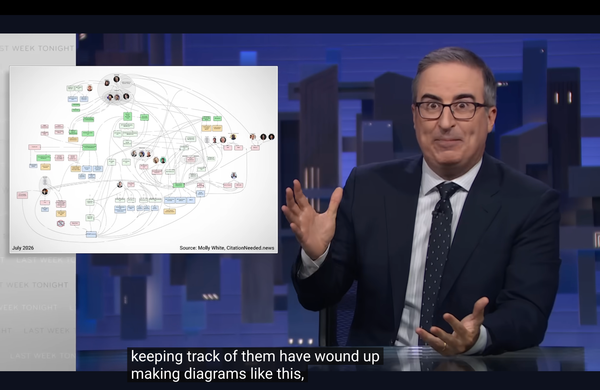
Mapping Trump’s crypto empire on Last Week Tonight
A new Citation Needed data project maps the Trump family’s web of cryptocurrency ventures, which have been generating billions in income for the president.