Issue 101 – Bought and paid for
Bitcoin is down 50%, several prominent industry figures have been uncovered in the Epstein files, Trump’s facing a probe into his family’s $500M deal with the UAE, and crypto super PACs spend their first $6 million in the midterms.


Bitcoin’s slide to its lowest price in more than a year — down 50% from its October highs — has fueled growing concerns that the market has entered another “crypto winter”. Traders are searching for someone to blame, and some have landed on Binance, whose October 10 liquidation catastrophe [Meltdown] coincided with — or caused — crypto’s downturn.
And those traders are not limited to obscure social media conspiracy theorists: Ark Invest CEO Cathie Wood and OKX founder Star Xu have both suggested Binance played a role in bitcoin’s recent weakness. Salman Banaei, a former SEC and CFTC staffer who now works as general counsel to a crypto firm, has suggested that regulators should open an investigation into the October flash crash. Binance and its former CEO Changpeng Zhao deny any responsibility for the downturn. Zhao has suggested the accusations come from traders who simply want Binance to repay their trading losses.1a
Regardless of its cause, fallout from the crash is beginning to surface. As I’ve mentioned repeatedly, there’s often a delay between a crypto price crash and visible evidence of damage, as companies spend weeks or months floundering before they can no longer keep their struggles out of the public eye. In November 2022, after FTX’s collapse, I wrote: “Right now I think a lot of people following the crypto industry are holding their breath, watching closely as other major dominoes wobble perilously” [I11].
Similar wobbling is happening now. The Gemini crypto exchange has just laid off 25% of its workforce, ditched at least three C-level executives, and announced an exit from the UK, EU, and Australia [W3IGG]. As CEOs are wont to do these days,2 the Winklevosses have tried to spin the layoffs as a good omen for a company embracing AI. But financial analyst Matthew Coad explained, “The biggest issue here is that Gemini’s management team placed a big bet on the crypto bull market run continuing through 2027 and instead crypto asset prices have cratered.”3 I can’t believe it! The “number go up, forever” business model has never failed us before. [Technoligarchy]
BlockFills, a Susquehanna- and CME Ventures-backed crypto lender, halted withdrawals on February 11, in a move that sparked flashbacks of the wave of withdrawal limits or halts that came as companies tried to halt their freefall in 2022 [W3IGG]. Sources at the company later revealed the firm had suffered $75 million in losses on their loans as crypto prices dropped, and co-founder and CEO Nicholas Hammer abruptly resigned.4 The firm is now reportedly looking for a buyer.5
Meanwhile, crypto is reeling from the latest wave of Epstein files disclosures, which show numerous crypto figures corresponding with the late child sex offender. Tether co-founder Brock Pierce was already known to have communicated with Epstein, though a Pierce spokesperson had previously downplayed their relationship as merely a “few communications ... related to cryptocurrency”.6 New emails show extensive correspondence with Pierce, who at one point thanked Epstein for “a great time with the girls” after a meeting in which Epstein had instructed Pierce to “leave your girlfriend home”.
![From: Brock Pierce <[redacted]> To: jeffrey epstein <jeevacation@gmail.com> Subject: Re: Date: Sat, 03 Mar 2012 19:26:37 +0000 I had a great time with the girls. Hope they had fun too. Thanks. Best regards, Brock [redacted] P.S. Please excuse any typos as this email has been sent from my mobile phone. On Mar 2, 2012 3:26 PM, "Jeffrey epstein" <jeevacation@gmail.com> wrote: Call mec212 5333739 Sony for all the typos .Sent from my iPhone On Mar 2, 2012, at 6:06 PM, Brock Pierce <[redacted]> wrote: Will do. Broke up with the GF last night so that wont be a problem. Best regards, Brock [redacted] P.S. Please excuse any typos as this email has been sent from my mobile phone. On Mar 2, 2012 2:32 PM, "Jeffrey Epstein" <jeevacation@gmail.com> wrote: [redacted] and [redacted] are alone in la , I had to leave.. please assist. leave your girlfriend home [redacted]](https://www.citationneeded.news/content/images/2026/02/Screenshot-2026-02-26-at-11.15.11---AM.png)
At one point, after Pierce fails to meet with someone Epstein refers to as “my new russian”, Pierce offers to introduce Epstein to a “girl in NY you may like”.7 Epstein also corresponds with a former assistant of his who had a romantic relationship with Pierce.b At one point in 2018, Pierce mentions that he’s “ready to marry [her] though I’ll have two wives. Going to attempt to thread that needle over the next few days with [wife]”.8 Epstein also discussed the marriage prospect with the woman, with Epstein seemingly excited to have access to a close confidante of Pierce’s.9 The woman ultimately declined Pierce’s proposal, though she suggested she might be open to it if it was the only option to procure her a visa. The relationship later ended.
Pierce and Epstein also talked business, with Pierce introducing Epstein to an opportunity to invest in the then nascent Coinbase cryptocurrency exchange. Epstein later invested $3 million into Coinbase’s series C, and the emails show that Coinbase co-founder Fred Ehrsam was aware that the investment was coming from Epstein — even years after Epstein had pleaded guilty to sexually abusing a minor.10 (Ehrsam left Coinbase in 2017 but remains its Board Director; he founded the Paradigm crypto venture fund in 2018.)
Epstein also corresponded with Adam Back, a bitcoiner so early on the scene that he once emailed directly with Satoshi Nakamoto. Back is the co-founder and CEO of the Blockstream crypto firm, and Epstein invested in Blockstream in 2014 via a fund associated with Joi Ito. Other emails show that Back and his co-founder Austin Hill likely visited Epstein’s island. Following the publication of these emails, Back downplayed Epstein’s investment and claimed that Ito’s fund divested its shares “a few months later... due to a potential conflict of interest, and other concerns.”11
Other crypto figures are mentioned in the emails, though no evidence has emerged that they corresponded directly. On April 22, 2014, Epstein received an email with the subject line “new plan” from a redacted sender, containing simply the name “Tyler Winklevoss”.12 Days later, Epstein emailed Joi Ito, “do you know the winklevoss boys?”13 Ito replied to say he did not. On June 5, Epstein emailed Pierce to ask, “do you know the winklevoss’s? i don’t”. Pierce responded, “Yes. How can I help?” Epstein replied, “I’d like to send [redacted] to them to get a download of what they were doing in the space, I prefer not to go through the silicon valley gossip mafia”.14
MicroStrategy’s Michael Saylor is mentioned several times, and although he’s not among Epstein’s penpals, he still comes out of this looking bad. Multiple emails describe him as oblivious, clumsily attempting to buy influence. In an email exchange describing Saylor as “the guy ... with the 160 foot Fed Ship”,c Hollywood publicist Peggy Siegel writes, “I think David Reuben might be a better boat owner (242)...he seems like a more stable new friend.”15 Shortly after Siegel met Saylor, she wrote in another email to Epstein:16
Jaqui Safra gave us $10,000 worth of wine from his own Napa Valley vineyard...kids drinking $100 bottles of wine...and Michael Saylor giving $25,000 for food and the opportunity to get his name on invite and meet a hip group. Saylor is a complete creep. He has no personality. Sort of like a zombie on a drug. We had smart directors sitting next to him and his idiot gorgeous date and could not get any conversation out of him except “I have a yacht I am taking to Cannes”. I walked him around and he was so weird that even I ran away from him. There is an obvious personal disconnect and I don’t think I can just take his money and deliver a better life because he has no feel for social behavior.
Last recap issue, to celebrate publishing my 100th recap issue and nearing 200 issues of Citation Needed overall, I announced a membership drive with a goal of signing up 50 new paid subscribers by issue 200. I’m delighted to say that not only did I blow through that goal within about a day of announcing it, but I’ve since more than doubled it.
Your support means so much to me, and it’s what allows me to spend my time researching, writing, and building auxiliary projects like Follow the Crypto. Even though the drive has more than met its goal, every subscription helps me to keep doing this work.
In the courts
SBF
Still apparently believing his lawyers were merely an impediment to his own winning legal strategy — one that included his disastrous decision to testify in his own defense — Sam Bankman-Fried has filed a pro se motion for a new trial. The filing came via his mother, Barbara Fried — though she was careful to note that Bankman-Fried would be representing himself, and that she was submitting the filing on his behalf simply because he is in jail.17d Bankman-Fried seems to be trying to exhaust all possible options: the motion comes as he waits for a decision on his appeal before the Second Circuit [I96], and he is continuing to fawn over Trump on Twitter in an extremely unsubtle bid for a pardon [I95].
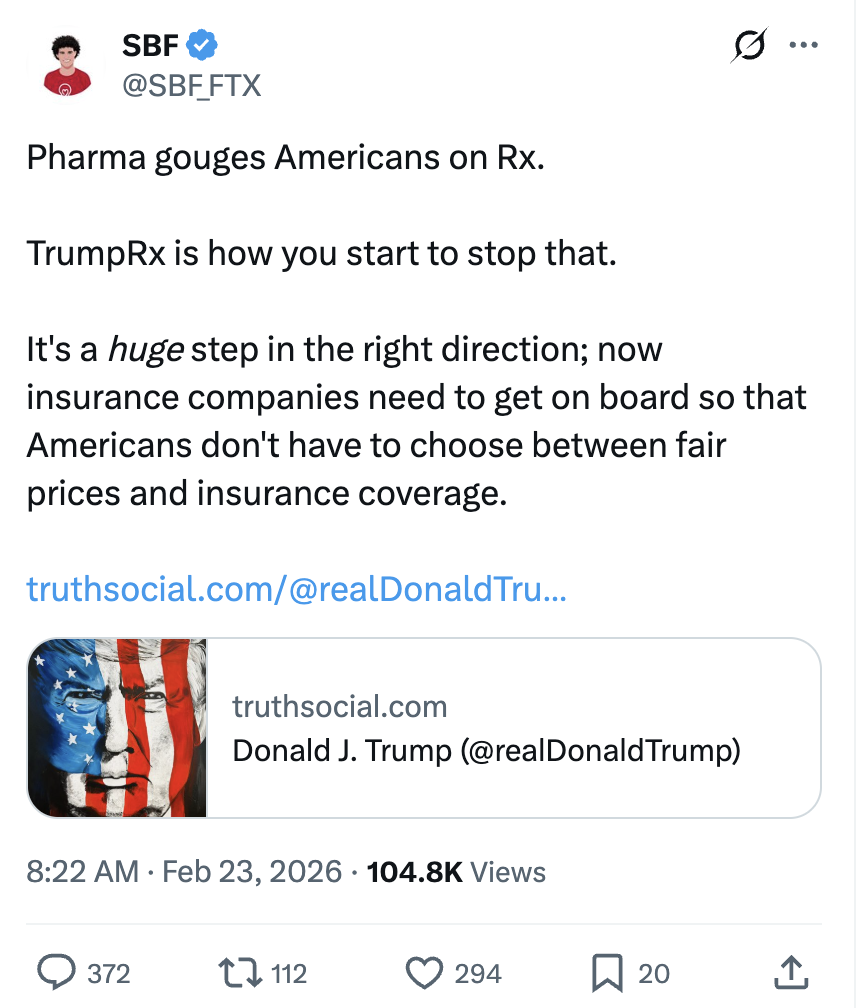
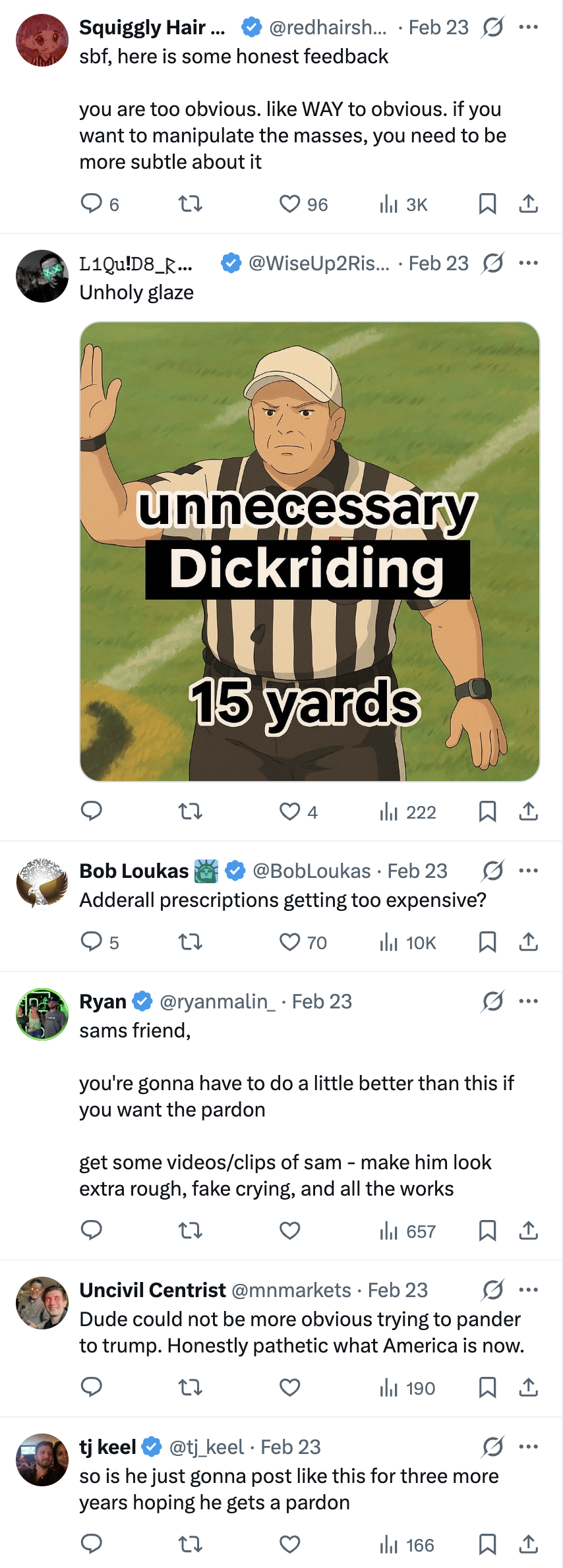
A recent SBF tweet, which was mostly met with criticism for SBF’s blatant pandering for a pardon
In January, Trump told the New York Times he had no intention of pardoning Bankman-Fried, and spokespeople for the White House have recently reiterated that position.18
Jane Street
The administrator overseeing the wind-down of Do Kwon’s Terraform Labs has filed a lawsuit against Jane Street, a major American quantitative trading firm.e The heavily redacted complaintf alleges that Jane Street exploited insider information about Terraform Labs’ operations — obtained via Bryce Pratt, an employee who’d previously interned at TFL and maintained close relationships with former coworkers — both unlawfully profiting from it and accelerating the May 2022 collapse of the Terra (UST) stablecoin ecosystem. The complaint portrays Pratt’s activities as explicitly directed by Jane Street leadership, alleging that “Jane Street deployed Bryce Pratt to establish lines of communication with his former colleagues at Terraform”.
After landing a systems engineer role at Jane Street, the former Terraform Labs software development intern stayed in contact with his TFL co-workers, including a software developer and the Head of Research. In a group chat named “Bryce’s Secret”, the three allegedly discussed a “certain trading company” that might be interested in investing in TFL. The TFL software engineer soon made it explicit: “bro we all know who the buyer is. its where u work”.
Once Pratt made more formal introductions between TFL and Jane Street higher-ups, he allegedly continued to use his insider knowledge and connections to give Jane Street an advantage. When TFL migrated to a new liquidity pool for UST, Jane Street allegedly exploited insider access to timing details to make a significant trade — causing a steep sell-off that contributed to UST’s May 2022 depeg. The complaint alleges Jane Street also used its access to dodge the fallout from the subsequent collapse: “Its abuse of material non-public information from insider [redacted] allowed Jane Street to unwind hundreds of millions of dollars in potential exposure at precisely the right time, mere hours before the Terraform ecosystem collapsed.” Jane Street then allegedly continued trading on inside information to profit even as Terra was in freefall.1920
Kevin O’Leary and Ben “BitBoy” Armstrong
Kevin O’Leary has won a $2.828 million default judgment in his defamation lawsuit against the crypto influencer Ben Armstrong, known online as “BitBoy Crypto” [I80].21 The suit was originally filed in March 2025, after BitBoy repeatedly accused O’Leary of being a “murderer” — referring to a 2019 boating accident involving O’Leary and his wife in which two other boaters were killed. BitBoy has been going through something of a slow-motion meltdown since at least 2023 [I40], which I’ve only briefly covered when he’s been arrested or wound up in court because it’s been evident for quite some time that he’s dealing with serious mental health issues. That’s supported in a belated filing to set aside the default judgment, which came from BitBoy’s uncle, and which states that BitBoy has been diagnosed with bipolar disorder, narcissistic personality disorder, disassociative identity disorder, Cotard’s syndrome,g and Capgras delusion.h22 Because BitBoy and his uncle missed numerous court deadlines and failed to respond to court orders or appear for hearings, the motion to set aside the judgment was denied.
Everything else
Braden Karony, the CEO of the SafeMoon pump-and-dump scheme, has been sentenced to eight years in prison [I43, 83, 85].
Rui-Siang Lin, the operator of the Incognito Market dark web drug marketplace, has been sentenced to 20 years in prison. Besides the drug crimes, Lin also stole at least $1 million in user deposits from Incognito Markets’ internal payments system and tried to extort both vendors and buyers for more by threatening to publish their transaction histories [W3IGG, I59].
In Congress
The Clarity Act cryptocurrency market structure bill is still stalled out in the Senate after Coinbase blocked it in mid-January. The decision earned mixed reactions from all sides: At Davos in January, banker Jamie Dimon pointed at Armstrong and declared “you are full of shit,” accusing him of lying in statements that blamed banks for sabotaging the legislation.23 Other companies in the crypto sector have urged for the bill to move forward, fearful that Coinbase’s unilateral objection could kill what they see as a general improvement to the status quo. And Treasury Secretary Scott Bessent has complained that “There seems to be a nihilist group in the industry who prefers no regulation over this very good regulation,” adding that those in the crypto industry who disapprove of it “should move to El Salvador.”24 You’re telling me there are people in the crypto industry who would prefer no regulation over regulation? Say it isn’t so.
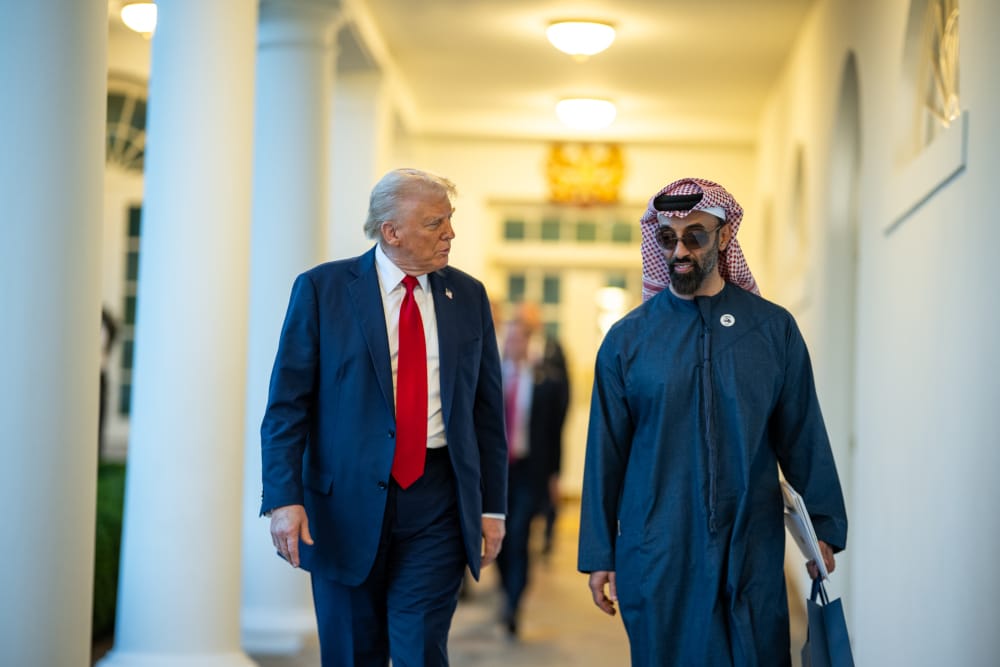
Simultaneously, letters and public statements have been flying out of both branches of Congress over various Trump corruption concerns. On January 31, the Wall Street Journal reported that the UAE’s “spy sheikh” Tahnoon bin Zayed Al Nahyan had paid $500 million to acquire a 49% stake in World Liberty Financial, the cryptocurrency company run by family members of both Trump and Special Envoy to the Middle East Steve Witkoff. After several months and multiple meetings involving Trump, Witkoff, and others, the White House approved a deal to grant the UAE access to sensitive AI chips.25 Congresspeople had already sounded the alarm over the apparent quid pro quo even before the $500 million deal was known, due to UAE enrichment of Trump through their selection of the Trump family’s stablecoin in a Binance investment that will ultimately leave more than $150 million in interest with Trump entities [I93, 94, 97]. The new details have sparked even more outcry, with Senator Murphy (D-CT) describing the deal as having the “elements of a bribe” and “potentially criminal”.26 On February 4, Representative Ro Khanna (D-CA) announced an investigation into the deal in his capacity as Ranking Member of the House Select Committee on the CCP.i President Trump has claimed no knowledge of the WLF deal, stating at a press conference: “I don’t know about it ... My sons are handling that. My family is handling it.”30
Senator Chris Murphy (D-CT) denouncing the Trump–UAE deal
Senator Blumenthal (D-CT) has opened an investigation into Binance as the Ranking Member of the Homeland Security Committee’s Subcommittee on Investigations. This followed reporting from the New York Times alleging that Binance’s own internal investigators uncovered more than 1,500 accounts on the platform that had been accessed from Iran, and around $1.7 billion in transactions from two Binance accounts to Iran-linked entities, including an account belonging to an Iranian military group.27 A separate Wall Street Journal report said the investigators had also discovered another $500 million that had gone to the Iranian entities.28 Reports from the New York Times,27 Fortune,29 and the Wall Street Journal28 then found that Binance had fired the investigators who uncovered the transactions, leaving the accounts untouched.
Binance has insisted that the reports are false, claiming their internal review found no evidence of sanctions violations and that the investigators left of their own volition. CEO Richard Teng even took to Twitter to publish a letter sent on Binance’s behalf to the Journal by attorney and “reputation and crisis manager” Amber Melville-Brown, demanding the Journal retract the article. Unfortunately for Binance, its years-long pattern of dismissing even mild criticism as “FUD” [I44] has eroded the credibility of such denials — particularly given that some of those dismissals have been followed by evidence proving the original reports true.
After Comptroller Jonathan Gould refused Senator Warren’s request to delay the review of World Liberty Financial’s application for a national trust bank charter, 41 House Democrats have sent their own letter to Treasury Secretary Scott Bessent about the issue, with questions about potential foreign influence on the US banking system, as well as the degree to which the White House influences OCC decisionmaking. While the letter included signatures from the expected crypto-skeptical lawmakers like Brad Sherman (CA) and Stephen Lynch (MA), it was also notably signed by some of the industry’s biggest Democratic allies in the House, like Ritchie Torres (NY) and Sam Liccardo (CA).31
Bessent also received a letter from Senator Warren, which followed up on Bessent’s responses to a line of questioning at a House Financial Services Committee hearing about the possibility that he might direct banks to bail out bitcoin.32 While he was clear at the hearing that he didn’t have the authority to do that — either as Treasury Secretary or as the Chair of the Financial Stability Oversight Council — Warren was looking for written confirmation. She also accused Bessent of dodging a question about whether “the money of our taxpayers… is… going to be deployed into crypto assets”, writing that “rather than giving a simple ‘no,’ he deflected, stating that ‘[w]e are retaining seized bitcoin.’”33 (While the President’s March 2025 executive order establishing a “strategic bitcoin reserve” does instruct the government to stockpile rather than sell seized bitcoin, it also states that efforts to acquire additional bitcoin for the stockpile must be “budget neutral and ... not impose incremental costs on United States taxpayers.” [Crypto reserves] Why Bessent invoked the reserve is unclear to me, unless he thinks Congress is worried about seizing assets from taxpaying criminals.)
In regulators
SEC
The House Committee on Financial Services held an “Oversight of the Securities and Exchange Commission” hearing with SEC Chairman Paul Atkins.34 Republicans were fairly quiet on the topic of crypto, save for a few who used the opportunity to bash former Chairman Gary Gensler, who has not been a part of the SEC for more than a year. Democrats were much more pointed, asking questions about the agency’s decision to drop more than 60% of cases involving the crypto sector, and about corruption involving Trump and his companies.
Atkins was extremely evasive, at one point claiming to have merely “heard the name” of the president’s Trump Media & Technology Group when answering questions from Representative Al Green (D-TX). This seems implausible given that he has received a letter from Senator Warren specifically regarding the company,35 the SEC is actively considering applications from the company,36 and the company demanded the SEC open an investigation into alleged naked short selling of their stock right as Atkins was joining the Commission.37
When asked about the long list of paused or dropped crypto enforcement cases, Atkins refused to answer questions pertaining to “ongoing investigations” — even though several have formally concluded. Representative Rashida Tlaib (D-MI) remarked:
Crypto intervened in dozens of elections across our nation, spending more than banks and oil companies. Experts have called it “one of the most aggressive corporate spending sprees in modern political history.” Fast forward to today, Mr. Chair, and the SEC has dismissed or stayed enforcement actions against major crypto-related donors or supporters of President Trump such as Coinbase, Kraken, Binance, Justin Sun. The Commission has seen a significant reduction in staffing, with perhaps one in five staffers leaving. Whistleblower awards are down dramatically and policies are issued without allowing public comment. Do you see what I’m saying here? And the SEC has basically stopped its enforcement efforts in favor of regulation by the CFTC, which has far fewer resources and staff. So my residents are asking: is this a coincidence? I don’t think so. And, Mr. Chairman, out of all due respect, I hope you understand the incredible importance of your position because it looks to me like cryptocurrency is getting a tremendous return in its political investments. I can’t fault anyone who thinks your agency is bought and paid for.
Representative Rashida Tlaib’s questioning of SEC Chair Paul Atkins
Ranking Member of the Digital Assets Subcommittee Stephen Lynch (D-MA) seemed to try to appeal to Atkins’ fondness for the crypto sector, saying: “Look, this is hurting the crypto industry, all these scams. I mean, look at crypto today, I think it’s down 25% in the last month. People are losing trust in that. This is not good for crypto. It’s certainly not good for consumers. And it’s awful, the reputational damage that the SEC is suffering right now is unbelievable.”
Representative Stephen Lynch’s questioning of SEC Chair Paul Atkins
CFTC
The CFTC is staking its claim on regulating prediction markets by submitting an amicus brief in Crypto.com v. Nevada, and threatening state gaming regulators who have been trying to fill the regulatory void that the CFTC will “see [them] in court”. Newly installed CFTC Chairman Mike Selig posted a video to Twitter about how prediction markets “have been hit with an onslaught of state-led litigation”. He waxed poetic about how said markets “provide useful functions for society by allowing everyday Americans to hedge commercial risks like increases in temperature and energy price spikes,” and adding that they also “serve as an important check on our news media and our information streams.”38
Selig conveniently omits that the vast majority of activity on these prediction markets is sports gambling, not commercial hedging. He also appears to have invented a novel role for the CFTC as guardian of America’s media ecosystem — a function notably absent from the agency’s statutory mandate.
Since the CFTC has filed no enforcement actions against prediction markets after embracing the sector following Trump’s election, Selig’s jurisdictional claim seems designed to shield the sector rather than regulate it.
And as Selig is declaring exclusive jurisdiction over a rapidly expanding sector, the agency’s enforcement ability is dwindling as staff resign en masse. Earlier this month, Barron’s reported that the last person on the once twenty-person team of top enforcement attorneys and investigators at the CFTC’s flagship Chicago office has resigned. Much of the Chicago office’s decimation occurred under Selig’s predecessor, Acting Chair Caroline Pham, who “undertook a sweeping reorganization of the enforcement division and closed about half of its open cases — sometimes without consulting the teams involved.”39 When Selig was confirmed by the Senate, Pham resigned and, days later, announced she would be joining the crypto firm and frequent Trump business partner MoonPay [I99].
OCC
The Office of the Comptroller of the Currency has started approving the slew of applications for national trust bank charters from the crypto sector, beginning with Erebor, a bank backed by Peter Thiel, Joe Lonsdale, Palmer Luckey, and Andreessen Horowitz. Startlingly, Erebor seeks to “fill the gap left by Silicon Valley Bank” — the tech startup-focused bank that failed in March 2023. In an interview with the Wall Street Journal, Luckey seemed to trying to set low expectations for the quality of Erebor’s banking services: “You can think of us like a farmers’ bank for tech. I think most farmers’ banks won’t claim that they’re the best bankers in the world, but they do understand farmers.”40
Circle, Ripple, Paxos, Stripe’s Bridge, and Crypto.com have received conditional approval for their charter applications. Coinbase and President Trump’s own World Liberty Financial also have applications open.
Trump business interests
On February 18, World Liberty Financial hosted a “World Liberty Forum” at Mar-a-Lago. Binance founder Changpeng Zhao attended, in his first US appearance since his October pardon [I95]. Attendees included crypto executives from Coinbase and BitGo; leaders of tradfi giants Goldman Sachs, Franklin Templeton, the Nasdaq, and the New York Stock Exchange; as well as a smattering of celebrities from FIFA president Gianni Infantino to rapper Nicki Minaj (who seemed a little confused about why she’d been invited, stating onstage that she “can like” crypto and then going on to talk about her stick-on nail brand). While ostensibly separate from presidential business, the conference drew Senators Ashley Moody (R-FL) and Bernie Moreno (R-OH), as well as cabinet member Kelly Loeffler and CFTC Chair Michael Selig, and cryptocurrency legislation was a recurring topic of conversation.414243
Several days later, World Liberty Financial’s USD1 stablecoin briefly lost its peg during a sudden sell-off, dropping to around $0.99.j Around the same time, posts about the company and its stablecoin vanished from Eric Trump’s Twitter account. WLF quickly put out a tweet that there was a “coordinated attack... against USD1 this morning. Attackers hacked several WLFI cofounder accounts, paid influencers to spread FUD, and opened massive $WLFI shorts to profit from the manufactured chaos.”44 It’s difficult to fathom why hackers would compromise an account as high-profile as Eric Trump’s only to delete a handful of tweets, and the claim was broadly met with skepticism.
In prediction markets
As the CFTC runs interference for prediction markets in the courts, Kalshi has disclosed the results of two of its internal insider trading cases cleared from what the company has described as a “backlog” of insider trading cases.45 One involves a video editor working for YouTube star MrBeast, who used his early access to MrBeast’s content to profit from around $4,000 in wagers on markets involving what words MrBeast would say. The trader’s “near-perfect trading success on markets with low odds” raised red flags in Kalshi’s monitoring systems, and the editor was fined more than $20,000 and suspended from Kalshi for two years.46
The second case involved Kyle Langford, a neo-Nazi47 who was briefly a candidate in the California gubernatorial race before withdrawing and entering the race for California’s District 26. His case probably didn’t require much investigation, given Langford had in May 2025 tweeted a screencap of himself placing a roughly $100 Kalshi wager on himself being elected governor of California. He was fined $2,246 for improperly profiting from a trade on a market where he was a “direct decision maker” — though he didn’t profit much, as $2,000 of the fine was a penalty. He was also banned from Kalshi for five years.4849
While the CFTC acknowledged Kalshi’s disciplinary actions,50 they showed no signs of opening their own investigations — either into the traders or into Kalshi itself. The CFTC has a responsibility to ensure Designated Contract Markets like Kalshi are sufficiently self-policing, yet the agency appears uninterested in how Kalshi developed a months-long backlog of suspicious behavior, or why it waited months after markets closed to take action.
Meanwhile, Kalshi and Polymarket have been running various marketing stunts. Both platforms have been giving away free groceries in New York City, and Polymarket announced plans to open “The Polymarket, New York’s First Free Grocery Store” — a five-day pop-up promotion.51
Kalshi has also been running TikTok ads featuring young women with captions like “POV: I was about to be unable to pay my rent, but I got two years of rent through Kalshi’s predictions. It’s amazing!” and “me because in 2026 i stopped working weekends and started predicting weather instead (making $280/week now vs $190 before)”.

This drew criticism from, of all people, the CEO of a crypto casino called “BetHog”.52 He compared Kalshi’s marketing to the trajectory of the vape company Juul, which pushed its products on “non smokers and particularly kids. (See the similarity?) The backlash took time to build but when it did it was devastating for the company.” He commented on how he’s worked in online gambling for more than 25 years, and:
This type of marketing is actually extremely rare in real money gaming. Firstly and most importantly it is rare because operators view it as highly unethical. It might surprise you that a lot of people in the gaming industry do actually care about things like underage and problem gambling. Secondly it is also rare because it doesn’t work. Do you think the teenagers in these ads are going to keep playing when they lose all their rent money?
In elections and political influence
In last week’s issue about the crypto industry’s war chest for the midterms, I wrote: “The pro-crypto super PACs have barely touched their accumulated cash so far.” The reports at the time had mostly only shown expenditures from last year, of around $3.2 million into various 2025 special elections. $42,000 from First Principles Digital to support Republican Mike Rogers’ Michigan Senate campaign marked the only spending from super PACs on upcoming races.
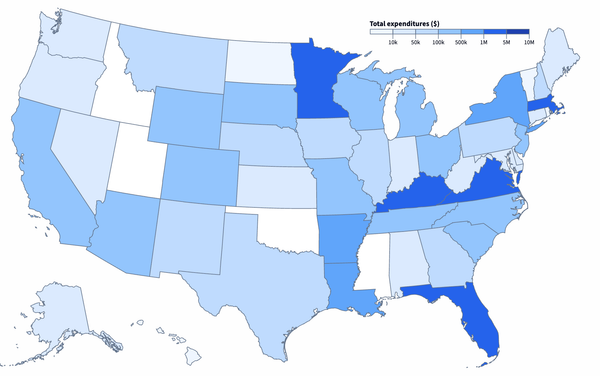
However, the Fairshake super PAC network (comprising Fairshake, Protect Progress, and Defend American Jobs) has since reported $6.2 million in expenditures, starting February 5. The largest single expense was just over $2 million in ads and direct mail to support Republican candidate for Alabama Senate and current Alabama Representative Barry Moore, who is looking to replace incumbent Tommy Tuberville. (Tuberville is not running for re-election, instead opting to run for Alabama governor.) This is reportedly just the beginning of a planned $5 million spend on advertisements highlighting Trump’s endorsement of Moore.53
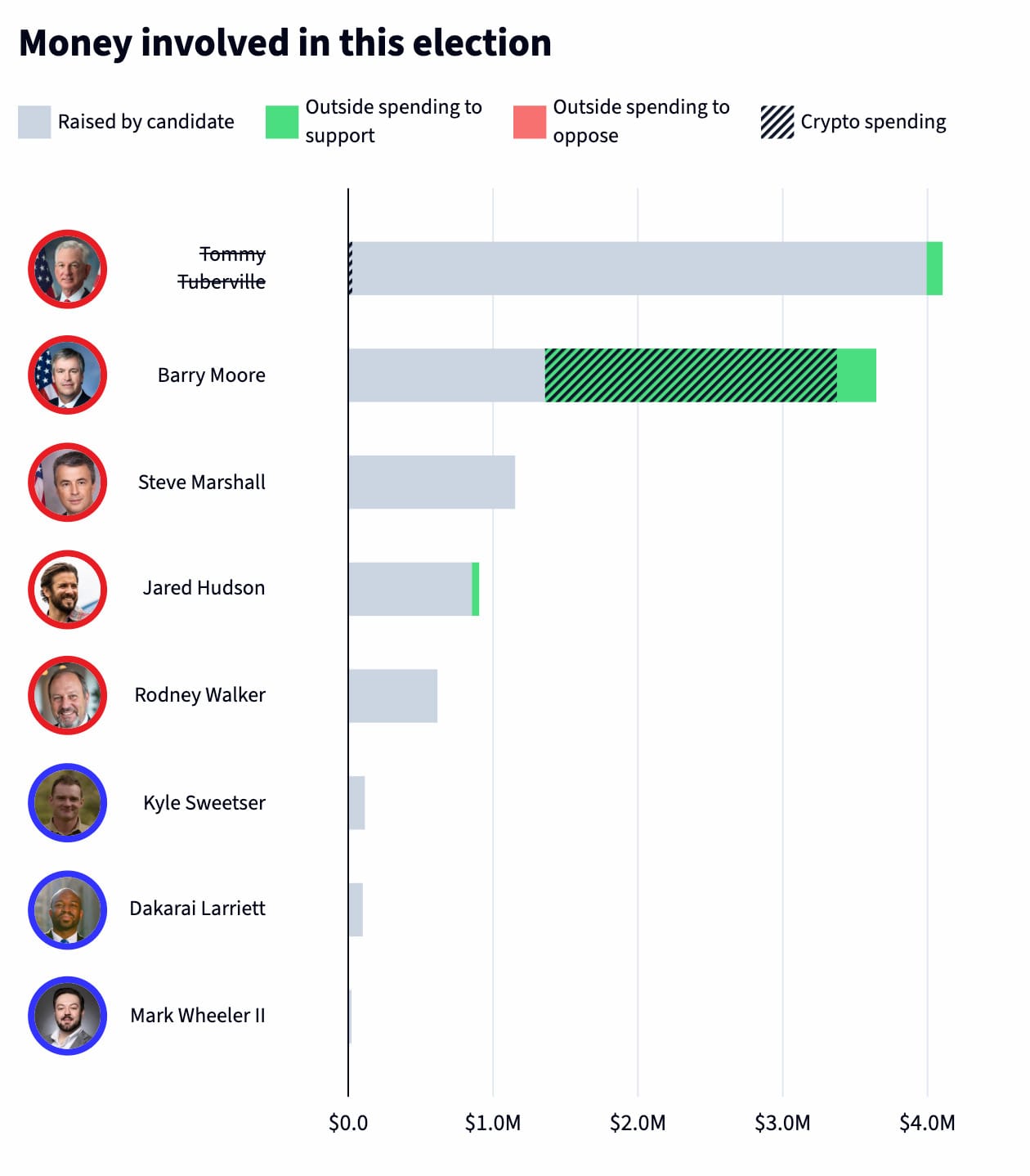
Moore has voted in favor of all crypto legislation that has come before the House during his tenure, and he was endorsed by Wyoming Senator Cynthia Lummis earlier this year. She was delighted that Moore is “one of the few members of Congress to personally own crypto assets.”54 Moore has held between $1,000 and $15,000 in bitcoin since his first filing in 2020,55 and added another $1,000–$15,000 in March 2024.56
The other Fairshake spending has mostly targeted races in states with March primaries, namely Texas, Illinois, Arkansas, and North Carolina.
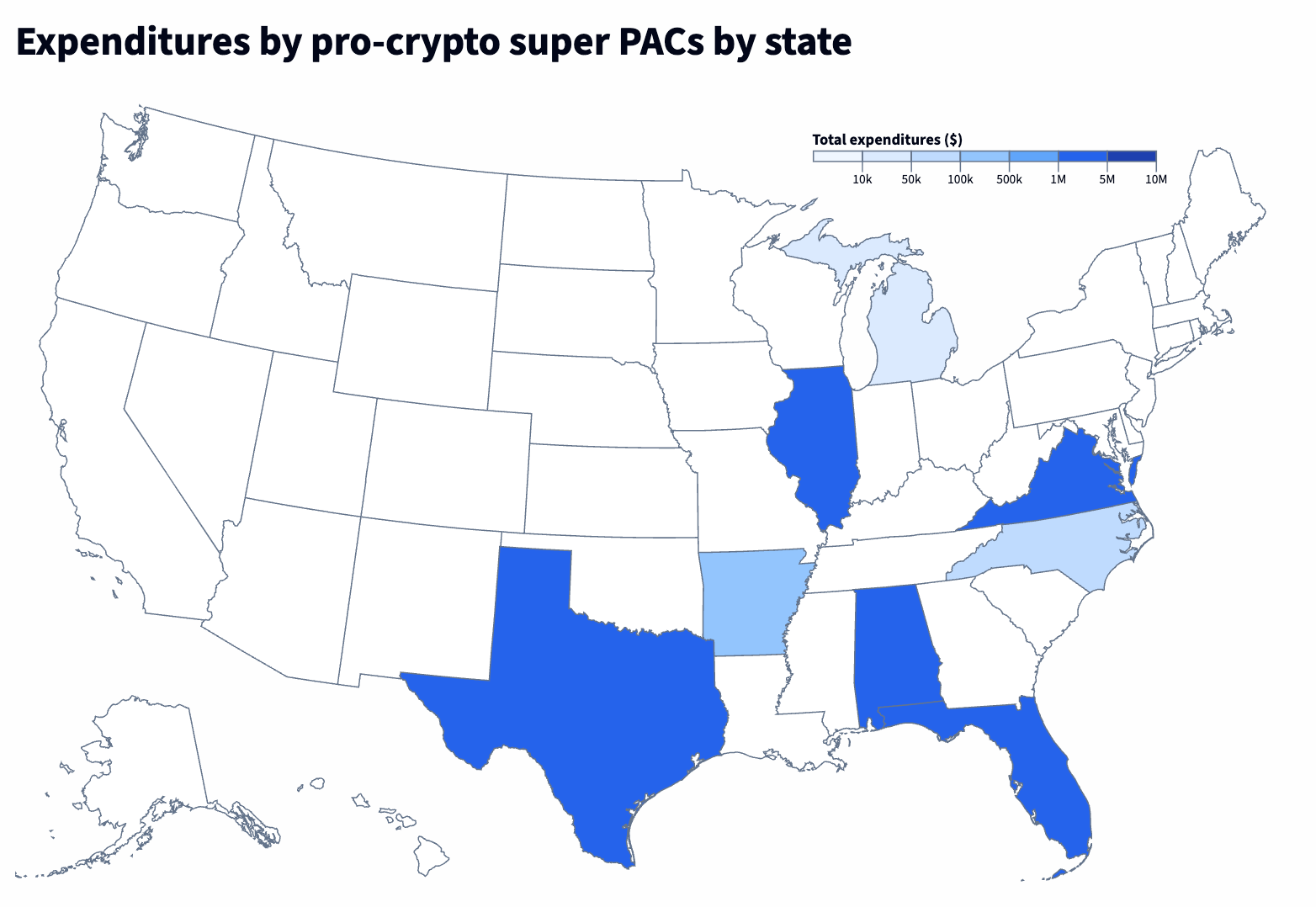
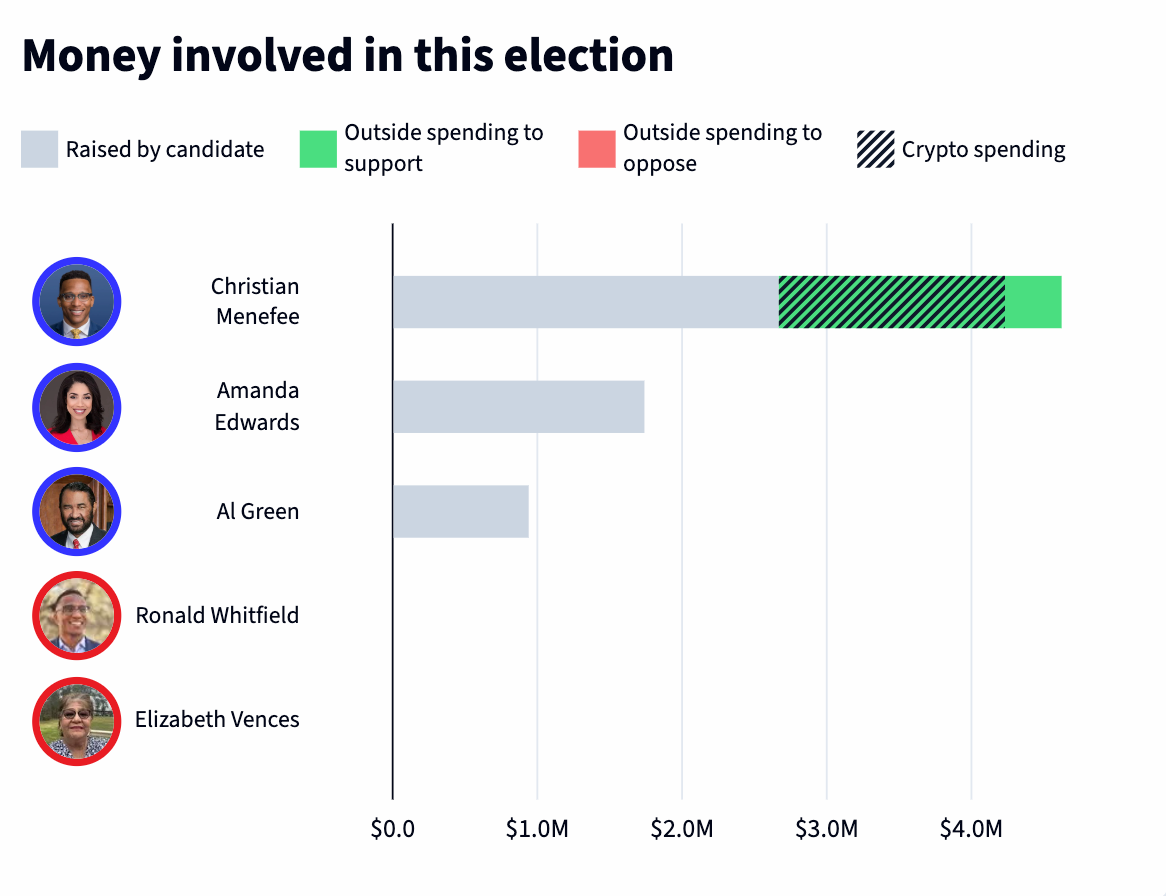
The PACs dropped more than $1.5 million in support behind Democrat Christian Menefee in Texas’ District 18 primary race against Al Green, the current representative for Texas’ redistricted 9th, who sits on the House Financial Services Committee. A spokesperson for Fairshake told the New York Times that Green is “actively hostile towards a growing Texas crypto community” and has “decided to try and stop American innovation in its tracks”.57 It probably doesn’t help that Green has been outspoken about Trump’s corruption, and demanded his impeachment. Menefee, on the other hand, has earned an “A” rating from Coinbase-linked advocacy group Stand With Crypto, seemingly solely based on responses to their questionnaire, where he wrote that “The federal government should set clear, fair rules that punish fraudsters and promote transparency, while leaving room for innovation. ... And we should make sure the next generation of blockchain innovation is built in America.”58 His website also holds nods to both blockchains and artificial intelligence, referencing Menefee’s history of “championing innovation”.59
Also in Texas, the Fairshake network has put $260,000 behind Republican Jessica Steinmann in District 8, $92,000 behind Chris Gober in District 10, and $142,000 behind Trever Nehls in District 22. Nehls has raised barely over $100,000 on his own, so that should be a nice help to him.
Fairshake also spent more than $1.5 million to oppose La Shawn Ford in his Democratic primary in Illinois’ 7th District — more than 3× the amount Ford has raised. The money went toward an ad campaign stating that Ford “was indicted on 17 counts. The verdict? Ford convicted on tax fraud.” The Illinois Wednesday Journal criticized the ad for “falsely imply[ing] that he was convicted of felonies related to bank fraud,” noting that the 17 charges against Ford were dropped and that Ford had pleaded guilty to a misdemeanor tax charge. Ford also spoke out against the spending, describing it as “blood money” motivated by his August 2025 vote in the Illinois House in favor of a bill creating the Digital Assets and Consumer Protection Act, which imposes regulatory requirements on cryptocurrency business in the state.60
In Illinois’ 2nd District, Fairshake spent $41,000 to oppose Democrat Robert Peters, who also supported the bill. Peters also has the endorsement of Senator Elizabeth Warren, whose support contributed to drawing more than $10 million in opposition spending from Fairshake against Katie Porter in 2024. A spokesperson for Peters issued a statement that “Super PACs funded by Trump-aligned billionaires are dumping millions of dollars into this race to try to buy this seat and subvert the will of the electorate. They’re all in for my opponent because he’s already shown that he can be bought—and I’ve made it clear that I can’t.”61 This is a nod to opponent Jesse Jackson, Jr.’s $1.1 million in backing from the Think Big pro-AI industry super PAC. Josh Vlasto is simultaneously one of the leaders of the pro-AI industry super PAC spending in support of Jackson, and the spokesperson for the Fairshake pro-crypto super PAC spending against Peters.
In Arkansas, the Fairshake network spent $384,000 to support longtime ally and Chair of the House Financial Services Committee French Hill, who is up for re-election in District 2. Besides the PAC spending, he’s received more than $500,000 in support from Coinbase, Andreessen Horowitz, the Winklevoss twins, and others. Finally, in North Carolina, the PACs spent $81,000 on Tim Moore’s race in the 14th District.
As crypto super PACs begin pouring their millions into federal races, Ripple founder Chris Larsen and bitcoin enthusiast Tim Draper are teaming up to fight California’s wealth tax by spending heavily electing moderates. Larsen has said he expects to spend $30 million on a “counterforce” to pro-labor legislators.62k
There’s a new 501(c)(4) dark money group on the list, with the announcement of the Hyperliquid Policy Center. The first goal on the group’s list is to “introduce lawmakers and regulators to Hyperliquid,” a decentralized crypto exchange launched in 2023. Thank goodness someone’s finally doing that.63
The Web3 is Going Just Great recap
There were ten entries between January 29 and February 25. $199.68 million was added to the grift counter.
- Step Finance, SolanaFloor, and Remora Markets shut down after January hack [link]
- YieldBlox lending pool drained of $10.2 million [link]
- IoTeX bridge exploited for $2 million after private key compromise [link]
- South Korean prosecutors lose $22 million of seized crypto to the wallet inspector, later recover it [link]
- Moonwell lending protocol suffers $1.78 million loss after second oracle misconfiguration in four months [link]
- BlockFills crypto lender halts withdrawals [link]
- Bithumb accidentally gives away $44 billion to customers [link]
- Gemini crypto exchange fires 25% of staff, blames AI [link]
- CrossCurve users exploited for around $3 million [link]
- $29 million stolen from from Step Finance treasury wallets [link]
In the news
I’m quoted again by David D. Kirkpatrick in his most recent story about Trump’s crypto- and non-crypto-related profiteering from the presidency. I describe the “mind-boggling conflict of interest” between two of the Trump family-involved companies (World Liberty Financial and Alt5 Sigma), and the highly unusual Binance promotion in which they pay their users to hold the Trump-linked USD1 stablecoin.
I spoke to Le Monde about the rise of prediction markets, and the shift towards everything becoming gambling.
That's all for now, folks. Until next time,
– Molly White
Have information? Send tips (no PR) to molly0xfff.07 on Signal or molly@mollywhite.net (PGP).
I have disclosures for my work and writing pertaining to cryptocurrencies.
Footnotes
While Zhao stepped down from Binance and is prohibited from regaining a role there thanks to his 2023 plea agreement, he remains something of a spokesperson for the exchange. Though he insists his interest is simply as a user and as Binance’s largest shareholder, he clearly retains some influence over the company’s operations. In December, his partner Yi He became co-CEO [I98]. ↩
Although the DOJ later redacted the names of the women mentioned in emails between Pierce and Epstein, early uploads left them visible, allowing us to establish their relationships to the two men. I’ve chosen to redact their names out of caution for victims. ↩
This is a typo for Feadship, the manufacturer of Saylor’s 45-meter superyacht Harle. ↩
Though Fried is a (now-retired) law professor, it’s not clear she currently holds an active license to practice law. ↩
Regular readers of this newsletter may recognize Jane Street as the company where Sam Bankman-Fried, Caroline Ellison, and other FTX executives interned or worked prior to founding FTX. ↩
There are two versions of the complaint circulating — the officially filed version from PACER, and another hosted by the Financial Times. While both are heavily redacted, there are differences in what is redacted, allowing more details to be pieced together. ↩
A disorder in which the affected person believes they are dead. ↩
The delusion that close family members have been replaced by identical impostors. ↩
While the primary players in this saga are the US administration and the UAE, much of the concern over granting the UAE access to the highly advanced chips stems from fears that the technology would wind up in China’s hands, given close ties between China, the UAE, and Tahnoon’s companies. ↩
While this seems a minor fluctuation, dips of even fractions of a cent can be severe for stablecoins. For perspective, a sustained depeg to $0.99 would erase $20 million from the UAE’s $2 billion USD1-denominated investment into Binance — though the loss would be avoidable if USD1 could still be redeemed at par with World Liberty Financial. ↩
One wonders if Larsen might save money by just paying the tax. ↩
References
“Crypto’s $19 billion '10/10' nightmare: Why everyone is blaming Binance for the bitcoin crash that won't end”, CoinDesk. ↩
“Did A.I. Take Your Job? Or Was Your Employer ‘A.I.-Washing’?”, The New York Times. ↩
“Winklevoss’ Gemini Risks a Hard Landing After the Crypto Rout”, Bloomberg. ↩
“Blockfills co-founder and CEO Nicholas Hammer has stepped down”, CoinDesk. ↩
“Susquehanna-backed Blockfills up for sale after $75 million lending loss”, CoinDesk. ↩
“The Strange Saga of Jeffrey Epstein’s Link to a Child Star Turned Cryptocurrency Mogul”, The Hollywood Reporter. ↩
Email exchange between Jeffrey Epstein and Brock Pierce, April–May 2012. ↩
Email exchange between Jeffrey Epstein and Brock Pierce, January 2018. ↩
Email exchange between Jeffrey Epstein and an unnamed individual, December 14, 2014. ↩
“Jeffrey Epstein Was an Early Investor in Coinbase, Emails Reveal”, Decrypt. ↩
“Jeffrey Epstein Invested in Bitcoin Firm Blockstream, Invited Founder Adam Back to Island”, Decrypt. ↩
Email from a redacted sender to Jeffrey Epstein, April 22, 2014. ↩
Email exchange between Jeffrey Epstein and Joi Ito, April 29, 2014. ↩
Email exchange between Jeffrey Epstein and Brock Pierce, June 5, 2014. ↩
Email exchange between Jeffrey Epstein and Peggy Siegal, March 2010. ↩
Email exchange between Jeffrey Epstein and Peggy Siegal, May 2010. ↩
Notice of motion filed on February 10, 2026. Document #583 in US v. Bankman-Fried. ↩
“Sam Bankman-Fried is waging a social media campaign for a pardon—but President Trump will not give him one, says the White House”, Fortune. ↩
Complaint filed on February 23, 2026. Document #1 in Snyder v. Jane Street Group (via PACER). ↩
Complaint. Document #1 in Snyder v. Jane Street Group (via the Financial Times). ↩
Omnibus order on findings of fact and conclusions of law and defendant’s motion to set aside the default judgment filed on February 13, 2026. Document #37 in O’Leary v. Armstrong. ↩
Affidavit of Timothy Smithwick filed on February 12, 2026. Document #39 in O’Leary v. Armstrong. ↩
“The Crypto CEO Who’s Become Enemy No. 1 on Wall Street”, The Wall Street Journal. ↩
“U.S. Treasury's Bessent calls out crypto 'nihilists' resisting market structure bill”, CoinDesk. ↩
“‘Spy Sheikh’ Bought Secret Stake in Trump Company”, The Wall Street Journal. ↩
“Binance Employees Find $1.7 Billion in Crypto Was Sent to Iranian Entities”, The New York Times. ↩
“Binance Fired Staff Who Flagged $1 Billion Moving to Sanctioned Iran Entities”, The Wall Street Journal. ↩
“Exclusive: Binance fires top investigators who claim to have uncovered evidence of Iranian sanctions violations”, Fortune. ↩
White House Press conference on February 2, 2026. ↩
Letter from Representative Gregory Meeks and others to Treasury Secretary Scott Bessent, sent February 19, 2026. ↩
Hearing Entitled: The Annual Report of the Financial Stability Oversight Council, United States House Committee on Financial Services. ↩
Letter from Senator Elizabeth Warren to Treasury Secretary Scott Bessent, sent February 18, 2026. ↩
Hearing Entitled: Oversight of the Securities and Exchange Commission, United States House Committee on Financial Services. ↩
Letter from Senator Elizabeth Warren to SEC Chair Paul Atkins, sent April 25, 2025. ↩
“Trump Media and Technology Group files two new crypto ETF proposals following SEC delay”, The Block. ↩
“Trump Media Alerts SEC to Potential Manipulation of DJT stock”, press release from Trump Media and Technology Group. ↩
“As Prediction Markets Boom, the CFTC’s Flagship Office Has Lost Its Last Enforcement Attorney”, Barron’s. ↩
“Hobbit-Inspired Startup Becomes First New Bank Greenlighted by Trump 2.0”, The Wall Street Journal. ↩
“Goldman Sachs, Franklin Templeton, and Nicki Minaj: Inside Trump’s surreal Mar-a-Lago crypto summit”, CoinDesk. ↩
“What to expect at Trumps’ World Liberty Forum despite $2tn market meltdown and Democrat probes”, DL News. ↩
“Trump crypto business unveils deals at Mar-a-Lago summit with Wall Street titans and Nicki Minaj”, New York Post. ↩
“Kalshi Clears 'Backlog' of Suspicious Activity, Plans to Disclose Actions Against Insider Trading”, Decrypt. ↩
Kalshi Exchange Notice Of Disciplinary Action: Artem Kaptur (download). ↩
“California gubernatorial candidate criticized for Auschwitz post”, KTLA. ↩
Kalshi Exchange Notice Of Disciplinary Action: Kyle Langford (download). ↩
“California Candidate For Governor Bets On Himself To Win”, Event Horizon. ↩
“CFTC Enforcement Division Issues Prediction Markets Advisory”, CFTC. ↩
“Polymarket, Kalshi clash over groceries as prediction markets boom”, Cointelegraph. ↩
“Crypto super PAC pumps $5M into GOP primary to support Moore”, Alabama Daily News. ↩
Financial disclosure report by Representative Felix Barry Moore, filed August 9, 2021. ↩
Periodic transaction report by Representative Felix Barry Moore, filed April 18, 2024. ↩
“Crypto Industry Targets Al Green, a Texas Democrat Who Voiced Concerns”, The New York Times. ↩
Christian Menefee, Stand With Crypto. ↩
Innovation and Emerging Technology, Christian Menefee. ↩
“Defiant Ford responds to misleading crypto PAC attack ads”, Wednesday Journal of Oak Park and River Forest. ↩
“Crypto super PAC wades into Illinois House primaries”, Politico. ↩
“Crypto Billionaires Try to Build a Moderate ‘Counterforce’ in California Politics”, The New York Times. ↩
“Hyperliquid Policy Center Launches in the United States”, Hyperliquid Policy Center. ↩