Issue 112 – We have a lot of advisers
After a blue wave, the “crypto president” can’t save bitcoin’s price, Washington is bracing for subpoenas, and a Trump-linked company distances itself


After a blue wave in the midterms, the White House, regulators, and lawmakers are beginning to scramble as they prepare for the realities of a Democratic Congress next year. Incoming committee chairs are promising the investigations into the Trump family’s crypto businesses they couldn’t get off the ground over the last few years, the president is suddenly nominating Democrats to the financial regulators he’s left nearly empty, and a prediction market is already distancing itself from its ties to the Trump family. And the crypto industry is getting a reminder that the “crypto president” may not be enough to prop up prices.
On Friday, when the Nasdaq fell more than 5% on AI bubble fears, bitcoin plunged right along with it. Bitcoin fell below $56,000, its lowest price since September 2024. Then, when Jensen Huang’s return to Nvidia kicked off a tech stock rebound, a brief bitcoin rally ended within hours, and by Tuesday it was back below $60,000, having recovered only about a quarter of its losses.
Bitcoin is currently below the price it was when then-candidate Donald Trump took the stage at Bitcoin Conference 2024 and declared he would be the “pro-bitcoin president that America needs” [I63].1 And that was before crypto super PACs spent more than a quarter billion dollars on elections, and before the crypto industry installed itself in the Capitol to write its own rules. Now, any gains from the so-called “Trump pump” have been erased.
Bitcoin is also trading well below what it costs to produce. Analysts at JPMorgan recently estimated it costs around $86,000 to mine a single bitcoin. In theory, unprofitable miners will stop mining, and the reduced competition causes the difficulty (and thus cost) of mining a bitcoin to fall. But JPMorgan’s analysis suggests that miners have been operating well below breakeven for almost a year.
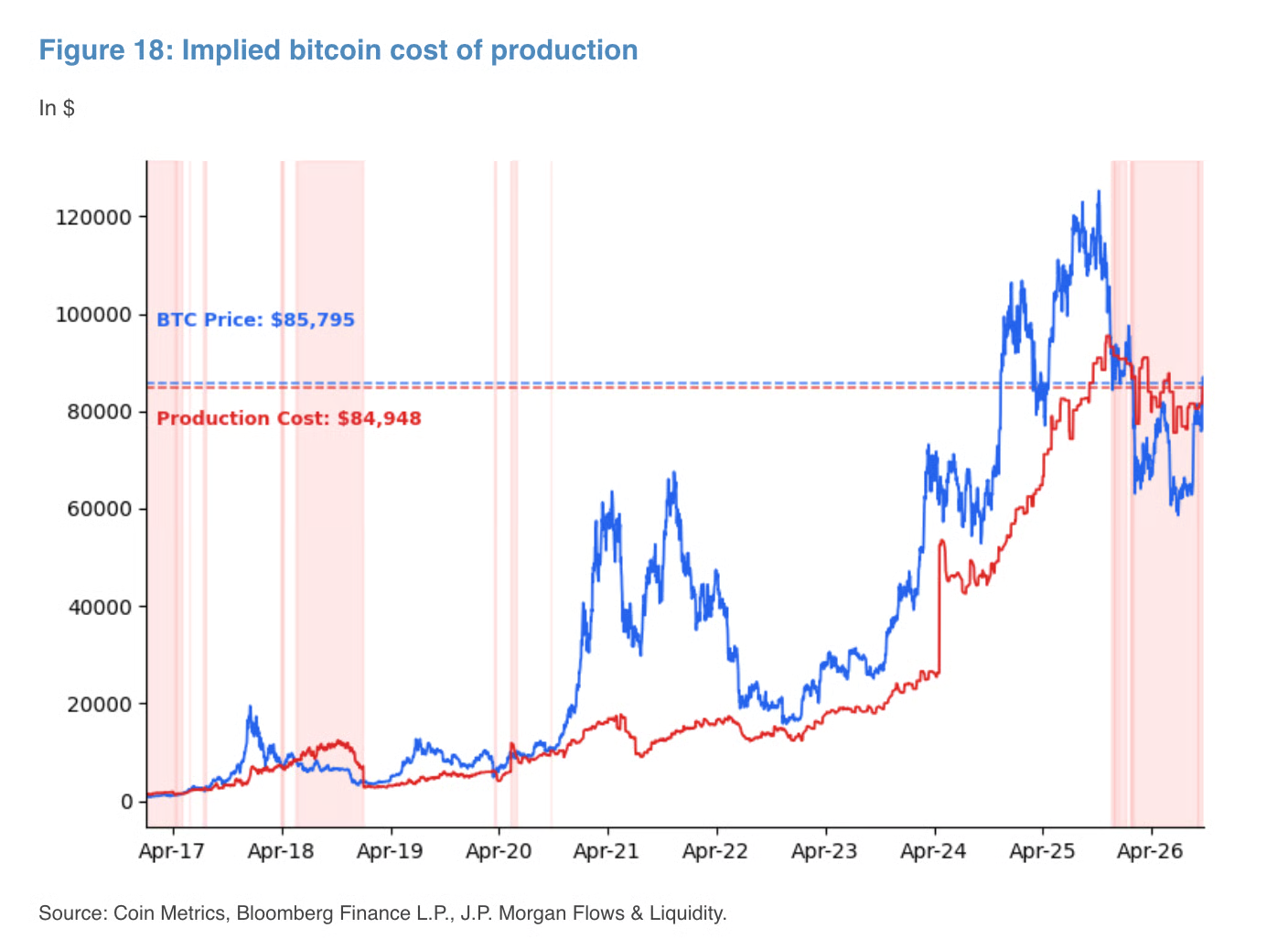
This is partly because some of the production cost is sunk. Mining operations have already paid for the hardware, leases, and fixed power contracts, so they can still keep mining without taking a loss on every coin. That can work for a while, at least until their mining rigs wear out, electricity contracts expire, or their portion of the sector’s billions in loans comes due. Others have been trying to pivot to becoming AI data centers in hopes of riding the next bubble — though recent events may have them questioning the strength of that lifeline.
I’ve been doing this long enough to remember the days when people advertised bitcoin as the thing you were supposed to buy to prepare for days like Friday. Countless times, bitcoiners insisted it was a hedge against the stock market, or “digital gold”. But when tech stocks plunged, bitcoin fell right alongside them — and unlike them, it hasn’t bounced back.
In regulators
After nominating chairs for the SEC and CFTC in 2025, Trump put forth no other nominees for the agencies’ commissions, which normally comprise five members with no more than three from any one political party. This has left the CFTC with Mike Selig, a Republican and Trump loyalist, as its sole commissioner — a state of affairs Trump has been only too happy to allow to continue. The SEC, similarly, has his Republican Chair Paul Atkins and only one other commissioner, Republican Mark Uyeda.
But now, Trump and his advisers seem to recognize that the odds of getting any of his often controversial and underqualifieda nominees confirmed are dwindling, and will only get worse after the new Congress is seated. They also likely understand that the new Congress will be less willing to continue to allow one or two commissioners to dictate an entire agency’s agenda and rulemaking. On November 12, Trump nominated one Republican and one Democrat to each agency: Republican Steven Levine and Democrat Kristin Johnson to the SEC, and Republican Nathan Anonick and Democrat Matthew Rowland to the CFTC. They’re fairly standard picks compared to some of Trump’s other nominees. Levine was counsel and then deputy chief of staff to Uyeda, and has served as general counsel for the White House Council of Economic Advisers.2 Johnson is a law professor at George Washington University and former CFTC commissioner.3 Anonick serves as counsel to the Senate Agriculture Committeeb and was a leading negotiator on the Clarity Act. Rowland is a career CFTC lawyer who also worked on the Clarity Act.4
Both nomination hearings were relatively uneventful, though Democrats were not shy in some of their criticisms. At the Senate Banking Committee’s hearing for nominees including those slated for the SEC, Senator Elizabeth Warren blasted the SEC for having “hobbled its enforcement division and ... dropped cases against the President’s billionaire buddies when they cheat American families”. She expressed concern that Levine would only worsen the issue, pointing to Trump’s 401(k) executive order from August 2025 [I90], which was issued while Levine was at the White House, and expressing skepticism that he would be anything other than “another puppet who will put Wall Street profits over protecting American investors”. But at the hearing, both SEC nominees expressed support for the agency remaining independent and active in enforcement.5 Johnson, the Democratic nominee, went slightly further in suggesting that the dramatic decline in SEC enforcement actions was “concerning”; Levine merely acknowledged the smaller number of actions. Johnson also offered some light pushback to the agency’s fast-tracking of crypto rulemaking, opining that the exemptive order allowing tokenized stock venues should undergo the formal rulemaking process with a public comment period [I110].
At the Senate Agriculture Committee’s hearing for the CFTC picks, the nominees said that regulations should be enforced regardless of company ties, including those to the president. Both fielded questions about prediction markets, over which the CFTC has, under Selig, claimed exclusive jurisdiction. Rowland, the Democratic nominee, stated he believed the agency needs to “think long and hard about balancing the public interest against the kind of economic usefulness of these contracts”. Asked by Senator Ben Ray Luján whether the CFTC, which has cut a quarter of its staff during Trump’s second term [I104], needs more people, Anonick replied that he believed the agency should be “appropriately resourced”. Luján fired back, “I understand that if you say too much, Trump will pull your nominations.”6
Tokenized stocks
The first tokenized stocks are beginning to trade after the SEC published its “innovation exception” in September [I110]. But they’re getting a chilly reception from the companies whose stocks are being tokenized. Of 62 companies whose stocks were proposed for tokenization on a joint venture between OKX and Intercontinental Exchange, 56 have filed objections preventing their shares from being tokenized, including Walmart, Costco, Nvidia, Microsoft, Tesla, JPMorgan Chase, and Wells Fargo. The remaining six are all firms in the crypto space: Coinbase, Robinhood, Circle, Microstrategy, Securitize, and BitGo.7
Perpetual futures
The CFTC is continuing its efforts to bring perpetual futures, or “perps” to American markets — a product that, until recently, Americans could only trade on offshore crypto exchanges. I wrote about them back in June [I106], shortly after the CFTC approved the first bitcoin-based perpetual futures contracts offered by Kalshi. On November 3, the CFTC approved perps on individual stocks, and Kalshi’s went live two days later — the same day as the worst tech stock sell-off since the beginning of the COVID-19 pandemic.8 “The CFTC is proving eager to push the envelope on its own legal interpretations, and frankly partner with its own regulated entities,” Healthy Markets Association president Tyler Gellasch told the New York Times.9
Retail traders were quick to pile in, particularly amid the controversy surrounding Jensen Huang’s exit and subsequent reinstatement as Nvidia’s CEO, which drew more than $100 million in perps volume in a single day. Kalshi was offering up to around 5× leverage, meaning any move in the stock price was magnified fivefold. A dip of less than 4% is enough for Kalshi to automatically close out a fully leveraged long position, and Nvidia fell 14% last Friday.
Both rounds of approvals quickly drew lawsuits, setting up a battle with some odd bedfellows on both sides: the regulators, prediction markets, and crypto firms on one, and Wall Street incumbents and investor advocates on the other. CME Group sued over the initial bitcoin perps approval in June, arguing that perps are really just swaps, and should be subject to stricter rules under Dodd–Frank [I106]. The new stock perps approval drew a same-day lawsuit from the Capital Markets Alliance Association, which argues that these new products are security-based swaps, and therefore belong under the jurisdiction of the SEC.
It doesn’t look good for the CFTC or the perps venues. The judge found that the plaintiff is likely to succeed on its claim that the CFTC lacks authority to allow these products because they are definitionally not the types of futures contracts over which the CFTC has jurisdiction. She added that “the CFTC’s actions seem to represent a major disruption to the equities market”, and found that the public interest favored preventing that, but stopped short of granting a temporary restraining order only because the plaintiff hadn’t shown it was likely to suffer irreparable harm without emergency relief.10
In Congress
Democrats preparing to take the majority are ramping up their oversight plans. Senator Elizabeth Warren, who is likely to chair the Senate Banking Committee, plans to prioritize investigations into the Trump family’s crypto ventures and prediction markets, according to her office. She spent the last two years laying the groundwork for those investigations with a raft of letters [Letters], but most were ignored — as minority members’ letters often are. As chair, she’ll have subpoena power. Trump family crypto businesses and others “should preserve their documents and prepare to answer tough questions,” a committee aide warned.11
Senator Richard Blumenthal, the incoming chair of the Senate’s Permanent Subcommittee on Investigations, has put “crypto corruption” high on his list of priorities. He re-sent a number of letters from earlier this year and last to recipients who had either not responded or responded inadequately.12 Among them are letters to Fight Fight Fight (one of the entities behind the $TRUMP memecoin) and World Liberty Financial about ethics violations and business dealings with foreign entities, some of which are under federal prosecution [I83]; a letter to Tether about illicit finance on its platform; and a letter to Binance — which cites my reporting — on the same subject [I101]. He also sent letters to all known donors to Trump’s ballroom project, citing pay-to-play concerns; recipients include Gemini’s Winklevoss twins, Paxos CEO Charles Cascarilla, Coinbase CEO Brian Armstrong, Kraken co-CEO Arjun Sethi, Ripple CEO Brad Garlinghouse, Tether CEO Paolo Ardoino, Intercontinental Exchange CEO Jeffrey Sprecher, and Cantor Fitzgerald’s Lutnick family.13
In the House, incoming Oversight Committee chair Robert Garcia has sent document preservation letters to a dozen people close to the president, including sons Donald Trump Jr. and Eric Trump, whom he described as “key player[s] in the Trump family’s pay-to-play schemes” through their roles at World Liberty Financial. “Lawyer up,” Garcia wrote on social media shortly after Democrats clinched the House majority.14
The administration and various Trump loyalists are already hard at work trying to spin these probes as illegal lawfare against innocent targets. White House Counsel William Scharf — or perhaps some asshole signing his name to stupid letters — warned Representative Garcia that his “abusive and capricious threats” could “cross the line into blatant criminality”.15 Similar threats came from, of all people, the US Attorney for the Southern District of Texas Aaron Reitz, who has no evident authority over a Massachusetts senator’s oversight work but who nevertheless seemed to delight in the social media spectacle of sending a letter to Elizabeth Warren full of racist stereotypes about tomahawks and “hunting for the scalps” of those who do business with Trump.16
In prediction markets
The blue wave also brought some sudden shifts to prediction markets, which have taken off since Trump retook office, in large part thanks to his CFTC chair who has shifted the agency’s role from regulator to booster.
Kalshi, which suddenly decided a week before Trump’s inauguration that Donald Trump Jr. had invaluable business wisdom to impart and added him as a strategic adviser, has announced that the two are parting ways. The company cited his venture firm 1789 Capital’s “significant investment in a competitor this past summer” — a reference to the $1 billion Polymarket funding round 1789 led in August. But 1789 has been invested in Polymarket since August 2025, when Trump Jr. also joined Polymarket’s advisory board.17 I’ve been pointing out ever since how bananas it is that he was simultaneously advising both [Death bets, I107, I110], but Kalshi would apparently like us to believe it only just noticed.
The timing is, of course, completely coincidental with Democrats’ pledges to investigate the businesses enriching the Trump family, including the prediction markets whose path Trump’s regulators have spent the last two years clearing. In a statement, Kalshi thanked Trump Jr. for “helping us market Kalshi to more customers”. That’s not much better than its co-CEOs could manage a year ago, when they apparently came to a CBS interview with exactly one answer prepared for why Trump Jr. was advising them:
Interviewer Jo Ling Kent: Why did you guys make Donald Trump Jr. a strategic advisor?
Kalshi co-CEO Tarek Mansour: We have a lot of advisors. And they span across the board, across different functions. But really, this is all about growing this industry, the prediction market industry, that a lot of people really believe in.
Kent: What kind of advice does he give you?
Mansour: So it really is, again, about growing prediction markets. He believes in prediction markets. We believe in prediction markets. A lot of people believe in prediction markets. And it’s really about go-to-market and expansion plans.
Kent: Does he come to meetings? How much do you pay him? What’s his role? I mean, this is the son of the president.
Mansour: We, again, I mean... we have a lot of advisors. And whether it’s our investors, whether it’s people that we really trust and respect...
Kent: Well, he’s not just any advisor. He has a direct line to the White House.
Mansour: We have a lot of advisors.
Court cases
Prediction markets are still grappling with significant legal challenges as more states sue the platforms and the CFTC and Justice Department fight to shield them. Things have really escalated in Utah, where Kalshi sued the state in February seeking a declaration preventing it from enforcing its gambling laws against the company and lost in August. Then the state sued Kalshi, the federal government sued the state, and the state filed felony criminal charges against Kalshi and its two co-CEOs.18 On November 23, Kalshi announced it would pause business in the state,19 citing its loss in its original lawsuit.20 Kalshi appears to have been waiting on a more favorable ruling in the CFTC’s case against the state, but on November 20, the judge — the same one who ruled against Kalshi in the first case — told the CFTC it had a “steep hill to climb” in arguing that Utah can’t apply its gambling laws to the platform.21 Kalshi paused operations the next business day.

Just weeks earlier, the CFTC had issued an interpretation directing exchanges not to shut down in specific states, with CFTC Chair Selig declaring that “geographic access restrictions are inconsistent with” federal law.22 This puts Kalshi in a difficult situation — though that was likely the point. The move looks designed to give prediction markets the argument that they cannot simultaneously comply with both federal and state law, and in turn bolster the CFTC’s preemption arguments. But courts have repeatedly rejected versions of that argument, including the Utah judge in Kalshi’s own lawsuit. Senator Adam Schiff (D-CA) responded to the CFTC’s interpretation by accusing the agency’s “rogue chairman” of “encouraging platforms to continue offering gambling products in contempt of these court orders”, calling it “the CFTC’s most egregious attempt yet to undermine state law, the Tribes, and now, the courts.”23
The federal government has thrown its weight behind Kalshi and the other prediction markets, and is now up to twelve lawsuits against states to defend what it maintains is its exclusive right to regulate the platforms — a right it appears to be seeking to establish primarily so that it can decline to use it. It hasn’t been going tremendously well lately. On November 20, a federal judge rejected the CFTC’s attempt to block a case in New York, finding the agency hadn’t shown it was likely to succeed on its claim that federal law preempts state gambling laws.24 She noted that three federal appeals courts have now ruled that states can regulate prediction markets, with a fourth ruling in the prediction markets’ favor — a split that almost guarantees the Supreme Court will eventually take up the issue.
Kalshi has generally been taking a bumptious approach to these lawsuits in public, seemingly emboldened by its allies in government. It called the Utah criminal charges “a crazy overreach”.18 In July, when New York sued the company, a spokesperson responded, “It’s sad to see this type of political theater from the leadership in our own state. States can’t just shut down a federally licensed exchange.” But in court, Kalshi’s tone is very different. In a letter urging New York Supreme Court Justice Melissa Crane to deny a temporary restraining order, Kalshi warned that such an order could “shut down operation of Kalshi’s federal derivatives exchange not only in the state but nationwide, as Kalshi is headquartered in New York”,25 and endorsed the CFTC’s opinion that a shutdown would pose an “existential threat” to the company.26 Apparently, Kalshi fears states can just shut down a federally licensed exchange.
On November 23, Justice Crane denied the temporary restraining order, and questioned why New York isn’t waiting for the Supreme Court to weigh in. “That ultimately will bind me,” she noted. She did, however, express concern over Kalshi’s policy of permitting anyone 18 or older to use the platform. (New York’s sports gambling laws require bettors to be 21 or older.) She asked the two sides to report back by November 30 on whether they could reach a compromise restricting younger users; a lawyer for Kalshi suggested the company might be willing to consider it, at least for some categories of bets.27
Amid all this, the CFTC has also been busy writing new rules for prediction markets, including one that would formally classify event contracts as swaps and distinguish them from casino-style bets, and another, now under White House review, that would define which contracts count as “gaming”.2829 A bipartisan group of attorneys general from 43 states and DC has formally objected to the first set of rules, saying the swaps proposal “rests on a legal fiction” and exceeds the CFTC’s statutory authority.30
The flurry of rulemaking reads to me as an attempt to get ahead of the Supreme Court, but an agency can’t simply rewrite the law it’s in charge of enforcing. The Court will decide for itself whether event contracts are swaps and whether federal law overrides state gambling laws; if the justices conclude that it doesn’t, no CFTC rule will change that.
DEATH BETS Act
On November 19, the Senate unanimously passed the DEATH BETS Act from Senators Adam Schiff (D-CA) and John Curtis (R-UT), which would bar CFTC-registered exchanges from listing contracts on terrorism, assassination, war, US military operations, or an individual’s death.31 Currently, the Commodity Exchange Act leaves it up to the CFTC whether to prohibit these kinds of contracts. In a press release, Senator Schiff wrote, “At a time when CFTC Chair Selig has indicated that he will rewrite the rules on prediction markets, the CFTC can no longer be granted this discretion.”32
Schiff’s press release added, “Lawmakers have previously raised the alarm to the CFTC on these ‘death contracts’ being offered on offshore exchanges, such as on whether or not Artemis II would explode, Maduro would be removed from power, or the Ukrainian town of Myrnohad [sic] would be captured by Russian forces.” The bill is a welcome step, but it’s not clear to me that the bill would actually prohibit all of the bets its own sponsors cited — not least because they were listed on offshore exchanges. The market on Maduro’s removal never mentioned war. An explosion of the manned Artemis II rocket is an event that would result in death, but the contract is written in such a way as to hinge on a rocket failure and may not fall under the bill’s definition of a contract that is “reasonably expected to resolve principally based on a death of an individual.” Nor would the bill likely touch markets like wildfire-related bets, or the contracts that cropped up amid rumors of Trump’s death last year which asked whether he’d be “out as president”. Both can resolve on plenty of outcomes that don’t involve death, but are still within the hazy category of contracts that could incentivize bettors to take dangerous or deadly action to win a payout.
In the courts
MEV bot case
A federal judge has acquitted the Peraire-Bueno brothers, who were indicted in May 2024 after exploiting Ethereum MEV bots — a type of software program that is itself controversial for profiting at the expense of traders by frontrunning them or otherwise causing their trades to be less profitable [I58, 95]. A jury deadlocked on the highly technical case in November 2025. Now, a judge has decided that the prosecutors did not adequately prove that the brothers had committed wire fraud or the related charges. This seems like something of a victory for the oft-used but rarely successful “code is law” argument. Some of the decision seemed to hinge on the idea that crypto is a total Wild West: “Ethereum is a ... trustless, highly adversarial environment with no terms of use,” wrote Judge Jessica Clarke. “Participants concoct different strategies—often using pre-programmed bots—to compete to obtain value, without the safeguards that exist in regulated markets.”33 This outcome is likely better than what the brothers expected, given their Google search history in the weeks following the theft for phrases like “how to wash crypto”, “top crypto lawyers”, and “prison or jail worse”.
Justin Sun v. World Liberty Financial
Justin Sun wants courts to sanction the Trump family’s World Liberty Financial and its lawyers for hiding its ties to the United Arab Emirates.34 Sun and World Liberty are locked in a contentious legal battle after Sun sued WLF for freezing WLFI tokens he purchased for tens of millions of dollars, and WLF sued Sun for defamation [I105]. World Liberty had initially attested that it was a citizen of Florida. However, after a judge determined that some of Sun’s claims against the company could continue rather than be forced into arbitration, World Liberty revised its disclosures to list almost two dozen entities with ownership stakes, some of which are in the UAE. The company is now using the non-US ownership to argue that a federal court can’t hear a dispute between foreign parties. Sun wrote on Twitter, “World Liberty was proudly American when it was selling tokens. It discovered its UAE roots only when it needed a way out of an American federal courtroom.”35
In their opposition to sanctions, World Liberty’s lawyers wrote, “World Liberty’s counsel was not aware when it filed the Initial Disclosure that World Liberty had any foreign citizenship.”36 That’s a remarkable claim, given that an Emirati royal’s roughly $500 million stake in the company was widely reported well before the erroneous disclosure filing, and that all they would have had to do is ask their client.
Custodia Bank
Custodia Bank’s six-year-long pursuit to secure a Federal Reserve master account is finally over, now that the Supreme Court has declined to hear its appeal [I54, 96, 102]. Custodia has maintained that, as a chartered depository institution, it is entitled to a master account rather than merely eligible for one. The Tenth Circuit issued a 2–1 opinion upholding the lower court’s decision against Custodia, adding that the company was “attempt[ing] to impair the Fed’s ability to safeguard our nation’s financial system”. It looks like that decision is now truly final.37
Most crypto firms have drifted away from seeking full master accounts, instead supporting a proposal to give crypto firms access to federal banking rails via “skinny” master accounts [I95] or limited-purpose master accounts like the one granted to Kraken in March 2026 [I102]. But Custodia has said these aren’t sufficient because they wouldn’t grant access to automated-clearing systems, and would limit the account balance and prevent them from earning interest on that balance.38
Trump business interests
Trump held his third memecoin dinner, following one in May 2025 [I85] and another in April 2026 [I105]. Like its predecessors, it did little to prop up the sinking price of the token, which has now fallen below $1. Billed on its website as an “evening of legends”, the event featured appearances from “the world’s power players” like... Floyd Mayweather, a boxer who hasn’t had a professional fight since 2017; Tristan Thompson, a former NBA player who’s been off the court for two seasons; “mentalist” Lior Suchard; and crypto booster Kevin O’Leary. As at previous dinners [Guests], most of the attendees were likely foreign nationals — barred from contributing to Trump’s campaign committees, but invited to enrich the president via events like this one.39
Just before the dinner, the New York Times reported that CFTC officials had opened a fraud investigation into the coin shortly after its 2025 launch, but quickly abandoned it, concluding that the agency would never approve the subpoenas the probe would require.40 According to the Times, it’s the only known federal investigation into Trump’s business interests during his second term. The agency still had four commissioners at the time, including two Democrats, but three were on their way out. The remaining commissioner, acting chair Republican Caroline Pham, had instructed the agency not to charge crypto firms with regulatory violations, pushed its enforcement division to drop crypto investigations, and intervened to clear the regulatory path for several crypto companies with ties to Trump and his family [I106]. Staff determined that an investigation into Trump wouldn’t get far. Pham left the agency after Trump’s pick was confirmed, joining the crypto company MoonPay — a frequent Trump business partner [I99].
The Web3 is Going Just Great recap
There were seventeen entries between October 15 and November 24. $3.526 billion was added to the grift counter.
- Fusionist exploited for $1.87 million [link]
- Cyber bridge exploited for almost $1 million [link]
- Chainflip loses $12 million to apparent key compromise [link]
- K3 Capital's yield-bearing sBOLD vault drained in flash loan attack [link]
- Lighter user(s) exploited for $15 million [link]
- Kava Lend exploited for $3.8 million [link]
- DataVault AI's stock crashes after it says it can't access its own bitcoin [link]
- Initia suffers second exploit less than a month after the last [link]
- Mercado Bitcoin halts withdrawals after $40 million hack [link]
- French bank Crédit Mutuel Arkéa hit in $133M crypto theft [link]
- Polymarket users' funds stolen, again [link]
- North Korea hacks Binance for around $6.3 billion, some frozen [link]
- Initia suffers $2.7 million loss after unauthorized mint exploit [link]
- CoinDCX admits $16 million theft after claiming it was a "false alarm" [link]
- Keystone to destroy 18,835 hardware wallets after website breach [link]
- Cysic bridge exploited [link]
- AI-focused Qubic blockchain halts after weak wallet seeds enable $1.4 million in thefts [link]
In the news
Scam investigator Coffeezilla used my map of the Trump family’s crypto grifts for his most recent investigation, this time scrutinizing Trump’s corruption and self-enrichment in office. I’m also interviewed in the video. It’s impossible to cover the truly enormous web of corruption in less than an hour, but Coffeezilla made a fantastic dent in it.
I went on Adam Becker’s Dreaming Against the Machine podcast, participated in a post-election panel with Brian Merchant for his Blood in the Machine podcast, and numerous publications cited me or my work pertaining to the midterm elections.
That’s all for now, folks. Until next time,
– Molly White
Have information? Send tips (no PR) to molly0xfff.07 on Signal or molly@mollywhite.net (PGP).
I have disclosures for my work.
Footnotes
Need I mention Fox News host-turned-Defense secretary Pete Hegseth, anti-vaxxer-turned-Health secretary Robert F. Kennedy Jr., home construction heir-turned-FHFA director Bill Pulte (who briefly moonlighted as acting Intelligence director)... ↩
The Senate Agriculture Committee oversees the CFTC, and it’s fairly common for CFTC Commissioners to be pulled from Senate Agriculture staff. ↩
References
Donald Trump’s speech at Bitcoin 2024. ↩
“White House eyes ex-SEC official for Peirce’s seat”, Politico. ↩
“Trump nominees to lead SEC pledge independence on Capitol Hill”, Reuters. ↩
“White House sends crypto-relevant picks to fill SEC and CFTC seats”, The Block. ↩
Senate Banking Committee Nomination Hearing, November 19, 2026. ↩
Senate Agriculture Committee Nomination Hearing, November 17, 2026. ↩
“OKXICE to debut tokenized stock trading with Strategy, Coinbase, Circle this month”, CoinDesk. ↩
“Trading on US Stock Perpetuals Contracts Is Approved by CFTC”, Bloomberg. ↩
“Kalshi Lets You Bet on Stocks. Exchanges Are Livid.”, The New York Times. ↩
Order filed November 3, 2026. Document #11 in Capital Markets Alliance Association v. CFTC. ↩
“Wall St executives should prepare for oversight under Senator Elizabeth Warren, aide says”, Reuters. ↩
“Blumenthal Sends Warning to Targets of Investigations into Crypto Corruption, Immigration Abuses, Big Tech & More”, Richard Blumenthal. ↩
Letter by Senator Richard Blumenthal to known Trump ballroom donors, November 5, 2026. ↩
“Incoming Oversight Chairman Robert Garcia Launches Document Preservation Letters on Trump Family Corruption, Corporate Corruption, DHS Misconduct, and Epstein Cover-Up”, Robert Garcia. ↩
“Read the letter the White House's top lawyer sent Rep. Garcia over threats to investigate Trump”, PBS. ↩
“Kalshi says it ended Donald Trump Jr's advisory contract over Polymarket conflict”, Reuters. ↩
“‘This is a crazy overreach’: Kalshi responds after Utah files criminal charges against company for promoting gambling, unlawful activity”, ABC4. ↩
“Kalshi blocks Utah users from its markets after court ruling”, Fox 13. ↩
Memorandum decision and order filed on August 4, 2026. Document #65 in KalshiEx LLC v. Cox. ↩
“Federal judge to decide the fate of Utah's Kalshi crackdown”, Fox 13. ↩
“CFTC Issues Impartial Access Requirements Interpretation”, CFTC. ↩
“US judge rejects CFTC emergency bid to block New York from policing Kalshi”, Reuters. ↩
Letter to Justice Crane filed November 19, 2026. Document #75 in People ex rel. James v. KalshiEX LLC. ↩
Order directing Kalshi to continue exercising DCM functions, CFTC, August 11, 2026. ↩
“Kalshi Notches Win As Judge Denies New York a Temporary Restraining Order”, Front Office Sports. ↩
“CFTC Draws the Line Between Prediction Markets and Gambling in New Rules”, Decrypt. ↩
“Prediction Market Rule From CFTC Under White House Review”, Bloomberg. ↩
“Attorney General Brown Co-Leads Bipartisan Coalition Urging CFTC to Keep State-Regulated Gambling Separate from Derivatives Products”, Attorney General of Maryland. ↩
S.4035 - DEATH BETS Act, Congress.gov. ↩
“ICYMI: Senate Unanimously Passes Sens. Schiff, Curtis’ Legislation to Explicitly Ban Death and War Prediction Contracts”, Adam Schiff. ↩
Opinion and order filed November 16, 2026. Document #294 in US v. Peraire-Bueno. ↩
Plaintiffs’ notice of motion and motion for sanctions filed on November 2, 2026. Document #70 in Sun v. World Liberty Financial. ↩
Defendant World Liberty Financial LLC’s opposition to plaintiffs’ motion for sanctions filed on November 16, 2026. Document #74 in Sun v. World Liberty Financial. ↩
“Supreme Court rejects Custodia Bank's bid for Fed master account”, The Block. ↩
“Supreme Court Rejects Crypto Bank Custodia's Bid for Fed Payment Access”, Bloomberg. ↩
“Guess Who’s Coming To Dinner?”, Public Citizen. ↩
“Watchdog Officials Considered Investigating Trump’s Memecoin, Then Punted”, The New York Times. ↩
Read more
How crypto and AI lost the midterms, and why they say they didn’t
Crypto and AI super PACs went undefeated in races they were always going to win. In competitive ones, most of their money backed losers.
Crypto and AI’s $250 million election goes sideways
The industries’ biggest bets lost almost across the board.
A crypto and AI money guide to election night
Where crypto and AI super PACs are spending, what their ads won’t talk about, and which races could embarrass them.

It’s always North Korea
Answering your questions about who was behind the Binance hack, how they launder the money, and where it goes